


Lukashenko Got A Sunstroke In The Pripyat Floodplain
11- 16.08.2026, 11:30
- 4,186
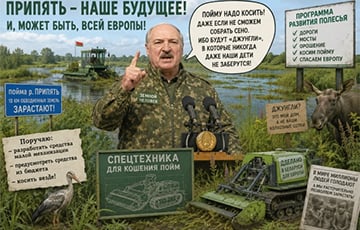
The dictator rushed to mow down the bushes and reeds in order to “save Europe.”
Just yesterday, the floodplain of the Pripyat River had been forgotten. But at the “Call of Polesie” festival on August 15, 2026, Alexander Lukashenko had an epiphany as an “earthly man” and saw in the floodplain—that it is Europe’s reserve fund in case of a climate apocalypse.
“As a man of the earth, I understand perfectly well that this floodplain is our future—and not just for Belarusians, but perhaps for all of Europe. The climate is becoming increasingly dry and hot, and we have such a treasure,” Lukashenko declared.
Residents of Polesye, who until now had regarded the Pripyat floodplain as a river, swamps, meadows, and a complex natural system, have been urged to think on a grander scale: it turns out to be “the future of all of Europe.” True, the “future” has already become overgrown, so now orders have been given to mow it immediately.
Europe can rest easy—they’re already looking for a mower
Lukashenko was outraged by the overgrowth of wild vegetation on the flooded lands. According to him, we’re talking about nearly 10 kilometers of such areas. He called leaving them in their current state “unacceptable waste,” reminding everyone that millions of people around the world are starving.
From this, a down-to-earth conclusion was drawn:
“We need to mow the floodplains. Even if we can’t harvest hay. Because otherwise, there will be a ‘jungle’ that not even our children will ever be able to enter.”
In short, the main threat to Europe’s future has been identified: bushes and reeds! As early as August 14, 2026, during a trip to the Zhitkovichi District, Lukashenko had already demanded that river floodplains be mowed “everywhere,” stating that Belarus was losing a huge amount of land.
At that time, a technical snag became apparent: ordinary powerful tractors are about as well-suited for marshy areas as a combine harvester is for harvesting cranberries. Therefore, a directive was issued to develop specialized small-scale equipment.
Now they want to allocate funds for its development as part of the Polesye development program. In other words, the process is gradually taking on the familiar contours of government planning: first, a strategic problem is identified; then, a directive is issued; and finally, new equipment, funding, and a program are needed. All that’s left is to wait for the interagency commission tasked with saving Europe from the reeds.
A floodplain is not an overgrown collective farm plot
The Pripyat floodplain is indeed of immense value. But this value isn’t limited to how many hectares can be mowed or how many bales of hay can be harvested. The Belarusian part of Polesie includes some of Europe’s largest natural floodplain and wetland complexes.
In 2023, a comprehensive management plan for the Pripyat River basin was approved. Such areas play a vital role in regulating the water regime, preserving biodiversity, and ensuring the resilience of ecosystems to climate change.
The “Middle Pripyat” Nature Reserve is one of the largest specially protected natural areas in Belarus and part of a unique floodplain system. Geographic Reference Materials
At the same time, haymaking in the floodplain itself does not necessarily harm nature. In certain areas, controlled mowing and grazing, on the contrary, help preserve open meadows and bird habitats.
The question, therefore, is not a simplistic choice between “mow or don’t mow.” The question is: what exactly should be mowed, where, when, how, and for what purpose?
Because there is a significant difference between scientifically sound management of floodplain meadows and the principle that “if it’s overgrown, it needs to be mowed.”
Why all of a sudden such concern?
If we set aside talk about the future of Europe, the reason seems far more prosaic. The authorities want to make more active use of floodplain lands for farming, obtain additional fodder, and prevent the areas from becoming overgrown. This required machinery capable of operating where a regular tractor would get stuck.
The mention of Europe may not be just a figure of speech. It is now extremely important for Minsk to restore at least some of its relations with the EU: without concessions from Europe, the pressure of sanctions remains painful, and Belarus has been trying for several years now to test the waters for a new round of negotiations with the West.
Therefore, Lukashenko’s remark that the Pripyat Swamp is “the future of all of Europe” can be viewed as yet another signal: Belarus wants to show that Europe still needs it—now not only for transit, potash, or its geography, but also for its water, wetlands, and climate resources.
There is no evidence that this was a premeditated diplomatic message. But transforming cheap floodplain hay into “the future of Europe” in a single day seems too dramatic to completely ignore the political subtext.
The logic is the same as always: first, convince your neighbor that you have something important for their future, and then talk about cooperation, sanctions, and the price of mutual concessions. This time, Pripyat unexpectedly emerged as a diplomatic asset.
Anton Mironovich “Belarusians and the Market”

Bank's name: Bank Millennium S.A.
Address: ul. Stanislawa Zaryna, 2A, 02-593, Warszawa
IBAN: PL97116022020000000216711123
SWIFT: BIGBPLPW
Name of the account holder: Fundacja “KARTA ‘97”
Purpose/title of payment: Donation for statuary aims
You can contact us by the e-mail charter97@gmail.com