
"Crimea Is Dragging Russia Down"
1- 16.08.2026, 17:08
- 2,186
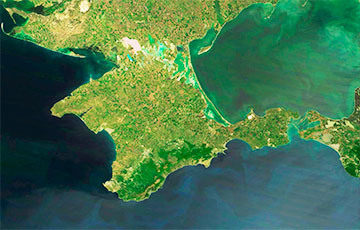
Residents began to leave the occupied peninsula.
A member of the Mejlis of the Crimean Tatar People and head of the Crimean Tatar Resource Center , Eskender Bariev , appeared on Radio NV spoke about the systematic attacks on Crimea, the energy and fuel crisis on the peninsula, and the problems this is causing.
— Explosions rocked Sevastopol and the Bakhchysarai district. They could be heard across virtually the entire territory of Crimea. Tell us about the Ukrainian strikes.
— Overall, I want to say this: over the past few months, explosions have been occurring in virtually every region of Crimea, and people are hearing drones flying overhead. That’s why Crimean residents are already saying that the situation is very tense and that the war against Ukraine is being felt very strongly there as well.
Explosions are occurring in various regions. I’d like to remind you: when we talk about Sevastopol—there are military units, a thermal power plant, and logistics centers there. There are also air defense systems.
It is no coincidence that the attacks are taking place precisely in these regions—to disrupt or halt their logistics, as well as the supply of the Russian Federation’s armed forces and their attacks on Ukraine. That is why such explosions in Crimea are occurring systematically.
— What do these strikes indicate, and what is their nature? As for how frequent and systematic they are—you’ve already answered that: right now they are very frequent, very systematic, and local residents are increasingly feeling firsthand that the war has come to Crimea as well.
— Speaking of the Saki District, the Novofedorivka airfield is a military airfield. Their aircraft appear there periodically. It is very important to destroy radar systems, since it is precisely through them that they are trying to control the skies over Crimea. To make the attacks more precise and effective, these systems must be destroyed, which is why the Ukrainian Defense Forces are doing just that. They are specifically targeting strategic and military facilities.
As for northern Crimea, the occupiers are primarily trying to shoot down UAVs there; as a result, debris is falling in various locations, including civilian facilities. These are the actions of the Russian occupiers and the Russian Federation’s armed forces, as well as their consequences.
Therefore, when we talk about the population of northern Crimea, people are already beginning to consider leaving; there is already a trend of people moving from northern Crimea to central Crimea—to be with relatives—or leaving the peninsula entirely. We have information confirming this. This is due both to the constant, systematic attacks and the lack of water and electricity, as well as to the likelihood of mobilization beginning after the September 2026 elections.
Although dozens of cases of summonses being issued have already been recorded. We’re not just talking about an offer to sign a contract, but specifically about mobilization summonses—the preconditions for these processes already exist. And this is happening against the backdrop of attacks. On the one hand, people are beginning to adapt, but on the other, they feel danger and fear, regardless of whether Crimean residents hold pro-Russian or pro-Ukrainian views.
But when we speak about our Ukrainian citizens, they hear and see that Ukraine continues to fight for Crimea.
And returning to the strikes: in Sevastopol itself, there is the Belbek airfield. To reduce the number of attacks from Crimea on Ukrainian territory, it is necessary to destroy military facilities such as Novofedorivka, the airfield in Gvardeyskoye, the airfield they built in Dzhankoy, and facilities in Sevastopol. This is necessary to minimize ballistic missile attacks directed at Ukraine.
— A severe fuel crisis has arisen in Crimea due to Ukrainian strikes on the peninsula’s transportation and oil infrastructure. Is it still ongoing? Please explain the current situation with gasoline at gas stations and what the fuel prices are.
— They are doing everything they can to ensure Crimea has as much fuel and gasoline as possible. After all, there’s a systemic problem here with electricity and water supply. I’ve already mentioned northern Crimea; I’d like to add that in southern Crimea as well—in Sudak, the Yalta region, Alushta, and some other areas—there are power outages lasting for weeks, sometimes as long as four days at a time.
Although there are now reports that gasoline is available again. It is available in limited quantities, and in some cities the price has even dropped to 100 rubles per liter. On average, however, gasoline currently costs—if you can buy it—about 270–299 rubles per liter.
As long as [Russian dictator Vladimir] Putin remains in power, Crimea is a sacred place for him and a matter of political image, just like the Kerch Bridge. They will try to do everything they can to subsidize the price of gasoline. No matter what it costs them—they’ll try to get gasoline to Crimea and mitigate the current situation. No matter how difficult it may be for them, they are trying to do so.
But we see that, despite all this, holding on to Crimea also has a very strong impact on the Russian Federation’s overall economy. The only question is how long they will be able to hold on to it.
As for Crimea’s economy, we now see that the supply of real estate there exceeds demand, whereas previously the situation was the opposite. Small and medium-sized businesses in Crimea are beginning to close. Although vacationers are coming, there are very few of them, and this is taking a toll on Crimea’s economy, as well as on small and medium-sized businesses.
As for northern Crimea, it’s all about agriculture. Here, Crimea is becoming an increasingly heavy burden on Russia. This is thanks to the systematic efforts of the Ukrainian Armed Forces. It is very important to us that Crimea—like a stone, not a medal—pulls Russia itself deeper and deeper into the abyss, and that this contributes to Ukraine’s victory.
— And one more thing about electricity. We remember the massive energy crisis in Crimea; tell us, are emergency power outages still happening? How is this happening?
— The most difficult situation is in northern Crimea, in the northeastern and northwestern regions.
As for the central region—primarily major cities such as Simferopol and Sevastopol—the power is cut off for several hours there, but they’re still trying to maintain the power supply. Why are they trying to bring in gasoline? To find any way to keep things running using generators.
But, as I’ve already said, even on the southern coast of Crimea, the power is out not just for a few hours, but for several days. They’re trying to reallocate resources and are developing programs under which they can pay 15,000 rubles if the power is out for more than 48 hours. But then they turn the power back on briefly—and refuse to pay people compensation.
However, this has a serious impact on the economy, especially when it comes to farms and poultry farms operating in northern Crimea. Large-scale systemic problems arise related to the supply of water and electricity. According to available information, farmers are forced to slaughter livestock and poultry just to sell something and generate at least some revenue. They are unable to harvest their crops in northern Crimea.
All of this is having an overall impact on the situation. However, it cannot be said that there is no food there—there is, but this is beginning to affect prices as well. And if this situation persists, it will worsen with each passing day. After all, perishable goods need to be stored somewhere using generators, and the high cost of gasoline is also affecting businesses.
As a result, many businesses are beginning to close. This is a trend that is rapidly gaining momentum. Consequently, it will also affect the overall situation.

Bank's name: Bank Millennium S.A.
Address: ul. Stanislawa Zaryna, 2A, 02-593, Warszawa
IBAN: PL97116022020000000216711123
SWIFT: BIGBPLPW
Name of the account holder: Fundacja “KARTA ‘97”
Purpose/title of payment: Donation for statuary aims
You can contact us by the e-mail charter97@gmail.com