
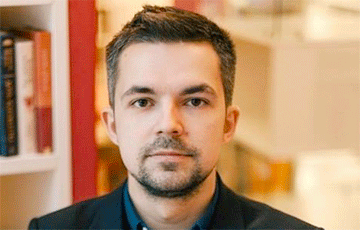
Writer Sasha Filipenka: The Protest Has Transformed, We Are at a Good Pace
2- 10.08.2021, 12:29
- 11,954
The second stage has begun.
A year ago, on the night of August 9-10, protests began in Belarus in connection with the announcement of the results of the presidential elections and the official announcement of the victory of Aliaksandr Lukashenka. Most of all, people were outraged by the declared 80 percent of the votes allegedly given for the re-election of the president, who was then in power for almost 30 years.
From that day on, the protest became nationwide. How is the Belarusian revolution seen now, a year later, and how has it changed civil society?
The correspondent of Radio Liberty in Minsk asked the Belarusian writer Sasha Filipenka about this.
Sasha Filipenka is known both in Belarus and in Russia. His most famous novels are "The Former Son," "The Red Cross," "Bullying," "Return to Ostrog." The writer's novels have been translated into many European languages.
Three editions of his books (French translation of "Bullying," a German and a Japanese edition of "The Former Son"), exhibited by the writer, were sold at a charity auction to help repressed figures of Belarusian culture.
Now Filipenka lives in Geneva, and, during his student years, he moved from Minsk to St. Petersburg, where he graduated with a master's degree from the Faculty of Liberal Arts of St. Petersburg State University.
Recently, he wrote a text for the video "The Day of the Big Traffic Jam," which features Belarusians' expectation of victory over authoritarianism and hope for the return to the country of those who were forced to leave it.
- What has this year since the protests began in Belarus been like for you?
- The year was very different. There was happiness, inspiration, delusion. I myself had a delusion. I thought that was it, we won, victory is very close, everything is about to change. Then there was a backlash, repression began.
On the one hand, I imagined that the government would act in this way, on the other hand, it seemed to me that it would not come to that. The police and the army must be with the people. I thought that they would go over to the side of the people in September.
We saw two different groups of Belarusians. One is a wonderful, beautiful, solidary group, and the second is an endangered species of dinosaurs who are fighting for their existence by any means because they understand that they have no place in the future.
These are security officials, propagandists, and officials who curry favor, realizing that for this they need to constantly move into the past.
Every day this year he gave us something. We watched how different groups of the Belarusian society woke up. We saw pensioners, doctors, students, workers.
Solidarity, awakening. In 2010, I realized that there were much fewer people around me who were ready to change something. We went out then, it seems to me, so as not to go crazy, to find people's faces, so as not to believe in all the absurdity that was happening in Belarus.
At Ploshcha in 2010, there were 50 thousand. Then it seemed that this is a lot. And here, the whole country came out. I no longer felt like I was in opposition but just a part of civil society.
- Now, after a year, is this split felt just as acutely? Is there a need to glue this society together?
- It is impossible to glue it together now when there are repressions, so many political prisoners, and constant trials. It will be necessary to glue it after the victory and change, in any case, we will have to do it because the people who worked for Akrestsina Street will continue to live with us in the neighboring houses.
I do not think that all of them will fall under lustration, they are unlikely to be found. We will have a post-traumatic society like in Germany. We will have to talk to those who destroyed us. And the propagandist assholes will walk along the same streets with us. This will be the next step.
But first, we need by any means to free the guys who are in prisons and hold new elections. I can't imagine how now you can close your eyes, pretend that nothing happened, and get on with the straw hats and tractors all over again.
This is impossible. Maybe I'm wrong again. For some reason, it seems to me that the people who stayed in the country know better. We're talking about a humanitarian disaster. We recently wondered how to calculate how many people left Belarus. This is impossible.
Hundreds of thousands have left. Youth, doctors, athletes, politicians. The longer the conflict continues, the more likely these people will never return.
After all, they will acquire new connections, friends, work, living in a new country. Children will start going to school. How to fix it? For example, now I cannot be in Minsk. Out of my seven close friends, there is only one left in Minsk.
- At what point of protest are we? I can hear it, it's scattered in the air, like a fog, so it's quite difficult to determine the point.
- The protest has not gone anywhere, it has transformed. We are at a good pace. The confrontation continues. The break is over. The second stage has begun. Everything is very clear. One side has a weapon, and the other side has no weapon and has no desire to take it in hand.
But I have no experience of overthrowing power and fighting armed thugs. Like most Belarusians. Everyone acts as best they can. We must all come up with some new ways to combat this regime.
In any case, society is smarter than those old men who remained in power, using old and understandable methods of violence. There are no talented people on their side - no talented journalists, no politicians, no one talented at all.
They are just cornered and fire back. Sooner or later, the protests will start again. It's just difficult to live in a country from which doctors leave, for example.
Who will heal people? You will take your child to a specialist that you don't know about - does he hold his position because he's really a doctor or is he the only one left?