
Tokayev Declares Kazakhstan The Heir To The Golden Horde
9- 8.10.2026, 11:31
- 2,030
The country is "rebranding" its history.
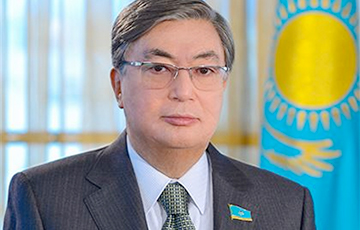
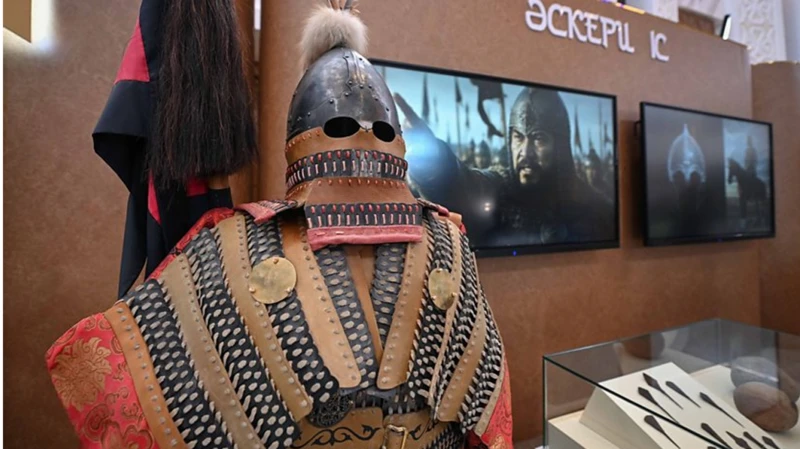
Under President Kassym-Jomart Tokayev, Kazakhstan has launched a campaign to independently reinterpret and “rebrand” its history. The Kazakh state is now presented, both domestically and on the international stage, as the heir to the Golden Horde, according to the BBC.
Kazakh authorities say that the country, which gained independence from Russia back in 1991, has now finally exercised its right to interpret its own history independently.
The new historical policy is clearly directed against the version of Kazakh history popular in Russia, according to which the Kazakhs had no statehood and were wild nomads before joining the Russian Empire and later the Soviet Union.
At the same time, this new perspective on history can also be viewed as an integral part of Tokayev’s foreign policy, as he promotes the image of Kazakhstan as a “middle power”—one of the influential medium-sized states on the world stage.
Direct Heir to the Horde
After Tokayev became president in 2019, Astana began actively supporting research into the history of the Golden Horde—more specifically, the Ulus of Jochi, the eastern part of Genghis Khan’s vast empire and later one of its successor states.
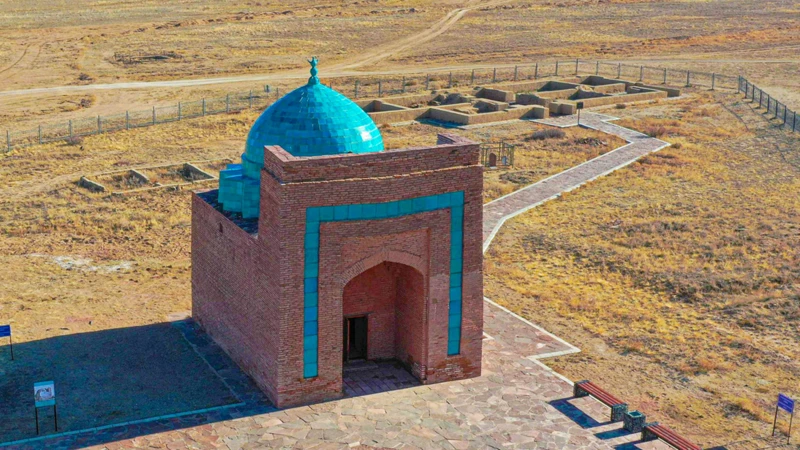
In 2021, Tokayev initiated the creation of the Institute for the Study of the Ulus of Jochi and ordered the restoration of the mausoleum of Jochi Khan, son of Genghis Khan, in the Ulytau Region in central Kazakhstan.
A recently published seven-volume history of Kazakhstan details the history of the Golden Horde as the predecessor to the Kazakh Khanate, which was established in 1465.
In May of this year, an international symposium on the history of the Golden Horde was held in Astana. President Tokayev personally opened the event.
In his opening remarks, Tokayev called the era of the Golden Horde the most important part of the “period of civilizational evolution” and stated that, according to Kazakhstan’s new Constitution—adopted just this past March—preserving continuity with the Great Steppe and its millennia-long history is a sacred duty of the Kazakh people.
“Our country is the direct heir to the Golden Horde,” the president declared.
Tokayev described the Ulus of Jochi as “an empire that united the West and the East, had a significant influence on the emergence and development of various civilizations and states, and was undoubtedly a major political system.”
The president noted that Kazakhstan is currently “actively reevaluating outdated dogmas and stereotypes that reduce the once-powerful steppe empires to so-called ‘semi-states’ and even portray nomadic peoples as a savage, barbaric force that existed entirely outside the global historical context.”
According to Tokayev, in reality, the intellectual evolution of Central Asia was based, among other things, on “the energy of the nomadic world and the Turkic-Mongol heritage,” and the economy of the Golden Horde combined a nomadic way of life, urban craft traditions, and control over the northern section of the Great Silk Road.
As interpreted by Tokayev, the Golden Horde united different cultures into “a unified system of humanitarian and political partnership,” and now, in his view, Eurasia must live up to its historical mission and be “an important civilizational and geopolitical pole of the world.”
The Annexation of Crimea as a Turning Point
As explained in July in an interview with “Azattyk Asia,” a division of “Radio Free Europe/Radio Liberty,” the head of the Institute for the Study of the Ulus of Jochi Zhaksylyk Sabitov, in the 1990s the situation in Kazakhstan was complex and “any attempts to foster a growth in national consciousness could have even led to civil war.”
Therefore, according to him, the Kazakhstani authorities refrained from emphasizing themes of historical and national identity among Kazakhs. Under Nursultan Nazarbayev, the authorities focused more on the idea of a modern, independent Kazakhstan as a state established in the very recent past.
The turning point, according to Sabitov, was Russia’s annexation of Crimea in 2014.
“The political elite came to realize that believing Nursultan Abishevich was the founder [of the state] was a very bad narrative. Therefore, interest in the history preceding Nazarbayev grew significantly after Crimea. In 2019, historical justice was restored. People began to pay attention to the Golden Horde. Because it preceded the Kazakh Khanate, and without it, it is impossible to understand the history of the Kazakh Khanate,” continues Zhaksylyk Sabitov.
Zhomart Zhenis, deputy head of Kazakhstan’s Institute of History and Ethnology, wrote in an article on the website of the newspaper “Vechernyaya Astana” that a Eurocentric paradigm had dominated Kazakhstan for many years, but now the country is capable of independently defining its own “true ideological direction.”
This direction, according to Zhenis, “is based on historical facts and national values, reflects the country’s status as a regional power, and can unite the people and the government and raise national morale.”
“Nothing to Be Proud Of”
At the same time, Astana clearly understood that its desire to position Kazakhstan as a state with roots stretching back to the times of the Golden Horde could not help but provoke an irritated reaction in Russia, where historians generally view the Horde through the lens of the suffering caused by the “Tatar-Mongol yoke.”
In his May speech, Kassym-Jomart Tokayev called for an objective and politically neutral study of history and urged people to avoid “a linear view of the complex, multi-layered history of the Golden Horde” so as not to spoil good relations between peoples and countries.
But many in Russia are not convinced by such appeals. For example, the author of the online journal “Military-Political Analytics” Nikita Mendkovich wrote in a June article following the May symposium in Astana that the Kazakhs have no reason to be proud of the legacy of the Golden Horde, because during the period of conquest it inflicted genocide on the ancestors of modern Kazakhs, and then, according to Mendkovich’s interpretation, “they were among the many tributaries of the Golden Horde, forming part of […] the lower social strata in the territories under its control.”
“The cultural revival of the Kazakhs,” as Mendkovich argues, began only in the 19th century, after their incorporation into the Russian Empire.
Some Russian commentators interpret Kazakhstan’s desire to emphasize its historical connection to the Golden Horde as a veiled attempt to lay claim to large swaths of present-day Russian territory, which were also part of the Jochi Ulus and whose indigenous populations are ethnically close to the Turkic peoples.
“The Most Significant Event in the History of Kazakhstan”
This departure by Kazakhstan from the Russian-Soviet version of history is welcomed, in particular, by the founder of the analytical center “Ukrainian Institute of the Future,” Anatoly Amelin. In May, he wrote that this “reformatting of the historical narrative” is of strategic importance.
According to Amelin, Kazakhstan is thus “distancing itself from the Soviet and ‘Russkiy Mir’ civilizational sphere.” Furthermore, according to the Ukrainian analyst, the search for roots in the history of the Horde and the Ulus of Jochi will also contribute to internal national consolidation.
“The legacy of the Golden Horde unites all Kazakh zhuz and clans under a common institutional umbrella that existed before the division into Kazakhs, Nogais, Tatars, and Uzbeks, which helps overcome tribalism,” — Amelin believes.
Historian Marat Gatin from Tatarstan, Russia, also welcomes Kazakhstan’s new approach to its history.
“This is a perfectly normal phenomenon. In Kazakhstan, people are interested in their own national history, which they associate with the legacy of the Golden Horde. This is directly linked to the strengthening of identity. After all, the era of the Jochi Ulus is perhaps the most significant period in the history of Kazakhstan,” Gatin said in an interview this past July.
But Uzbek anthropologist and political philosopher Bakhtiyor Alimjanov fears that Kazakhstan’s claims to continuity with the empire of the conquerors could create tension in Central Asia.
In a conversation with “Azattyk Asia,” Alimdzhanov recalled that since the early 1990s, Uzbekistan “began promoting the ideology of Timur” and asserting that Uzbeks are the heirs of Tamerlane—that is, the leaders of Central Asia.
“It was precisely the rehabilitation of this imperial legacy that hindered Central Asian integration. At that time, none of its neighbors had such ambitions. Only Uzbekistan did. And now Kazakhstan is also ‘caught up’ in it.” The fact that Kazakhstan is the heir and successor to the Golden Horde certainly creates tension in the region. Because now there are two similar imperial mindsets. And now they will compete with each other,” Alimjanov believes.
“The Process Cannot Be Reversed”
In Kazakhstan itself, many historians and political commentators enthusiastically support Tokayev’s historical policy.
“Denying the Kazakhs’ connection to the Golden Horde is like denying modern Europeans’ connection to the ancient world,” wrote Marlen Zimanov, a columnist for the independent publication Exclusive.kz, in June.
“The Kazakh Khanate did not arise out of thin air. It was a direct continuation of the Jochi statehood following the collapse of the Ulus of Jochi. The Kazakh khans descended from the same Chingizid dynasty that ruled the Golden Horde. Political institutions, norms of authority, military organization, and concepts of statehood were formed within the Horde world,” explains Zimanov.
Kazakh political scientist Askat Dukenbaev, in an article on the same Exclusive website debating Nikita Mendkovich and other opponents, explains that Kazakh historians are striving to overcome the legacy of the Russian and Soviet periods, which led to the dominance in Central Asia of the Russian popular version of the history of the Ulus of Jochi.
“Interpretations originating from the Turkic and Mongolian peoples of post-Soviet Eurasia—the Kazakhs, Tatars, Bashkirs, Uzbeks, Karakalpaks, Turkmens, Azerbaijanis, Kalmyks, Buryat-Mongols, and other peoples whose historical and historiographical traditions are linked to the legacy of Genghis Khan and the Chingizid ruling dynasties, — have often been perceived (and in many ways continue to be perceived) as secondary, peripheral, or politically motivated, rather than as equal versions of a shared past,” explains Dukenbaev.
“Nevertheless, despite this persistent asymmetry—which is being increasingly and consistently challenged by the evolving historiography of Kazakhstan and other post-imperial societies in the region— — the Kazakhstani political scientist continues — “the peoples of Northern and Central Eurasia are gradually rethinking the Horde’s legacy and integrating it into their own historical narratives.”
“The process of understanding and reinterpreting the Mongol legacy has already become part of the region’s historical reality and cannot be reversed or ‘blocked’ by external interpretive frameworks,” concluded political scientist Askat Dukenbaev.

Bank's name: Bank Millennium S.A.
Address: ul. Stanislawa Zaryna, 2A, 02-593, Warszawa
IBAN: PL97116022020000000216711123
SWIFT: BIGBPLPW
Name of the account holder: Fundacja “KARTA ‘97”
Purpose/title of payment: Donation for statuary aims
You can contact us by the e-mail charter97@gmail.com