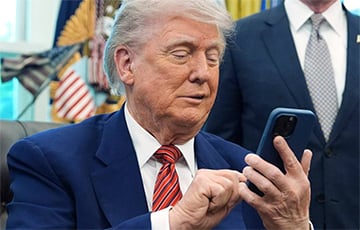


Trump Unexpectedly Reversed His Decision To Withdraw U.S. Troops From Europe
- 15.11.2026, 9:33

NATO's eastern flank will be stronger.
U.S. President Donald Trump has repeatedly made it clear that Europe can no longer rely on American protection and must take responsibility for its own security by increasing defense spending. However, the war with Iran has demonstrated just how much the United States itself needs European military bases, logistics routes, and the airspace of its allies. It appears that, faced with its own strategic needs, the Trump administration has revised its approach: the troop reduction is now expected to be significantly smaller—about 5,000 troops, rather than the 25,000 that Europeans had feared.
This was reported on November 14 by Bloomberg on November 14, citing sources familiar with the discussions within the U.S. administration.
One of the agency’s sources noted that the allies should be prepared for the withdrawal of approximately 5,000 U.S. troops, rather than 25,000, as had been planned until very recently.
One reason for the revision of these plans was the increase in defense spending by European NATO members. Washington viewed positively the fact that the allies have begun to invest more actively in their own defense and are gradually taking on greater responsibility for Europe’s security.
Another important factor was the situation in the Middle East. According to Bloomberg, Pentagon leadership has recognized how important U.S. forces stationed in Europe are for projecting U.S. military power in other regions. In particular, the U.S. Army is actively using European infrastructure during operations amid the protracted conflict with Iran.
Earlier this month, the U.S. Ambassador to NATO Matthew Whitaker also commented on a possible troop reduction. According to him, U.S. troops in Europe are stationed in the right places, and he does not expect a large-scale withdrawal of troops.
“We have a lot of resources here, located exactly where they’re needed. I don’t expect anything on a large scale,” — Vitaker said.
Which countries might lose U.S. troops
According to Bloomberg, the upcoming reduction in U.S. troop levels in Europe could affect NATO countries in different ways. The largest number of troops will likely be withdrawn from Germany, as that is where the largest number of U.S. military personnel in Europe is concentrated. On the Alliance’s eastern flank, however, the U.S. presence may actually be strengthened. This applies to countries bordering Russia, as they are willing to partially cover the costs of stationing U.S. troops on their territory.
It should be noted that the reduction of the U.S. presence in Germany has already caused tension in relations between Berlin and Washington. Previously, the Pentagon announced its intention to withdraw about 5,000 troops from there and also canceled the planned deployment of certain units. Now, as part of a broader review of U.S. military strategy, the U.S. may once again change the deployment of its forces in Europe. At the same time, Bloomberg does not specify the exact number of troops planned for withdrawal from Germany under the new decision.
Incidentally, Poland is one of the most active countries regarding the deployment of U.S. troops on its territory. For example, Warsaw is offering not only to cover the costs of hosting U.S. service members—at a rate of about $15,000 per year per service member—but also to finance the infrastructure for a permanent military base.
Lithuania has also adopted a similar model: it has offered to pay for the construction of a new base for U.S. troops. In November, Romania also announced its willingness to share the costs of hosting U.S. troops. Bucharest is interested not only in retaining U.S. troops but also, if possible, in increasing their numbers on its territory.
When Trump Will Make a Final Decision
Despite the revision of plans, no final decision has yet been made regarding the extent of the reduction in U.S. troop levels. A Pentagon spokesperson told Bloomberg that the review is ongoing and that the department has nothing to announce at this time.
U.S. Deputy Secretary of Defense for Policy Elbridge Colby is tasked with preparing an official report containing proposals to adjust the U.S. military presence in Europe and submitting it to Pentagon chief Pete Hagseth. Hagseth is expected to present his final recommendations to President Donald Trump by December 1. It is then that Trump will make his final decision.
What restrictions has the U.S. Congress imposed?
Legislative restrictions also influence the Trump administration’s ability to reduce its military presence in Europe. Last year, the U.S. Congress passed a law prohibiting the Pentagon from reducing the number of U.S. military personnel in Europe below 76,000 for an extended period without meeting certain requirements.
Specifically, before reducing troop levels, the U.S. Department of Defense must assess the risks to the security of the United States and its allies, consult with partners, and submit relevant reports to Congress. Furthermore, without following the established procedure, the Pentagon cannot simply close military bases or withdraw major weapons systems.
The current review of the military presence takes into account the risk assessment prepared by the commander of U.S. European Command Alexus Grinkevich, as well as the positions of NATO allies.
Bloomberg cites the results of the U.S. midterm congressional elections held on November 3 as another factor that could limit Trump’s options. According to the agency’s assessment, the Democrats’ takeover of Congress could make it difficult to implement large-scale cuts to military spending and troop levels overseas.
Thus, the issue at hand is not the U.S. definitively abandoning plans to reduce its troop presence in Europe, but rather a reassessment of the scale of those reductions. If the estimates reported by Bloomberg prove accurate, the U.S. troop presence on the continent will be reduced by approximately 5,000 service members instead of the 25,000 that European allies had previously feared.

Bank's name: Bank Millennium S.A.
Address: ul. Stanislawa Zaryna, 2A, 02-593, Warszawa
IBAN: PL97116022020000000216711123
SWIFT: BIGBPLPW
Name of the account holder: Fundacja “KARTA ‘97”
Purpose/title of payment: Donation for statuary aims
You can contact us by the e-mail charter97@gmail.com