


Lukashenko Wants To Bring Back Serfdom
- 15.11.2026, 13:31
And this is not journalistic hyperbole.
Lukashenko wants to reinstate serfdom for villagers, and this is not journalistic hyperbole. He says so himself, stating that without permission from the local landowner (that is, the chairman of the district executive committee), it will be impossible to leave one’s farm. “This nonsense is over,” Lukashenko declares. But what does that mean?
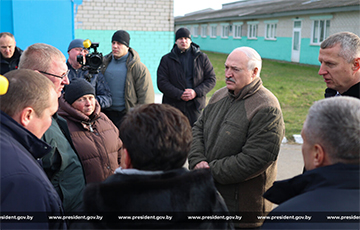
During a visit to “Govyady Agro” in the Shklov District on November 7, Alexander Lukashenko demanded that workers not leave the farm without permission from the chairman of the district executive committee. He made his point as clear as possible:
“I’ll say it again: don’t try to go anywhere. No one will leave the farm without his permission. The chairman of the district executive committee makes the final decision on where to send workers. This was and is called the systematic distribution of labor resources in the country. Therefore, we don’t need to increase vagrancy and crime in the cities.”
It’s telling, by the way, how he really feels about rural residents. For some reason, he thinks that their move to the cities will immediately increase crime there.
The essence of the statement “don’t try to go anywhere” is obvious: Lukashenko would like people to work in one place—diligently, selflessly, and with discipline—without complaining about their wages, and without even hoping to move to another place where conditions and wages are better.
But Belarusians want a better life. And because of this “harmful” desire, if they don’t see good job opportunities in a particular area, they move to other cities or even to Minsk (which, by the way, Lukashenko forbids from expanding).
Similar statements have been made before. In January, the chairwoman of the “Council of the Republic” Natalya Kochanova stated that officials and managers should not leave the Vitebsk region without the approval of the regional leadership. She cited Lukashenko’s directive, and in February, the chair of the Grodno Regional Executive Committee Yuri Karaev prohibited employees of the “Skidelsky” agricultural complex from resigning.
But now Lukashenko wants to subject all rural residents—not just individual officials—to serf-like conditions:
“This is your life. This is your job, your paycheck. And don’t think you can run off somewhere and that someone is waiting for you in the city. That’s it. As we used to say in the village, the nonsense is over.”
The “nonsense” is over. The “nonsense”—that is, constitutional rights—ended long ago. But that concerned freedom of speech, the right to express one’s opinion, and political freedoms. Now they’ve declared even the right to leave one’s village and go to the city to be “nonsense.”
I suppose Lukashenko would love to bring back serfdom, with district executive committee heads acting as landowners. But times have changed; it’s unlikely to happen. There are no laws yet that would restrict people from traveling from one region of the country to another—it’s unlikely to come to that.
However, one could call ordinary work a battle for the harvest. A war. And in a war, restrictions and special rules can be imposed—in effect, a state of emergency.
Lukashenko, by the way, likes to talk about such things. And if there’s a state of emergency, what rights remain? Then rights can be restricted, and travel can be prohibited—after all, we’re at war, not just working.
If not serfdom, then Lukashenko could very well reinstate the Soviet system of forcibly assigning workers to agriculture. Legally prohibiting a person from quitting their job or changing their place of residence does not seem possible at this time. However, creating administrative and economic conditions that would effectively prevent them from leaving the farm is entirely feasible. District executive committees will try to control who moves where by leveraging dependence on housing, company apartments, social benefits, and other resources.
And why shouldn’t people be allowed to leave their villages? After all, there is far too much parasitism in agriculture. On November 7, Lukashenko repeated this phrase several times:
“After all, in our agriculture, parasitism is excessive. I can already see that. There should be no freeloading.”
And in this case, it’s not just the kind of public rhetoric typical of this figure. This remark is consistent with the government’s policy in recent years. The authorities continue to gradually shift the priorities of government spending. The share of funds allocated to social programs is shrinking, while an ever-larger portion of the budget goes toward supporting the economy, law enforcement agencies, and national defense. The draft budget for 2027 continues this trend and gives no reason to expect that the government will actively seek to improve citizens’ well-being.
In 2022, 45% was allocated to the social sector, but this figure subsequently began to decline. By 2026, it had already fallen to 41.9%.
This shift is taking place against the backdrop of Lukashenko’s repeated statements that Belarusians rely too heavily on government assistance and must take responsibility for their own financial well-being. In fact, the authorities are making it increasingly clear that the state’s ability to support the population is not unlimited, and that citizens should rely less on the budget. But while budget-funded social benefits will be cut, what is supposed to replace them? Lukashenko’s favorite word is “discipline”:
“There must be iron discipline! Just as there should be every day. This is my most stringent demand. If there isn’t—heads will roll immediately.”
Discipline—that is, to work in silence, without complaints, and make no demands, since in today’s repressive state system, making demands or even complaining has long since become dangerous. One blogger recently wrote about hour-long lines at a clinic—the police called immediately.
For over 30 years, they’ve been enforcing discipline and order, hindering the development of private business in rural areas, and pouring vast sums of money from the budget into propping up state-owned agricultural enterprises. And now, finally, they admit that this has bred a class of “freeloaders.” And who is to blame for this? And in the end, they come to their own Shklov District and tell their own people that there will be no more help from the state:
“We’ll give you a fishing rod; go catch your own fish. No one will give you fish. That’s harmful. We used to give fish to agriculture, but today we think—listen, handing out money is wrong.”
Who is saying this? A capitalist who wants to roll back the social gains of the working class? A libertarian economist? Milton Friedman? Margaret Thatcher? No, this is coming from a man who, in the early 2000s, built “market socialism,” then boasted about social achievements, and has now suddenly realized that handing out money is wrong.
As a result, a new reality is emerging for Belarus’s so-called welfare state: it formally maintains its obligations to citizens, but its share in the distribution of state resources is shrinking. Security, defense, and other state needs are taking center stage. Meanwhile, Lukashenko and his officials are increasingly telling the population to solve their financial problems on their own. “We won’t be giving out fish anymore—catch your own.”
Vitaly Tsygankov, “Belsat”

Bank's name: Bank Millennium S.A.
Address: ul. Stanislawa Zaryna, 2A, 02-593, Warszawa
IBAN: PL97116022020000000216711123
SWIFT: BIGBPLPW
Name of the account holder: Fundacja “KARTA ‘97”
Purpose/title of payment: Donation for statuary aims
You can contact us by the e-mail charter97@gmail.com