Russian Authorities Have Banned Cryptocurrency Mining In Moscow And The Moscow Region
- 1.08.2026, 16:25
- 1,240
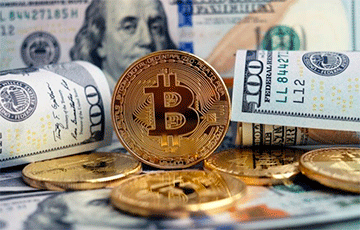
The ban will also affect the border regions of the Kursk Oblast.
Russian Prime Minister Mikhail Mishustin has signed a decree banning cryptocurrency mining in Moscow and the Moscow Region, according to The Moscow Times. Similar measures apply to eight border districts in the Kursk Region—Belovsky, Bolshesoldatsky, Glushkovsky, Korenevsky, Lgovsky, Rylsky, Sudzhansky, and Khomutovsky—as well as the city of Lgov. The decision will take effect on August 15 and remain in force until December 31, 2032.
In mid-May, the head of the Kursk Region Alexander Khinshtein spoke about the difficult situation with energy supply and asked the Cabinet of Ministers to ban mining in areas where, following the invasion by the Armed Forces of Ukraine in August 2024, residents were temporarily exempted from paying for electricity. He noted that electricity costs in these areas are covered by the federal budget.
Authorities in the Moscow Region also pushed for a ban. The local energy minister Sergey Voropanov stated that approximately 1 GW of capacity in the capital and the region is consumed by mining farms, which “do not bring any positive effect to the economy of the Moscow region.”
Prior to this, mining had been banned in 13 energy-deficient regions, including the Irkutsk Region, the annexed territories of Ukraine, and the republics of the North Caucasus (Dagestan, Ingushetia, Kabardino-Balkaria, Karachay-Cherkessia, North Ossetia, and Chechnya). Similar restrictions affected 19 districts in Buryatia and 14 districts in the Zabaykalsky Krai.
In May, *Kommersant* reported that due to a shortage of power capacity, the government was considering a ban on cryptocurrency mining in 19 regions of Central Russia, including Moscow and the Moscow Region, but with the proviso that large-scale projects would be allowed to operate in exchange for investments in power generation and transmission grids.
Cryptocurrency mining was legalized in Russia on November 1, 2024. Following this, the Federal Tax Service’s registry system went into effect: by February 2026, more than 1,500 companies and sole proprietors, as well as about 4,000 individuals, had registered in the system.
At the same time, authorities are tightening control over the industry: on May 27, the State Duma passed a bill in its first reading that would introduce criminal liability for illegal mining. The maximum penalty is up to five years of imprisonment with confiscation of property obtained through criminal means.

Bank's name: Bank Millennium S.A.
Address: ul. Stanislawa Zaryna, 2A, 02-593, Warszawa
IBAN: PL97116022020000000216711123
SWIFT: BIGBPLPW
Name of the account holder: Fundacja “KARTA ‘97”
Purpose/title of payment: Donation for statuary aims
You can contact us by the e-mail charter97@gmail.com