
An 80-metric-ton Section Of One Of The Seven Wonders Of The World Was Recovered From The Sea
1- 13.08.2026, 15:58
- 2,790
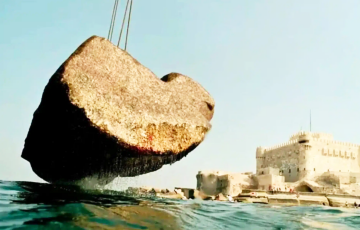
They needed a barge and a powerful crane.
Off the coast of Alexandria, 22 enormous stone blocks—each weighing between 70 and 80 metric tons—were recovered from the seabed. Researchers note that the discovery will be an important step toward the digital reconstruction of the Lighthouse of Alexandria—one of the Seven Wonders of the Ancient World, according to Daily Galaxy.
Among the objects recovered from the seabed are large lintels, door jambs, a threshold, and the slabs on which the structure stood. They also found something that had not been seen before: an Egyptian-style gate. Scientists believe that all these stones once formed the main entrance to the lighthouse—a place where Egyptian and Greek architectural styles blended. A barge and a powerful crane were needed to retrieve such heavy blocks from the water.
The recovered blocks will now be studied and scanned. Together with these, more than 100 such blocks have already been collected, which were examined underwater over the past ten years. Each stone is photographed from all angles, and then, based on these photographs, a computer builds an accurate 3D model—this allows engineers to “rotate” the stone on the computer without even touching it.
The ruins on the seabed have been known since 1968. In 1995, they were thoroughly investigated and cataloged. Even earlier, in 1994, more than 3,300 different objects were counted on the seabed—sphinxes, columns, and granite boulders.
These excavations are part of the large-scale PHAROS project. As noted, as part of the project, scientists are also collecting historical drawings and texts about the lighthouse—from the time it was first built all the way up to the moment it collapsed.
Next, each stone is “fitted” into a computer program, as if assembling a giant jigsaw puzzle, to understand what it actually looked like. The goal is to create a digital replica of the lighthouse that is so accurate that people can take a virtual walk through it, just as if it were real.
The lighthouse was built before the Common Era on the orders of King Ptolemy I. It stood on the island of Pharos and reached a height of over 100 meters—at the time, it was one of the tallest structures in the world. The Dassault Systèmes Foundation even refers to it as the first “skyscraper” in human history: for over a thousand years, its light guided sailors to the port.

Bank's name: Bank Millennium S.A.
Address: ul. Stanislawa Zaryna, 2A, 02-593, Warszawa
IBAN: PL97116022020000000216711123
SWIFT: BIGBPLPW
Name of the account holder: Fundacja “KARTA ‘97”
Purpose/title of payment: Donation for statuary aims
You can contact us by the e-mail charter97@gmail.com