

For The First Time In The World, The Ukrainian Armed Forces Dropped Ground Robots From A Drone Behind Enemy Lines
- 5.08.2026, 10:39
- 4,896
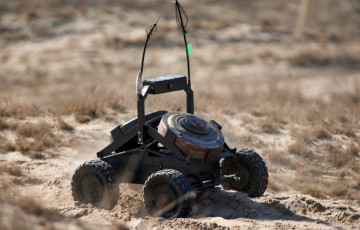
The U.S. and China put it off for 30 years, but Ukraine did it.
On August 3, Forbes published an article summarizing a series of operations that the U.S. and Chinese militaries had been unable to carry out beyond demonstrations for 30 years: Ukraine became the first country in the world to employ the tactic of dropping ground-based robotic platforms from heavy unmanned aerial vehicles in real combat conditions. A heavy hexacopter delivered the ARK-1 ground-based robotic complex, equipped with anti-tank mines, deep into Russian rear areas—and allowed it to continue its mission autonomously, writes itc.ua.
What it looked like: video from the enemy’s Telegram channel
The first footage of the operation appeared publicly not from Ukraine, but from Russia—the video was published by a Russian Armed Forces Telegram channel. The footage shows a heavy bomber hexacopter carrying the ARK-1 on cables, carefully lowering it to the ground behind enemy lines, and flying away. The ARK-1 then proceeds on its own toward enemy positions.
Russian channels are in an uproar today over a new video—filmed from the Russian side—showing a Ukrainian heavy drone delivering a ground-based kamikaze robot by air to destroy Russian positions.
While Putin is about to mobilize at least 500,000 troops for more ground assaults, Ukraine is… pic.twitter.com/qb9dmySNRQ
— Jay in Kyiv (@JayinKyiv) July 19, 2026
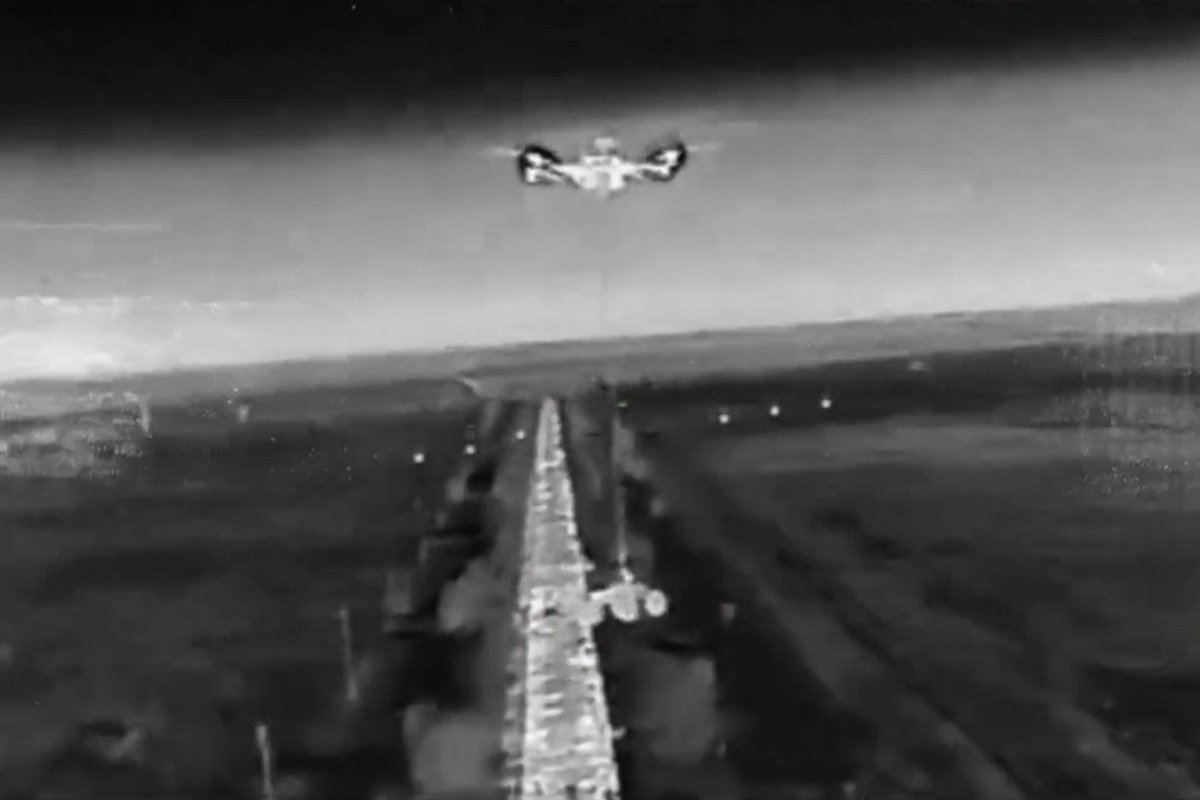
The ARK-1 is a compact, all-wheel-drive platform with off-road tires. Its claimed top speed is up to 40 km/h, its payload capacity is up to 15 kg, and its range is up to 14 km. In this operation, the platform carried TM-series anti-tank mines and was tasked with autonomously laying mines along the approaches to enemy positions after landing.
Forbes journalist David Humbling, who has been writing about unmanned systems and technology for over a decade, explicitly called this a precedent:
“Drones carrying other drones on board had remained merely a concept until this war. The U.S. military experimented with this idea repeatedly over the course of three decades, but never progressed beyond demonstrations. Now Ukraine is using this technology in combat, and the only limit may be the operators’ imagination,” David wrote.
The U.S. did indeed have similar programs—specifically as part of DARPA’s projects on autonomous ground systems and the “MULE” (Mobile Unmanned Light-weight) concept back in the 2000s. But none of them ever made it beyond test range trials. The reason was the difficulty of coordinating between the aircraft and the ground platform in real combat conditions involving electronic warfare, unpredictable terrain, and enemy countermeasures. Ukraine solved this problem not after many years of laboratory research, but in just a few months of testing on the front lines.
Kinburn Spit: Another “First” Three Weeks Before Forbes
The Forbes article was published on August 3, but in fact, the first documented “pouch-type” operation took place as early as July 13—and was even more radical: the “Magura” maritime drone delivered the Rys ground robot, armed with a PKT machine gun, to the occupied Kinburn Spit.
This was the world’s first documented instance of a maritime drone serving as a carrier for a ground combat vehicle. Forbes dedicated a separate article to this operation on July 14. In other words, in three weeks, Ukraine carried out two operations of this kind—one at sea and one in the air—and both were the first of their kind in the world.
ARK-1 and the Future of “Remote Combined Operations”
ARK-1 is included in the Brave1 registry and is part of a large-scale rearmament program: Former Minister of Digital Transformation Mykhailo Fedorov announced plans to procure 25,000 UGVs in the first half of 2026 alone—roughly twice as many as in all of 2025. The goal is to replace 30% of frontline personnel with robotic systems. In Forbes, Hambling compares this logic to a classic helicopter assault—but without the risk to human life:
“When drones and UGVs are deployed instead of people, the risk disappears,” he says.
The “marsupial” tactic, as Forbes calls it, solves one of the main problems with UGVs: limited mobility and vulnerability when moving across open terrain under the surveillance of reconnaissance drones. If the carrier drops the ground vehicle directly in the target area, the UGV doesn’t waste battery power on the approach and doesn’t reveal its route to the enemy.

Bank's name: Bank Millennium S.A.
Address: ul. Stanislawa Zaryna, 2A, 02-593, Warszawa
IBAN: PL97116022020000000216711123
SWIFT: BIGBPLPW
Name of the account holder: Fundacja “KARTA ‘97”
Purpose/title of payment: Donation for statuary aims
You can contact us by the e-mail charter97@gmail.com