

"Oreshnik" Syndrome
1- 23.09.2026, 12:26
Aaron Lea, Baruch Taskin, The Moscow Times
The Kremlin is resorting to the nuclear option not because it has an abundance of options, but because it lacks them.
While experts speculate on the likelihood of a strike, nuclear weapons continue to yield significant political dividends for the Kremlin. And all Russian missiles are still in their launch sites. Some aren’t even operational.
Almost two years ago, in the article “The Man with ‘Oreshnik,’” we analyzed whether Putin would start a nuclear war. Today, we must admit: the question was framed incorrectly, since we did not specify “when.”
Pays for itself without a launch
A column by Boris Bondarev for The Moscow Times outlines a phased scenario of a nuclear crisis, and his main observation is not what will happen after a strike, but what happens before it: as soon as intelligence detects signs of preparations—leaks begin, panic sets in on the markets, demands for an immediate deal arise, and a refusal to accept Moscow’s terms already looks like consent to disaster.
“Self-deterrence” is a well-established term in Western analysis: As early as April 2023, the Atlantic Council called the very idea that “the West must restrain itself so as not to provoke an escalatory response from Putin, including the use of tactical nuclear weapons,” a “logical fallacy,” — and insisted that “only a clear demonstration of resolve deters despots.” One of the leading experts on this issue, *The Atlantic* columnist Anne Applebaum, describes the same effect as the result of a deliberate campaign of intimidation. The mechanism that Bondarev outlines as a future scenario is already at work: in the delayed deliveries of weapons to Ukraine, in the Ukrainian Armed Forces’ self-imposed restrictions on strikes deep into Russian territory, and especially in oil refining. (Just look at the antics of U.S. President Donald Trump regarding Russian-produced diesel fuel!)
But if the premature monetization of the threat is already yielding maximum benefits for the Kremlin without the costs of crossing the threshold—why press the red button? A likely answer: the audience is getting used to the rhetoric, and to maintain its impact, increasingly dramatic signals are needed. The nuclear threat is a fading stimulus; its impact diminishes with each repetition, creating an incentive for escalation.
In a cocoon
There is also a simpler explanation for why the Kremlin’s calculations might turn out to be irrational in the first place.
On September 1, Putin announced the capture of Svyatogorsk, personally citing reports from security agencies and a “sufficiently objective” picture of the war. Six days later, the commander of the 3rd Army Corps of the Armed Forces of Ukraine Andriy Biletsky calmly filmed a video from the city center, and the ISW confirmed that Svyatogorsk remains under Ukrainian control; even the Kremlin’s military correspondent admitted the statement was false. If frontline reports are false, why would nuclear ones be accurate? The general staff, which has for years been reporting on nonexistent victories, could just as easily be concealing failures in deterrence and the actual readiness of strategic forces. Decisions on the use of weapons are made within the same information bubble—and thus are less rational than any scenario, including Bondarev’s, would suggest.
There is also skepticism regarding the claim that Putin, having survived the use of such weapons, would become the most respected leader in the world. There is simply no historical precedent confirming that the use of weapons of mass destruction enhances the aggressor’s prestige rather than isolating them. But the idea is interesting and will certainly force Western think tanks to reassess their options.
A Staircase, Not a Cliff
The scenario itself takes a sharp turn: from “the threat is no longer paying off” to “a nuclear demonstration or strike,” as if there were no other steps in between. But there are at least two more:
A high-altitude test explosion without combat casualties, which would break an eighty-year-old taboo without killing anyone—a far cheaper operation than a tactical strike on a target, and one that cannot be lumped together with an actual attack.
A semi-covert—that is, accessible even to investigative journalists—distribution of highly enriched fissile materials to outcasts like Iran (a slap in the face to Trump), North Korea (a slap in the face to Xi), or Yemen’s Houthis (a slap in the face to both Trump and Netanyahu).
These steps in no way preclude the continuation of the invisible pressure that Moscow is already applying with increasing intensity: sabotage of undersea communication cables, GPS jamming, operations against satellites, and hybrid attacks such as the incident at Leipzig Airport.
And as long as these acts of sabotage are labeled “hybrid warfare” rather than “state terrorism,” as suggested by Kaupo Rosen, head of Estonian intelligence, the Kremlin can restore the credibility of the threat, which has been shaken, without even coming close to actual nuclear strikes.
The entire scenario is described as Moscow’s game against the “West”—but it has long since gained a third player, whose decisions are no less significant. Ukrainian strikes on the rear, the escalation of the air war, and the stability of the front line—factors that directly shape the Kremlin’s risk assessment, rather than merely serving as a passive backdrop for negotiations between Washington and Moscow—must be taken into account.
And we are not even calling Ukraine’s non-nuclear status into question yet.
It Doesn’t Hold Up to Scrutiny
The diagnosis of “self-restraint” is not the author’s own discovery. What is original is the second part: an operation to split the Russian elite through back channels. But the “crabs in a bucket” effect still applies to the elites; we have also written about this and concluded: they will not split. They are too intimidated, and all “signals” like Melnichenko’s demarche are provocations by Moscow to test the West and erode its resolve.
Nuclear authorization goes through two distinct levels, not just one: approval—three “chegets” from the president, the defense minister, and the chief of the General Staff; and execution—officers of the Strategic Missile Forces and the 12th Main Directorate of the Ministry of Defense, who physically operate the launch. Even if all three “chegets” confirm the order, a refusal or delay at the execution level is possible. This has already happened during the Cold War (Stanislav Petrov, Vasily Arkhipov, William Bassett). A signal addressed to the vague “general staff” misses both real points of influence at once, so it is necessary to name both layers separately, rather than one in place of the other.
The emigration center and the guarantee of personal safety as a condition of the deal remain an unresolved issue: the Lubyanka treats political emigration as a list of targets, not as a partner. This means it is unlikely that any Western government could physically protect an officer inside the Russian Federation while pushing him toward defection on the grounds of preserving peace through the diaspora.
Far more serious is another issue: the covert signals regarding regime change transmitted during the nuclear crisis—a classic trigger for the “use it or lose it” logic. The Cuban Missile Crisis was sustained by deterrence directed at the sovereign leadership at the top, not by inciting officers to stage a coup. An operation conceived to prevent a strike can, at the height of a crisis, actually accelerate it. Moreover, intelligence agencies never publicly broadcast offers of asylum for precisely this reason—turning Bondarev’s thought experiment into a “political proposal” implies attributing to it a degree of feasibility that a covert operation simply cannot have.
Finally, China’s reaction is not mentioned at all in this scenario—even though the author himself acknowledges elsewhere in the text that limited nuclear escalation could be beneficial to Beijing. Here, the situation is even more uncertain—and therefore dangerous.
Now try this
Depriving the threat of its monetizability is a necessary condition, but not a safe solution: a dictator, having discovered that demonstrating preparations for a nuclear strike no longer buys concessions, will most likely once again take the lower rungs of the escalation ladder (hybrid sabotage, a test explosion) rather than resort to a nuclear strike.
But the information cocoon makes even this calculation less predictable. Bondarev’s assessment—“The West is already paying the price for a threat that has not yet materialized”—is spot-on. His prescription—a covert split within the elite—is intuitively appealing, but it does not hold up to scrutiny by the structure of nuclear command, the logic of a crisis, or the logic of secrecy. There remains a gap between the correct diagnosis and the risky treatment, a gap that no one has yet bridged in open discussion, and it must be filled not by a coup d’état, but by action at the lower, non-military levels of escalation, where the Kremlin is already operating and where the West has real, verifiable leverage.
All the solutions are there—from “sanctions from hell” to the timely supply of weapons and ammunition to Ukraine, and counterattacks that are no longer merely diplomatic in nature.
The Devaluation of the Last Trump Card
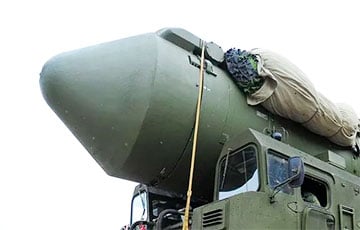
The Kremlin is returning to the nuclear card not out of an abundance of options, but out of a lack thereof. Russia cannot compete with the U.S. economically or technologically, with China industrially or demographically, or with Europe in terms of market size; and the war with Ukraine, after four and a half years, has failed to achieve any of its stated goals: not even the Luhansk region is yet fully under the control of Russian troops. The only area where Russia remains a superpower on par with the United States is nuclear weapons. And its only trump card: the more glaring the gap between its claim to superpower status and its ability to back it up, the more often it has to play that card. “Oreshnik” is not a weapon of the strong, but rather what remains when everything else fails.
Its vast territory is also a common argument: the Russian Federation cannot be destroyed—the country is simply too large. But the size of the territory also means the cost of maintaining it: eleven time zones that must be connected and secured, coupled with a shrinking population, turn into a constant financial burden. And a state does not function based on square kilometers, but on hubs—government, energy, transportation, communications—and the empty space between them does not make them any less vulnerable. Territory (even if two-thirds of it is swamp) provides strategic depth, but it does not prove the ability to “win” a nuclear war—just as a large house does not become fire-resistant simply because it has many rooms.
This “last trump card” has an unpleasant quirk: it works only as long as the enemy believes the missile can actually launch. The war in Ukraine is gradually eroding that belief: Western guidance and control systems, long-range missiles, strikes on Russian territory—every time another “red line” is crossed, the world doesn’t come to an end. The same mechanism of eroding the “premium”—discussed above in relation to war tactics—also operates at the level of superpower status: the more often the Kremlin plays this trump card, the less it is worth; yet—lacking an equal in power—it cannot be abandoned. Hence the growing need to confirm the threat more and more convincingly—through words, doctrine, military exercises, new delivery systems, the notorious “Burevestnik,” and other “Avangard” missiles. Sooner or later, every blackmailer faces the same question: what to do if the victim no longer believes you?
And one more important point. The USSR’s superpower status was not secured by the nuclear triad alone. There was also a diversified economy, a bloc of allies, as well as the military, demographics, and a universalist ideology. In today’s Russian Federation, the gap between its claims and its resources is significantly wider, and its nuclear arsenal is the only thing bridging that gap, allowing what is essentially a conventional great power to demand the status of one of the two “guardians of the world.” Worse still, Trump’s setbacks are spurring Putin on, and he no longer seems content with parity; he wants to become the ruler of the seas (struck through) the sole master of the globe, emulating the Bolsheviks whom he both hates and loves so much. Therefore, for the Kremlin, the loss of the credibility of the nuclear threat is not the loss of a military tool, but the loss of a recognized status—a status for which the war is largely being waged. And for a man who considers the restoration and transcendence of this status his personal historical mission, such a defeat may prove more terrifying than a defeat on the battlefield.
And so, because of this “trump card,” the necessity of maintaining a vast territory, and a past thoroughly eroded by corruption, everything looks far worse than Bondarev describes.
Driven (though perhaps this, too, is an ideologeme), by divine providence and destiny, Putin is in the grip of illusions, obligingly sold to him by the “beacons of nuclear reason”—the Kovalchuk brothers—and the singer of the world’s destruction Sergey Karaganov. There is no doubt that Yuri, the beloved student of Nobel laureate Zhores Alferov, is talented (he defended his doctoral dissertation at age 34—very early, since in the USSR it was rare to earn a doctorate before age 45). There is no doubt that Mikhail Kovalchuk, an outstanding physicist and crystallographer, is not only an older brother but also a prominent scientist. But let’s see what advice they gave Putin:
all past leaders (starting with Khrushchev) were weaklings who refused to use nuclear weapons, whereas today’s Russian leadership is not weak—quite the opposite;
the concept of “mutually assured destruction” (MAD) is a hoax concocted by the Pentagon
limited-yield nuclear strikes will not lead to a nuclear winter, this is a hoax invented by “concerned scientists”—the Krakatoa volcano serves as proof;
Russia can and must win a nuclear war, and will survive thanks to its territory, an extra chromosome, and the “genetic code of a winner”
Putin and another 150,000 of the finest Russians will at least be able to escape and wait it out in the underground cities of Yamatai (as reported by The New York Times as far back as 1996) and in the Altai region (facilities personally commissioned by Timur Ivanov, who is currently in prison).
All of these ideas, so dear to Putin’s heart, will serve as the justification for a first nuclear strike, and we are confident that the Kremlin will not stop at the use of tactical nuclear weapons. He will destroy the world using none other than “Satan” (or, if you prefer, “Sarmat”).
Such advice also fosters an internal conviction that nuclear weapons will indeed have to be used. And then Putin will say once again: “It’s not my fault—we were forced into it.” When the tool of deliberate threats has exhausted its short-term political dividend, it is precisely this eschatological conviction—locked away inside an information bubble—that could turn nuclear blackmail from a bargaining chip into an order. And the repeated captures of Ukrainian cities do little to shape the worldview that would allow Putin to grasp the consequences.
And from there on—it’s all on the executor’s risk.
Here we agree with Bondarev.
Aaron Lea, Boruch Taskin, The Moscow Times.

Bank's name: Bank Millennium S.A.
Address: ul. Stanislawa Zaryna, 2A, 02-593, Warszawa
IBAN: PL97116022020000000216711123
SWIFT: BIGBPLPW
Name of the account holder: Fundacja “KARTA ‘97”
Purpose/title of payment: Donation for statuary aims
You can contact us by the e-mail charter97@gmail.com