

What Can We Expect From The Talks In Abu Dhabi, Which Begin Today?
- 10.11.2026, 8:57
The meeting is unlikely to bring Ukraine any closer to true peace.
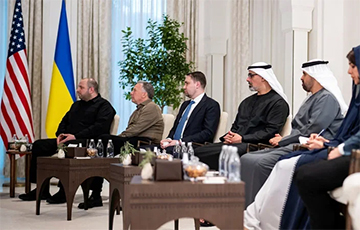
On November 10–11, Abu Dhabi, the capital of the United Arab Emirates, is set to host talks between Ukrainian and Russian delegations, mediated by the U.S.—the first such meeting since February 2026 as part of efforts to pave the way for ending Russia’s war against Ukraine.
After the U.S. launched an operation against Iran on February 28, 2026, no such trilateral meetings involving Ukrainian, American, and Russian delegations have been held. New agreements to resume the format were reached after Volodymyr Zelenskyy met with Steve Witkoff in Oslo in late October, who subsequently met with Russian dictator Vladimir Putin in St. Petersburg.
NV has compiled the key points you need to know about the two-day talks in Abu Dhabi and Ukraine’s expectations for them.
The head of the Office of the President of Ukraine Kirill Budanov will be in Abu Dhabi, but he is not leading the Ukrainian delegation. Rustem Umerov has been appointed head of the Ukrainian delegation, and according to RBC-Ukraine sources, the full delegation consists of the following members:
Rustem Umerov, Director of the Foreign Intelligence Service (head of the delegation),
Kirill Budanov, Head of the Office of the President of Ukraine,
David Arakhamia, head of the Servant of the People faction in the Verkhovna Rada,
Sergey Kislitsa, first deputy head of the Office of the President,
Vadym Skibitsky, Deputy Chief of the Main Intelligence Directorate of the Ministry of Defense,
an analyst from the Foreign Intelligence Service team.
Representing the U.S. in the UAE will be U.S. Presidential Special Envoy Steve Witkoff and Donald Trump’s son-in-law Jared Kushner. Witkoff described the United States’ role in this meeting as “mediation in working-level negotiations.”
Russia will be represented by a delegation that, for the first time, includes Russian Deputy Foreign Minister Sergey Ryabkov. The delegation will be led by Vladimir Medinsky, an aide to Russian dictator Vladimir Putin. Back in February 2026, Volodymyr Zelenskyy expressed his disappointment that Medinsky had also been appointed head of the delegation at that time. The Ukrainian president suggested that this was done to drag out the negotiations and pointed out that Medinsky is known for his tendency to give lengthy pseudo-historical “lectures,” through which he attempted to explain the reasons for the war unleashed by Russia against Ukraine.
The full composition of the Russian delegation is as follows:
Vladimir Medinsky, aide to Vladimir Putin, head of the Russian Military-Historical Society (head of the delegation);
Sergey Ryabkov, Deputy Minister of Foreign Affairs of Russia;
Mikhail Galuzin, Deputy Minister of Foreign Affairs of Russia;
Igor Kostyukov, Chief of Russian Military Intelligence;
Yuri Zhigalovsky, Deputy Chief of the Main Operational Directorate of the General Staff of the Russian Armed Forces.
Advertisement:
Medinsky, Galuzin, and Kostyukov have already participated in previous rounds of negotiations; Zhigarlovsky and Ryabkov are joining them for the first time.
Reuters notes that Ryabkov is responsible at the Russian Foreign Ministry for relations with countries in North and South America, as well as for arms control issues and matters related to the Iranian nuclear program. Ukrainian journalist Vitaly Portnikov believes that Russia included Sergey Ryabkov in the delegation precisely because he is the “US liaison” and because Americans will be present at the negotiating table—not because Moscow has allegedly become more interested in finding a compromise and therefore “upgraded” the delegation, as some media outlets, notably Bloomberg, had suggested.
Will Europeans be in Abu Dhabi, and what will their role be?
On the eve of the meeting in Abu Dhabi, Moscow tried to downplay Europe’s significance in the negotiation process. In particular, Kremlin press secretary Dmitry Peskov stated that the format of the talks provides for the participation of only delegations from Russia and Ukraine, with the United States acting as mediator.
Nevertheless, the European Union and NATO will still be represented in the UAE. Specifically, the head of the Ukrainian delegation, Rustem Umerov, emphasized that the following will be present in Abu Dhabi during the negotiations on November 10–11:
representatives of the “quartet” of European countries—namely the United Kingdom, France, Germany, and Italy—
representatives of NATO,
and representatives of the European Commission.
“We are doing everything we can to ensure that Europe participates in the diplomatic process,” Umerov emphasized, stating that for Ukraine, “it is of fundamental importance to maintain close coordination with all our key partners, ensure consistency in our positions, and reach a common understanding of the next steps in the negotiation process.” He clarified that “separate coordination meetings” will be held with European partners.
Jared Kushner stated that he and Witkoff would hold a meeting with representatives of the EU, NATO, Germany, France, the United Kingdom, and Italy, with Ukraine’s participation, prior to the start of the two-day trilateral talks with Ukraine and the Russian Federation. Kushner announced these talks as a continuation of “the close consultations and coordination we have been conducting on European security and Ukraine’s post-war future over the past few weeks.”
Ahead of the talks in the UAE, Politico reported that many European officials “privately acknowledge that Europeans no longer trust Washington to protect either Europe’s interests or Ukraine’s.”
A NATO spokesperson told Suspilne that (https://charter97.org/ru/news/2026/11/9/704891/, the Secretary General’s Chief of Staff, will represent the Alliance in Abu Dhabi) Jeffrey Van Leuven, while the European Commission’s Chief Spokesperson Paula Pigno stated that the Commission will be represented by the National Security Advisor and Chief of Staff to Ursula von der Leyen, Björn Seibert.
It is known that Germany will be represented by Günter Sautter, foreign policy and security advisor to Chancellor Friedrich Merz. French Foreign Minister Jean-Noël Barrot also confirmed on November 8 that his country would be represented at the talks in Abu Dhabi, though he did not name the representative.
Sources at Suspilne also reported on a likely joint delegation from the European Commission and the European Council.
Shortly before the talks in the UAE, Ukrainian President Volodymyr Zelenskyy also held discussions with the leaders of Northern European and Baltic countries, coordinating preparations for this meeting with them.
Rustem Umerov, upon departing for Abu Dhabi, articulated the main goal of the Ukrainian delegation as follows: “Our goal is long-term and sustainable peace, guaranteed security for Ukraine, and real opportunities for Ukraine’s post-war recovery.”
Steve Witkoff officially announced that the talks would focus on topics such as post-war security arrangements, ways to de-escalate the conflict, humanitarian efforts, and further steps toward peace. Meanwhile, a day before the meeting in Abu Dhabi, Kushner outlined four priorities that U.S. negotiators consider key:
a cessation of hostilities,
the development of “reliable post-war security guarantees and agreements that will reduce the risk of a resumption of the conflict,”
the preparation of a “comprehensive economic and prosperity plan for Ukraine,”
and the promotion of humanitarian measures “to alleviate suffering and address the humanitarian consequences of this war.”
In late October, Volodymyr Zelenskyy emphasized that Ukraine had proposed including the following topics on the agenda for the Abu Dhabi talks:
a ceasefire in the energy sector and at sea,
the exchange of prisoners and the release of civilians held in Russian prisons (On his way to the UAE, Kirill Budanov emphasized that “great attention” would be paid to this issue in order to intensify exchanges and agree “on the next steps for bringing our people home”);
the return of Ukrainian children;
preparations for a summit between the leaders—that is, Putin and Zelenskyy—which the Ukrainian president called the “main task” of the delegations’ technical meetings and expressed hope that “one or two meetings” would be sufficient for such preparations.
Zelenskyy also emphasized that the issue of territories remains the most contentious in the negotiation process, but official Kyiv is ready to discuss it “only at the leadership level.” Previously, Russia had demanded that Ukraine relinquish even those territories—particularly in the Donetsk region—that the Russian Federation had not yet occupied, including Slavyansk and Kramatorsk. Furthermore, Moscow continues to insist, without justification, that it considers not only the illegally occupied territories of Crimea and the Donbas to be part of Russia, but also the territories of the Kherson and Zaporizhzhia regions within their administrative borders. Zelenskyy emphasized that Ukraine will never recognize all these occupied territories as Russian, although it is ready to discuss the possibility of a ceasefire along the current front line.
At the same time, Russia has made it clear that it intends to discuss what it calls “its own security” issues during the trilateral talks in Abu Dhabi. Russian Foreign Minister Sergey Lavrov claimed on November 9 that American negotiators had allegedly proposed “placing the issue of collective security at the forefront of the agenda for negotiations on the Ukrainian settlement.”
Earlier, The Telegraph speculated that Russia would attempt to use the peace talks on Ukraine to weaken NATO and push for the Alliance’s borders to be limited to their 1997 boundaries.
Recent statements by Donald Trump also point to the risk that the U.S. may indeed be planning to discuss a broader agreement with Russia, which could include an attempt to redraw spheres of influence, including in Europe. Just days before the talks in Abu Dhabi, Trump announced several times a “very major agreement” that, in his view, should “cover not only Ukraine but all of Europe.” He also suggested that Ukraine “will ultimately take on a somewhat different form,” hinting at a change in Ukraine’s borders.
Volodymyr Zelenskyy warned that this “big deal” announced by Trump could prove potentially dangerous. Ukraine’s position is that negotiations to end Russia’s war against Ukraine must take place first, followed by the agreement on security guarantees. According to Zelenskyy, talking about a new “security architecture” in Europe is dangerous first and foremost for the EU, since Ukraine is not yet a member of the bloc but is merely moving toward membership. “We don’t want a Yalta-2. We are not ready for such a format; we don’t want Russia to divide us. Sovereignty and territorial integrity are key issues for any democratic country,” Zelenskyy emphasized.
The New York Times speculated that the talks in Abu Dhabi will address the question of whether Russia might soften its demands for an end to the war if it is given a role “in shaping the postwar regional security architecture.” “Some view this approach as a concession to Russia,” the publication notes.
Why This Meeting Is Unlikely to Bring True Peace to Ukraine
Neither official Kyiv nor European diplomats, high-ranking officials, nor international analysts expect a significant breakthrough from the meeting in Abu Dhabi, pointing out that Russia shows no signs of wanting to end the war.
In an interview with CBS News shortly before the talks in the UAE, Kirill Budanov, head of the Presidential Office, emphasized that he does not expect a significant breakthrough during this round of negotiations. At the same time, he said that the resumption of trilateral talks “is already a sign of progress.” Budanov also expressed hope that, thanks to the military experience of the negotiators, discussions on the technical aspects of a possible ceasefire could prove to be the most constructive.
At the same time, Norwegian Prime Minister Jonas Gar Støre acknowledged that a recent conversation with Putin, which he held jointly with Finnish President Alexander Stubb, had not convinced him that the dictator was ready for a peace agreement. Therefore, the Norwegian and Finnish delegations do not expect a significant breakthrough in Abu Dhabi, Politico reported on November 9, one day before the talks in the UAE.
The New York Times, in its analysis of the talks in the UAE, noted that many analysts do not expect any breakthrough in the negotiations until spring. By that time, Russia likely hopes to see results from its winter attacks on Ukraine—aimed at undermining the morale of Ukrainians and destroying the heating, electricity, and water infrastructure in Ukrainian cities as the cold weather sets in, the NYT notes. The publication also suggests that negotiators in the UAE may focus on security guarantees designed to prevent a resumption of the war should a ceasefire agreement be reached. The idea is to move away from territorial issues and consider the broader context of European security, the newspaper suggests.
At the same time, the topic of a purported new “security architecture in Europe” could become a Russian trap for Witkof and Kushner, who are inexperienced and uninformed in diplomatic matters, The Washington Post wrote on the eve of the talks in Abu Dhabi. The publication cited the views of a number of international affairs experts and diplomats, who pointed out that Russia has already violated numerous agreements and cooperation frameworks concluded with Western countries following the collapse of the Soviet Union. In particular, one official familiar with the progress of the talks told the WP that Kushner is using the Russia-NATO Council—which was established after the end of the Cold War—as a model; however, its work was suspended back in 2014, following Russia’s invasion of Ukraine and occupation of Crimea.
The Institute for the Study of War has also repeatedly emphasized that Russia is demonstrating a commitment to its maximalist military demands, which leave Ukraine no chance of survival as an independent state. This was further evidenced by the fact that Putin used his conversation with Stubb and Stere to reiterate his claims about the so-called “root causes” of Russia’s war against Ukraine. These demands include a pro-Russian puppet regime in Ukraine, restrictions on the Ukrainian military, and a renunciation of NATO membership by those states that joined the Alliance after 1997, ISW experts noted.
In addition, ISW analysts believe that for the negotiations in Abu Dhabi, the Kremlin apparently sent “a delegation of officials who had previously stalled the negotiations, which once again demonstrates that the Kremlin remains uninterested in participating in good-faith negotiations.” In particular, Sergey Ryabkov, Lavrov’s deputy, has repeatedly stated that Russia can accept only those peace proposals that align with Putin’s military objectives and “realities on the ground.” Ryabkov has also regularly insisted on adherence to mythical “agreements” following the Alaska summit in August 2025, despite the absence of any public statements regarding the reaching of any agreement or understandings. It was Ryabkov, in particular, who helped ensure that in 2021, before the invasion of Ukraine began, the Kremlin issued an ultimatum to the U.S. and NATO countries. Therefore, Moscow may now use his experience and these demands to divert attention from Ukraine’s efforts to secure safety guarantees for Kyiv in trilateral negotiations, the ISW concludes.

Bank's name: Bank Millennium S.A.
Address: ul. Stanislawa Zaryna, 2A, 02-593, Warszawa
IBAN: PL97116022020000000216711123
SWIFT: BIGBPLPW
Name of the account holder: Fundacja “KARTA ‘97”
Purpose/title of payment: Donation for statuary aims
You can contact us by the e-mail charter97@gmail.com