


A Tree Fell On A Belarusian Woman's New House
1- 15.09.2026, 9:54
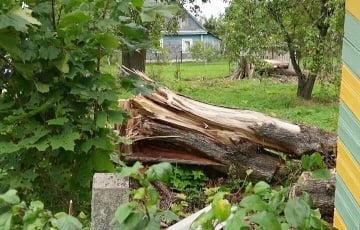
Photo: “First Information”
The authorities “explained” why it hadn’t been cut down earlier.
A resident of a village in the Vileika District bought a house, and a few days later, during a storm, a tree from the village council’s property fell on it. The woman claims she had warned local authorities about the danger in advance, but no measures were taken. As a result, the roof was damaged, and she had to seek compensation through the district executive committee, according to “Zerkalo”, citing “First Information.”
Marta Gurman became the owner of a house near Vileika in early August. According to her, even at the time of purchase, she was alarmed by a large tree on a neighboring plot of land that belongs to the village council. She claims that she contacted the chairwoman of the Lyudvinovsky Village Executive Committee before the hurricane.
“We actually came to look at a different house. We met some local residents here, and they showed us this house. It was nice, solidly built, didn’t leak—you could move right in and live there. We reached an agreement with the owners, closed the deal, and I picked up the documents. That tree was standing right here; it had already bothered me back then. I contacted the village council a few days later. The chairwoman wasn’t there. I called her, and she replied sharply, ‘No one is going to cut anything down—go ahead and write to the president if you want.’ On Friday, I called the chairwoman and told her that the tree was lying on top of our house,” the woman said.
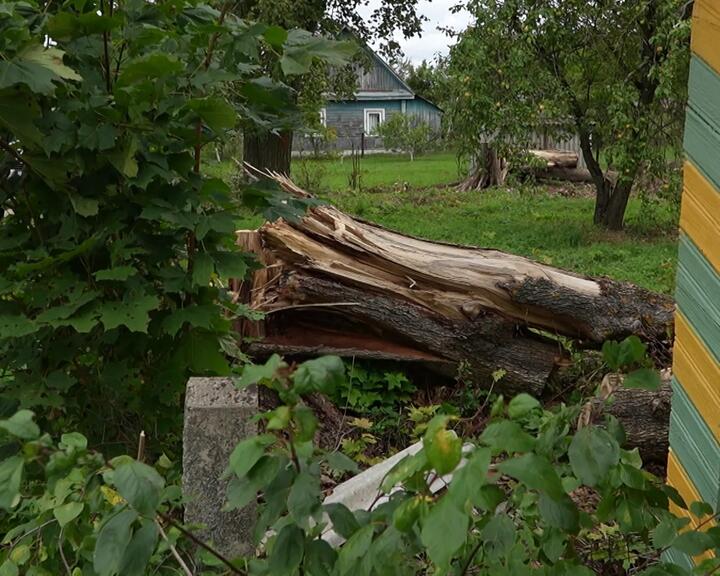
On the night of August 6–7, a severe storm swept through Belarus—the Vileika District was hit the hardest. That’s when the tree fell on Marta’s house and tore through part of the roof.
“Thanks to our chairman for this ‘beauty,’ for ignoring the complaints about the tree standing there. Now we have this ‘summer shower’—water’s pouring in everywhere. It’s rotting, too. And the authorities think there’s absolutely no need to compensate for the damage,” the homeowner remarked sarcastically.
Meanwhile, the chairwoman of the Lyudvinovsky Village Executive Committee Natalia Sheveleva claims that Marta called her only on August 5—that is, one day before the storm hit. According to her, it would have been impossible to resolve the issue even within a few days, since the tree first had to be officially declared a hazard.
“The village executive committee is responsible for trees located on public property. She contacted me, and I explained to her that in order to have the tree removed and declared a hazard, she needed to submit a written request. But, unfortunately, we didn’t have time to do anything and didn’t manage to submit the application. The procedure requires a citizen to submit an application to the village executive committee. We then forward the request to the Vileika Experimental Forestry Enterprise. After that, if the tree is deemed hazardous, the village executive committee sends the application to the Vileika Center for the Support of Budgetary Organizations. There were strong winds on the night of the 6th to the 7th. We went to the scene immediately. Marta wasn’t there because she only comes on weekends. We agreed with her that we would help her cut up the tree and clean it up,” says Sheveleva.
Marta, however, emphasized that although the tree was indeed cut up after that conversation, she had to clean up the branches and debris herself.
“They came, cut it down, but the branches and all the debris were left behind; we cleaned everything up on our own. The chairwoman provided some used roofing shingles and plastic sheeting. That’s all,” she said.
Local residents claim they had complained about the tree before. One of them said that the previous owner of the house had repeatedly asked the village council to look into its condition.
“My grandmother used to live here; she kept reaching out and asking because she had a feeling that this tree would fall. But it’s to be expected, because we have a huge linden tree standing here, too. It’s going to fall soon, too. Three like that have already fallen,” the woman said.
Sheveleva, for her part, stated that she had not received any previous complaints, and the tree itself did not appear to be in a dangerous condition.
“No, no one contacted me. We drive through and inspect every village. This happens once a month. And we check—if a tree is dry, leaning, or showing signs of dying, we see it ourselves and take a closer look. But I’ll say it again: this tree didn’t look diseased or dry. It was full of leaves and visually beautiful,” says the chairwoman.
However, Dmitry Drozd, director of the Vileika Experimental Forestry Enterprise , came to a different conclusion after his inspection.
“We received a request from the Lyudvinovo Village Executive Committee on August 10. By August 13, when our staff arrived here, the tree had already fallen. Based on what I see in this situation, the entire central part of the trunk is completely rotten. There is heart rot, dieback, and clear signs that the tree is leaning more than 30 degrees from its vertical growth axis,” he stated.
After that, Marta contacted the 115 service to request an inspection of other trees near the property. Specialists arrived within three days and deemed the trees hazardous.
The woman initially tried to seek compensation through the village council but received a reply letter of refusal from the chairperson. Sheveleva stated that the village executive committee was not authorized to resolve such issues and advised her to contact the Regional Emergency Situations Department, her insurance company, and the Vileika District Executive Committee.
According to Marta, after she contacted the district executive committee, a commission arrived the very next day. Deputy Chair of the Vileika District Executive Committee Alexander Katovich reported that specialists documented the damage and prepared a cost estimate.
“When we arrived at the site, we saw that a tree had fallen and destroyed the man’s addition. We also saw that the roof had already been repaired. On site, we determined that the damage to some of the load-bearing structures had occurred long before the emergency. Well, the homeowner simply hadn’t paid attention to it before. We took measurements and drew up a defect report based on the findings, which was then used to prepare a cost estimate for repairing the damage caused by the emergency,” Katovich explained.
In the end, compensation was agreed upon for the woman, and she considered the amount acceptable.
“Basically, I’m satisfied with everything. The only thing is that the village council is once again staying out of it. There was a tree on its property that they were supposed to take care of, outside the boundaries of the territory,” Marta stated.

Bank's name: Bank Millennium S.A.
Address: ul. Stanislawa Zaryna, 2A, 02-593, Warszawa
IBAN: PL97116022020000000216711123
SWIFT: BIGBPLPW
Name of the account holder: Fundacja “KARTA ‘97”
Purpose/title of payment: Donation for statuary aims
You can contact us by the e-mail charter97@gmail.com