

BBC: What Blow Will Be Inflicted on the Regime in Belarus by Western Sanctions
23- 18.08.2021, 16:41
- 42,302
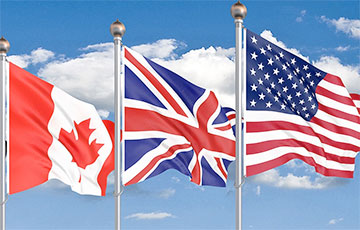
The US is hitting potassium, and the UK is hitting petroleum products.
In August, Western countries introduced new sanctions against the Belarusian authorities, timed to coincide with the anniversary of the presidential elections and the start of mass protests. European countries and the United States did not recognize the election results. How can their sanctions affect the Belarusian economy?
The UK, USA, Canada, and Switzerland imposed sanctions against Belarus early last week.
Before this, the EU presented four packages of sanctions, including the most severe - sectoral. Switzerland, Canada, and the UK have imposed similar sectoral sanctions, and the US has imposed similar sanctions against several Belarusian officials and companies.
Three packages of European sanctions were personal - they concerned Lukashenka himself, his entourage, as well as officials, security officials, and judges who passed sentences to the activists. With the fourth package, the EU introduced economic restrictions, banning the export to European countries of the main Belarusian export goods - potash fertilizers and oil (albeit only a part), as well as financing of state projects and enterprises.
The BBC explains the damage that sanctions can cause to Lukashenka.
Potassium, but not all
The EU imposed sectoral sanctions on June 24. The opposition calls them "the first painful sanctions." Before that, the EU regularly expanded personal sanctions - 166 people were on the final list.
With the latest package of sanctions, the EU banned the purchase of oil products from Belarus, part of potash fertilizers and raw materials for the production of cigarettes, and also closed the public sector (government and state banks) access to European financing and insurance.
Oil and potash are the main export sectors of the Belarusian economy. The main sales markets were Ukraine, Great Britain, and the EU. Now the alignment may change.
Belarus occupies 20% of the world market for potash fertilizers - they are used in agriculture. The supplier is the largest enterprise of Belarus Belaruskali in Salihorsk.
After the presidential elections in August last year, the employees of this enterprise joined the protests, for which they later came under repression from the leadership and security forces. Tsikhanouskaya called on Western countries to impose sanctions against Belaruskali back in December.
Due to European restrictions on potash trade, the decline in exports may be as little as 0.5-0.7%, analysts from the credit rating agency S&P Global Ratings predicted in June. There are several reasons.
Firstly, the EU is not the main market for the sale of Belarusian chemical products - about half of the exports go to Brazil, China, and India. None of these countries have joined the European sanctions - and are unlikely to join them.
Secondly, some of the main export items are not affected by European sanctions. In particular, the EU did not impose restrictions on the export to European countries of the most popular type of fertilizer in the world - potassium chloride with a useful substance (potassium oxide) content of 40-62%.
According to Eurostat, in 2020, the export of fertilizers not subject to sanctions to European countries amounted to 140.5 billion euros. Potassium, which fell under the sanctions, was supplied by Belarus for 141.8 billion euros.
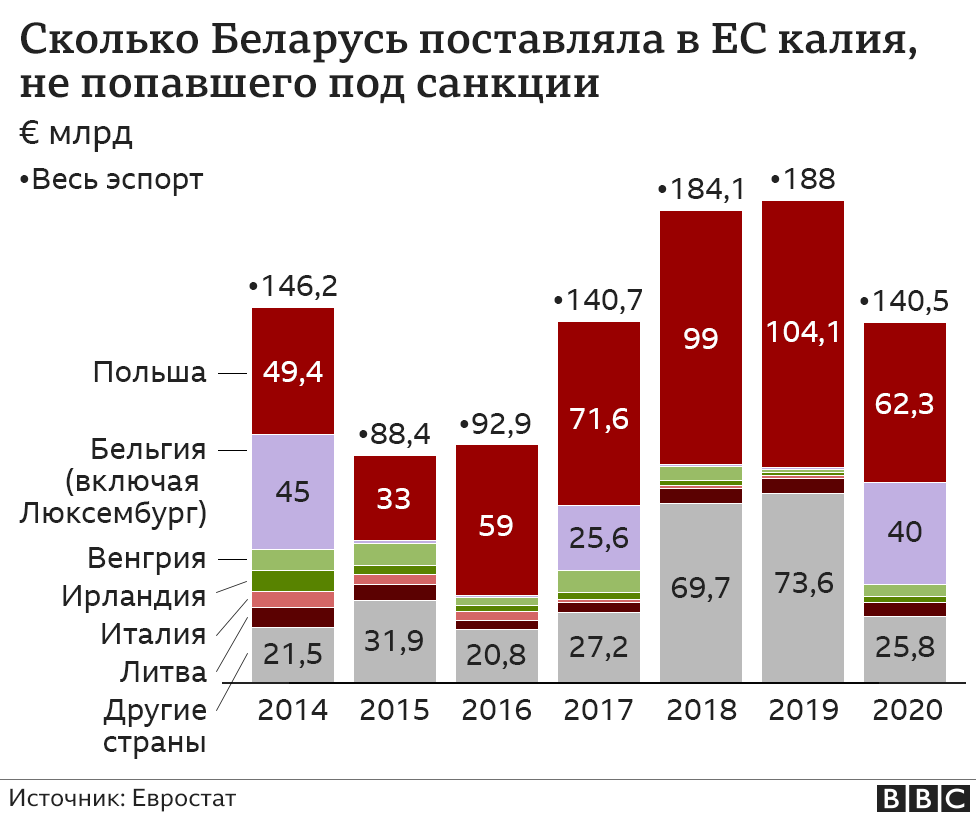
The negative consequences of the European sanctions for the Belarusian potash sector will most likely be noticeable in the second half of the year, according to S&P Global Ratings. This is because the restrictions imposed by the EU do not apply to transactions concluded before June 25, 2021. And most of the contracts for the export of potash are long-term.
US sanctions are stronger
Unlike the EU, the United States has included the Belaruskali enterprise in its sanctions lists - the US sanctions are still targeted.
On August 9, US President Joe Biden, by his decree, allowed to block any actions with structures of the defense, energy, potash, tobacco, construction, transport sectors, and state security.
In carrying out this decree, the US Treasury Department named 23 people and 21 enterprises against which sanctions are being imposed. All of them, according to the US, have become Lukashenka's "wallets."
The US authorities believe that these individuals provide funds for the "personal enrichment" of the Belarusian president and financing of his "corrupt and brutal regime." The main persons involved are Belarusian businessmen Mikhail Varabei, Aliaksei Aleksin, and Nebojsa Karic.
The US sanctions, in contrast to the European ones, were adopted with a secondary effect: one can fall under them for cooperation with a sanctioned enterprise. "This is what makes US sanctions dangerous, they are perceived as very toxic. It says that it is forbidden to help circumvent these sanctions. For example, Chinese companies are very afraid to deal with sanctioned enterprises, they are trying to avoid it in every possible way," economist Yekaterina Bornukova says.
American sanctions have already entered into force; only Belaruskali has been given a 120-day grace period - until December.
Economist Ales Alekhnovich is sure that "no one will cooperate with Belaruskali from December thanks to the US sanctions against Belaruskali": "Bypassing the sanctions through Russia, India, China will be complicated. One-day firms will have to be found. But to supply millions of tons of Belaruskali products (which sells about 10 million tons of products) to a one-day firm without the use of international logistics firms, ports, insurance is almost impossible."
Oil sanctions
A more serious blow than on the potash sector, European sanctions can inflict on oil refiners - up to $ 0.9 billion, says Sofya Donets, chief economist at Renaissance Capital. The amount of losses is comparable to 4% of Belarusian exports.
Belarus bought oil from Russia, refined it, and sold it to the EU and Ukraine. And even such oil is subject to sanctions - the EU explains that the ban is imposed not only on oil products of Belarusian origin but also on those exported from Belarus.
The main oil refineries of Belarus - the Mozyr Oil Refinery and the Navapolatsk Naftan, came under sanctions even earlier. On April 19, the US Treasury canceled the moratorium on sanctions against Belneftekhim and its seven enterprises, including Naftan, which had been in effect since October 2015, on April 19. After that, Russian companies have already halved the supply of oil to this refinery.
The sanctions of Great Britain, which accounted for about 30% of the export of Belarusian oil products, can be considered significant, Bornukova believes. Swiss sanctions are also important because there are large oil traders through whom sanctions can be circumvented.
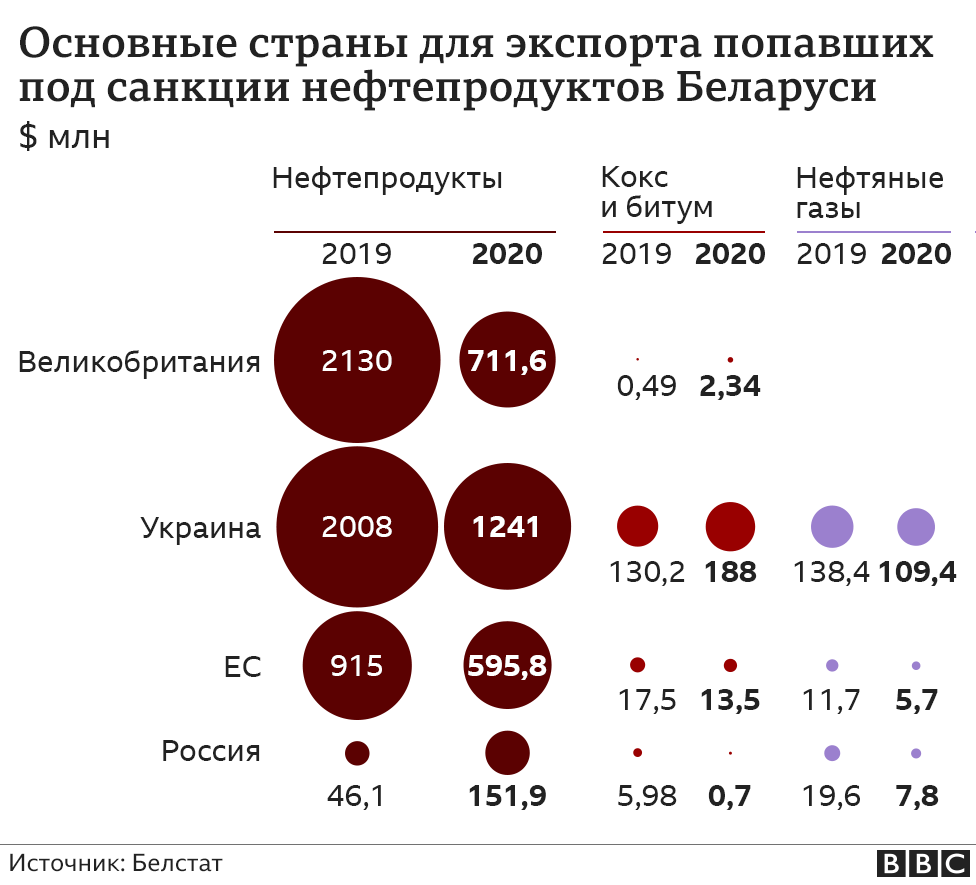
The dependence of all Belarusian exports from the EU is not as significant as that of other CIS countries but remains high - 25-28%, analysts of Loko-Invest estimate.
In 2020, the export of Belarusian goods to the EU amounted to about $ 5.5 billion. This is two times less than the amount of goods that Belarus sold in Russia.
In general, Russia accounted for about 40% of the annual Belarusian export in 2000-2018.
According to Loko-Invest's estimates, the EU's share of sanctioned Belarusian goods in 2020 was $ 1.5 billion, or 5.2% of all exports.
The general package of European restrictions on the export of petroleum products and fertilizers, together with sanctions against the main Belarusian enterprises MAZ and BELAZ, as well as the ban on flights of European airlines to Belarus, announced back in May, could cause direct damage to the Belarusian economy in 4-4.5% of GDP, as the analysts of the company Loko-Invest calculated.
And this is without taking into account the secondary negative effects associated with disruption to logistics and financial constraints.
And what about Ukraine?
In the new sanctions environment, the important question is whether Ukraine will join the sanctions, Donets said. Ukraine has 40% of the export of Belarusian oil products, which is more than the entire EU.
If Ukraine refuses to import Belarusian oil products, the total damage can be estimated from 4.5 to 7.5% of GDP, said Dmitry Polevoy, Investment Director of Loko-Invest.
At the same time, it is clear that sanctions against Belarusian oil products are not beneficial for Ukraine itself, but the political situation now is such that such decisions cannot be ruled out, Donets believes: “Earlier, Ukraine joined the ban on air travel to Belarus, although it was also not entirely beneficial for it.”
In early June, Ukraine threatened Belarus with sanctions if the Belarusian airline Belavia starts flying to Crimea. The general director of Belavia responded by saying that this decision can be made only if Belarus recognizes Crimea as a part of Russia.
It is unlikely that it will be possible to close the supply of oil products from Belarus to Ukraine because Ukraine has no better alternative, Bornukova believes: "In fact, Ukraine has three main suppliers - Belarus, potentially Russia, and Azerbaijani oil and oil products. The problem is that Azerbaijani goods are a little more expensive, and it is not a fact that they will be able to cover all needs. And Russian oil products are politically unacceptable."
The regime is getting more expensive
"Previously, Lukashenka could play on the interests of different countries. Now there is an absolute consensus of all 27 EU countries, the USA, Canada, Great Britain, Norway, and other countries that they cannot do business with this man. These sectoral sanctions show that Europeans and Americans are ready to bear some loss for their business," Alekhnovich is sure.
Economists note that the disadvantage of the Belarusian economy lies in the fact that trade relations are built in one direction, therefore, one has to rely only on the support of Russia in crisis.
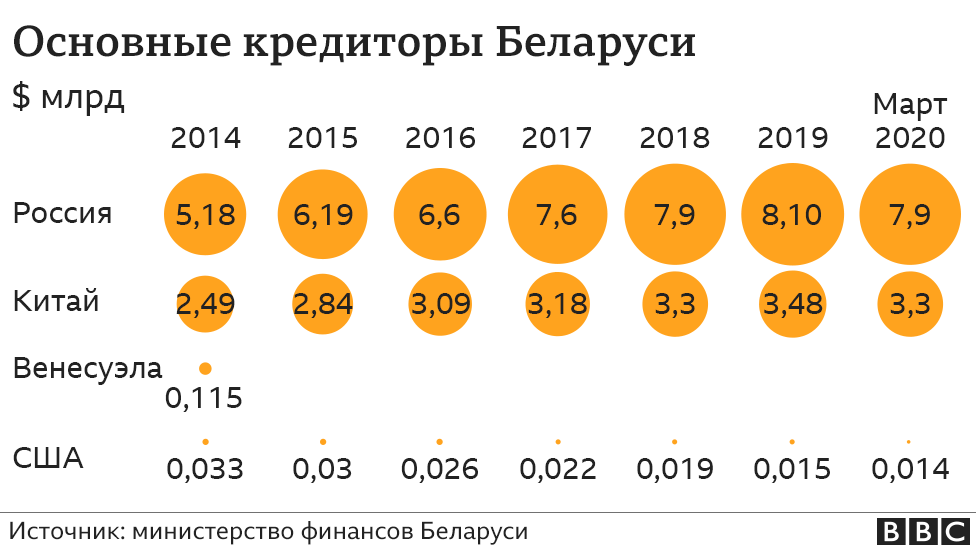
Soon after the forced landing in Minsk of a Ryanair plane with the former editor-in-chief of the Nexta Telegram channel Raman Pratasevich on board, Putin confirmed his intention to transfer the second tranche of this loan to Belarus in the amount of $ 500 million.
"These measures show that the regime is becoming more and more expensive. It is also a signal to Russia that Lukashenka is becoming more toxic and more difficult to work with," says Valery Kovalevsky, spokesman for Tsikhanouskaya's international affairs staff. "Russia can lend a shoulder to Lukashenka, but it can be very expensive."