
Large-Scale Financial Crisis Is Looming in Belarus
13- 27.08.2021, 12:29
- 35,210
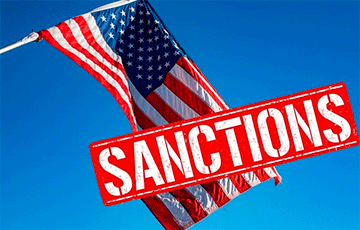
The sanctions hit the economy's most vulnerable spots.
This summer, the main economic news was related to the adoption (of various packages of sanctions against the regime in Belarus). These sanctions, depending on the scope and from which country they come from, are very heterogeneous in their impact. In an article on the website Belarusians and Market, economist Dzmitry Kruk analyzes those of them that are important on the scale of the entire economy.
Sectoral Export Sanctions and Their Potential Macro-effects
The sectoral sanctions of Great Britain and the EU concerning oil products and potash can be called a peculiar core of all the packages. By blocking some exports, they have the potential for a tangible negative effect in the form of a drop in output, income, employment, and financial destabilization. Having assessed the size of subsanctioned exports, we can then try to estimate the impact on the relevant macro-indicators as well.
In terms of scale, the EU sanctions in June can be estimated in the range from 3.5 to 7% of total exports (depending on the interpretation of the "sanctioning" of certain subgroups, primarily in the framework of potash fertilizers). The UK sanctions significantly increase the estimate of the total export shock to 10-13.5% of total exports.
For real indicators, I can offer a very simplified scheme for assessing the macro-effect from an export shock based on the macro-model. It can be expected that each percentage decline in exports over two to three quarters will lead to a decline in GDP of about 0.6%, with a comparable decline in real incomes and wages. All other things being equal, these losses could gradually be mitigated by a depreciation of the exchange rate. However, in our case, stabilization at the expense of the exchange rate is fraught with a debt crisis, and losses in output, income, employment, on the contrary, will increase with a high probability over time. The latter is because intersectoral relationships will come into play, within which the energy and potash sectors of Belarus are extremely important. Therefore, in the interval of up to ten quarters, losses from the export shock will expand, gradually reaching the ratio of 1 to 1, i.e. each percent of export decline will be fraught with a comparable sag of output and income.
Applying this scheme to assessing the scale of sectoral sanctions in the UK and the EU (based on the lower bound of the scale of the shock — 10% of total exports), we can say that, at first, the potential drop in output and income is about 6% (relative to the base trajectory). Subsequently, due to intersectoral relationships, the potential loss of output will grow, reaching about 10%.
At the same time, financial destabilization is highly likely to result from the export shock. Its intensity depends on the initial strength of financial stability and the scale of real output losses. By both criteria, the situation in Belarus looks almost deplorable. Our financial stability is already chronically fragile and periodically alternates with episodes of financial stress. The scale of the real shock mentioned above, if updated, leaves little chance of avoiding a full-scale financial crisis.
Financial sanctions and their consequences
The second most important element in the overall picture is financial sanctions (EU, UK, Canada, Switzerland). At first glance, their isolated effect is relatively modest. It can be broken down into four components: direct losses, side effects, informational effects, and lost profits.
Direct financial losses are relatively small. From the data available in the public domain, it can be assumed that the size of the potential outflow (and gradual) of funds from state banks due to the sanctions does not exceed $ 0.8 billion. With regard to the resource base of these state banks and all borrowed funds, this amount is about 3%.
Side effects are associated with the fact that, in response to the initial shock, the sanctioned banks will be forced to worsen their position in other areas. For example, to mitigate liquidity problems, interest rates on funds raised in the domestic market will be raised. We can also expect a more active "drying" of their loan portfolios and attempts to better align the active part of the balance sheet with the ongoing changes in the passive part. All this can lead to a weakening of the financial position.
The information effect suggests that many clients and counterparties of the sanctioned banks, based on a precautionary motive, will refuse to deal with them. This is fraught with a new shock on the part of depositors today. But over longer periods, this effect can lead to serious and tangible financial losses. Especially if it is amplified by the effect of foregone benefits in the form of closed access to external resources and cooperation with the world leaders of the financial industry.
The potential for financial sanctions increases when contextualized. For sanctioned banks, these effects affect the weakest points. And an additional blow, albeit light and smooth, but in the most vulnerable places, may well become a trigger for financial stress.
But the most important thing in financial sanctions is their interaction with export ones. Superimposed on output losses and financial destabilization with it, they will increase both the probability of the latter and its scale.
US sanctions and the big picture
At this stage, the US sanctions are best viewed separately, based on the country criterion. So far, they have been mainly reduced to selective in relation to individuals and companies. Their sectoral export element will be finalized and activated from December, and the financial component has not yet been practically detailed at all.
But the American part of the sanctions is important in two ways. First, by the fact that the possibility of settlements in dollars is practically blocked for sanctioned companies and sectors. Secondly, these sanctions can generate so-called spillover effects or secondary sanctions. In the practice of the United States, there are precedents when they demand and achieve compliance with the sanctions regime not only from their own residents (as well as foreign companies with subsidiaries or affiliates in the United States) but also from residents of third countries. There is no need to talk about the direct application of such a mechanism in relation to Belarus. But, taking into account or assuming it hypothetically, many companies from third countries, out of a precautionary motive, will most likely, on their own initiative, refuse to cooperate with Belarusian counterparties.
At the same time, I suppose that the refusal from transactions with goods of Belarusian origin will not be total. I think business relations will remain where transactions are economically significant for the counterparty of the Belarusian side or where there are other considerations in addition to commercial ones. For example, I doubt that the US sanctions will be a reason for Chinese and Indian counterparties to refuse to buy Belarusian potash.
On the other hand, if the United States details and introduces a financial element within the framework of its sanctions, then due to the secondary mechanism this will increase financial sanctions in the aggregate by an order of magnitude.
In the overall picture of sanctions against Belarus, the US sanctions today play the role of a kind of the cherry on the cake. They significantly reduce the possibility of avoiding export sanctions by the UK and the EU and contribute to the expansion of the application of the sanctions regime. Due to this, potential losses are increasingly likely to turn into actual ones.
Thus, the general picture today looks like this, in my opinion. The already adopted sanctions packages have a very significant potential for damage to the Belarusian economy. First, they can cause the economy to shrink to 10-13.5%. In this case, a full-scale financial crisis becomes almost inevitable (its various mechanisms are possible). Secondly, large-scale financial destabilization can be realized as a separate track, even if the losses in output and income can be stopped.