
Daniel Fried: Putin Unleashed Personal Russo-Japanese War
6- 21.10.2022, 11:04
- 19,560
Russian history shows that dictators often end up badly.
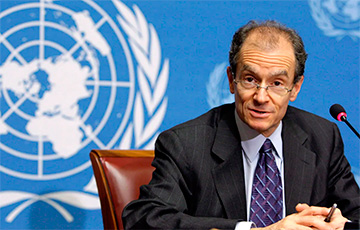
Daniel Fried, the former State Department Coordinator for Sanctions Policy, former US Ambassador to Poland, and expert at the Atlantic Council Analytical Center, said this in an interview with Charter97.org.
— Does the West have the will and ability to maintain the Ukrainian Army in the long term?
— I think the West does have the will to continue sending arms to Ukraine. I don't know what the capacity is for replenishing stocks of Soviet weapons. The Poles have done a magnificent job providing a great number of T-72 and other Soviet-era tanks. Some of these have been refurbished, so they are in pretty good shape. I consider that other countries of the former Warsaw Pact make the same for the same reason.
We have seen a Western determination to continue supporting Ukraine expressed even after Putin threatened the use of nuclear weapons. G-7, NATO, the EU and individual governments have all said that they're going to continue supporting Kyiv. In other words, Putin's attempt to intimidate the West to surrender is not working. The political will certainly is there, and it is not been crippled by Russian aggression and threats, even though there is a lively debate about it in the West.
— If Russia would go for this nuclear option, are any economic "nuclear" sanctions available in response?
— The short answer is yes, there are things we could do. The use of nuclear weapons would essentially lead to, I believe, and should lead to a full financial embargo and comprehensive, if not completely full, trade embargo with Russia as well as some other steps.
This will not be easy, and there will likely be some exceptions for medicines and food, and there must be some winding down period for certain types of energy carriers. However, we should be thinking about retaliation.
There is one important point: I don't favour holding some economic sanctions against Russia in reserve and not using them unless there's a nuclear assault, because that suggests that we're not going to push Russia as hard as we can. But as a practical matter, I think that a full financial and comprehensive trade embargo would be difficult to agree to in the West, short of Russian nuclear use.
An economic response should not be the principal response. And I think the United States government (and I don't have any special inside or confidential information) has been considering its options and discussing them with the Europeans and others. That is why you've seen such strong statements. . I think it's not hard to tell at least indirectly that we are serious about a strong response.
By the way, I don't think it is likely that Putin will use nuclear weapons. I think rather, he is trying to intimidate us into abandoning Ukraine. But it doesn't matter what I think. If I were in government, I would be planning for all contingencies whether I found them likely or not.
— How long can Russia sustain this rate of the expenditure given the scale of this war? Do they have an economic "safety cushion"?
— I don't know what Russian military stockpiles look like. And I suspect that those are highly guarded secrets within Russia. However, I have seen plenty of credible western analyses that the Russians are running low on all kinds of equipment. And there's plenty of anecdotal evidence and second-order evidence that this is the case.
After all, it shouldn't be a surprise. A country's military, to some degree, reflects that country's society and political and economic system. And in Putin's political and economic system everyone lies and everyone steals from top to bottom. So, is it any surprise that the Russian military was stripped of a lot of assets? This is a combination of Soviet lies and tsarist incompetence.
The scenes we see of Russian soldiers newly drafted apparently without modern weapons and without food remind us of 1905 or 1917.
I don't want to suggest that the Russian military has exhausted its potential. But it does not seem as if they have massive reserves — they don't act like it. Their lashing-out against Ukraine appears to be more desperate than confident.
It's not to say that Ukrainian victory is inevitable — nothing is inevitable. I'm not saying the Ukrainians will suddenly mount such a successful counteroffensive that they will drive the Russians out of right-bank Ukraine. But it is also true that ever since the beginning of the war, the Ukrainian military has done better than expected and the Russian military has done worse than expected (if you regard Western experts as setting the expectations).
— How does the mobilization affect the Russian economy at large?
— I'm not sure of the reliability of the numbers, but let's say that several hundred thousand young Russian men, prime working age, have fled the country. Russia's population is not that great, and the population of young people in very productive years is not infinite. So, run the numbers: that is a significant portion of the working-age population.
I don't know what effect it will have and what occupations they were leaving, but generally the stories suggest that these are educated people. A combination of financial sanctions, export controls, young people fleeing, corruption and, I would say, repression as a general rule are a drag on the Russian economy. And that drag, I suspect, will be similar to what we saw with the late Soviet economy. I'm not predicting that the Russian economy will collapse — the numbers don't suggest that. But they do suggest a general deterioration — there's plenty of evidence for that.
Putinism no longer looks like the wave of the future. Putin and others were speaking of their authoritarian model the way fascists spoke in the 1930s: the wave of the future against the decadent weak and confused democracies. Well, we know how that turned out: badly for everybody and worse for the fascists. But I hope to avoid a general war.
— Lukashenka regime is a co-aggressor in Ukraine alongside Russia. Should there be a parity in the sanction pressure on the both, aggressor and co-aggressor?
— If I were in the government in my old job as sanctions coordinator, I would be preparing a set of sanctions against Belarus should they enter the war more directly. The regime is already culpable: they've let their territory be used by the Russians for aggression against their neighbor.
Whether the Belarusian army enters Ukraine and starts fighting? I think that Lukashenka would prefer to avoid that. I don't think that such a war would be popular in Belarus, to put it mildly. But I think, nevertheless, even if the chances that Lukashenka joins Putin's war are small, we should be preparing for the sanctions and letting him know that we will hit. Of course, we should be doing that in coordination with the European Union and with the individual member states who know the situation best.
— You've mentioned that the Russian economy is unlikely to collapse the way the USSR economy did. But will this war affect Putin's rule? How do you see the demise of Putin?
— Predictions are dangerous, usually foolish. But it is true that dictators who start wars they cannot win, often end up badly — that's Russian history. This is not World War II. It's more like the Russo-Japanese war or it could get there (we don't know).
I think it is also a mistake to assume continuity in Russia (it could be — Putin has been in power for 22 years), but if you look at the last 40 years of Russian history, it is marked by discontinuities: Brezhnev to Gorbachev, Gorbachev to Yeltsin, the fall of the Soviet Union, Yeltsin and Putin — these are huge breaks.
The Putin system is under pressure: it has started a war it cannot win, or, at least, doesn't seem able to win. Economic pressure, international isolation, young Russian men being killed (sometimes, a couple of weeks after being mobilized; sometimes) — this doesn't look like a formula for success.
I'm not predicting any particular end for Putin — who knows? Regime change is not the US policy, and it should not be the US policy. Regime change may be a bonus, but it shouldn't be policy. We have to assume that we are going to be dealing with Putin for a while. We don't have to like it (it doesn't matter what we like).
But we should in no way use the possible reality of Putin's continued rule as an excuse to abandon Ukraine. There are many in the West, including, I regret to say, in my own country, that argue that we ought to simply allow Putin to seize Ukrainian territory because Ukraine cannot win this war, they say, and because Ukraine is not worth it, in their view. These people regard Russia as a great power and apply special rules to the great power. They call it "realism" but I think it is power worship. In any event, it is not even respect of power realities, because the power realities are that Ukraine is winning on the battlefield, and Russia is not.
I don't know how the war ends and the Biden administration wisely has not rejected negotiations. Neither do I, but I don't like negotiations from a position of weakness or based on Putin's terms. If there are going to be negotiations, let them be from our terms.
A colleague of mine said, "If Russia proposes a ceasefire, Ukraine should accept and add that we will agree to a ceasefire … while you withdraw."

Bank's name: Bank Millennium S.A.
Address: ul. Stanislawa Zaryna, 2A, 02-593, Warszawa
IBAN: PL97116022020000000216711123
SWIFT: BIGBPLPW
Name of the account holder: Fundacja “KARTA ‘97”
Purpose/title of payment: Donation for statuary aims
You can contact us by the e-mail charter97@gmail.com