Lukashenko's Ice Fever
13- 10.10.2026, 18:50
- 12,752
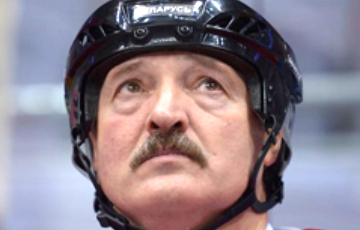
The more arenas there were, the worse the Belarusian hockey players performed.
Today I want to talk about the history of Belarusian megaprojects.
The Egyptian pharaohs built pyramids, the kings of the East built mausoleums, and the Roman emperors built palaces.
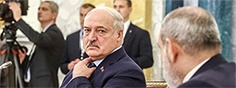
Alexander Lukashenko also really wants to leave his mark on history. And most importantly, with a single stroke of his pen, he wants to instantly solve all of Belarus’s economic problems.
That is why the Belarusian authorities, time and time again, set out to bring their mega-ideas to life. Although the outcome is always the same.
“All the investment projects the government takes on perform abysmally. It has become the norm to make grand promises and then ask for a one-year extension—or even several years,” Lukashenko said at a government meeting in 2018.
However, Alexander Lukashenko’s first mega-project had nothing to do with the economy. I mean, in the ’90s, during the first seven years of Lukashenko’s rule, the Belarusian economy was quietly sliding into the abyss.
So the main idea was to figure out where to scrape together a little money.
Hence all these attempts to monetize “brotherly love” with Russia through the smuggling of vodka and cigarettes into Russia, which I discussed in a program that aired on our channel last December.
Not a mausoleum, but a monument nonetheless
But after the year 2000, oil prices began to rise, and Lukashenko managed to latch onto these cash flows, getting his own little slice of the pie. And along with this “wild money,” as Lukashenko puts it, came an irresistible urge to put that money to some use.
Well, if you already have everything you need but suddenly find yourself with extra money, what would you spend it on? You’d spend it on some innocent hobby. That’s exactly what Lukashenko did.
Starting in 2000, Belarus saw the beginning of real boom in the construction of ice palaces. Over the course of ten years, about one and a half dozen were built in the country. Over the next few years, five more such facilities were built in the country.
It all started modestly. In 2000, ice arenas, or simply sports arenas, were built in Gomel, Mogilev, and Brest, each with a capacity of 2,000 to 3,000 people.
Gradually, the scale of the projects grew.
All officials knew: if you want to please Lukashenko, build him an ice arena. This is exactly what the then-head of the National Bank Pyotr Prokopovich did; it was on his initiative that an ice arena was built in his hometown of Pruzhany, a city with a population of 18,000.
Well, the head of the National Bank could afford it.
The most grandiose monument to this “palace fever” was the Minsk Arena complex, which officially opened in 2010. It seats 15,000 spectators.
Initially, the construction cost was estimated at $105 million. Along the way, the cost ballooned threefold. In the end, the arena cost at least $350 million.
Expensive Fever
In total, Lukashenko’s “palace fever” cost the country one hundred million dollars. Although these figures are most likely incomplete.
“Any insinuations that the president has built too many of these ice palaces are nonsense—we built them for the people,” Lukashenko said in 2017, when the ice palace craze had generally come to an end.
The ungrateful people, however, did not appreciate this effort. Over a quarter-century, not a single one of these facilities has paid for itself. Literally only two or three—and we’re talking about small complexes—cover their operating costs.
The revenues from all the others cover between 10 and, at best, 40 percent of current expenses.
At the same time, these maintenance costs alone amount to tens of millions of dollars a year. Even small regional complexes pay 20,000–30,000 just in utility bills each month,
and that’s at discounted rates. Not to mention Minsk Arena, which pays bills running into the millions every year.
The “arena fever” didn’t subside until the mid-2010s. Perhaps the final high-profile chapter was the construction of the Chizhovka Arena complex in 2014, which cost $190 million.
And as we know, despite having a record number of arenas per capita, Belarus never became a major hockey powerhouse.
The last major success for Belarusian hockey came in 2002, when, thanks to a shot by Vladimir Kopat against the Swedish national team, the Belarusian team advanced to the semifinals of the Olympic Games.
And then an interesting pattern emerged: the more arenas there were, the worse the Belarusian hockey players performed.
Alexei Mazartov, “Belarusians and the Market”

Bank's name: Bank Millennium S.A.
Address: ul. Stanislawa Zaryna, 2A, 02-593, Warszawa
IBAN: PL97116022020000000216711123
SWIFT: BIGBPLPW
Name of the account holder: Fundacja “KARTA ‘97”
Purpose/title of payment: Donation for statuary aims
You can contact us by the e-mail charter97@gmail.com