
Sovereign And Vassal
2- 3.10.2026, 16:12
Why Lukashenko Can't Turn His Back on Russia.
People often ask a rather naive question: Could Lukashenko change his mind on the fly, abandon Russia, and flee to the West? If you know anything about politics, the only realistic answer is “no.” Lukashenko may try to play some petty games with the West, but at the first real threat to his power, he’ll run to Russia to seek refuge. Just as he did in 2020.
Recently, Alexander Lukashenko once again swore his loyalty to Russia. This took place on September 29 during a meeting with the governor of Russia’s Ulyanovsk Oblast Alexey Russkikh. Lukashenko emphasized that Belarus’s policy of “multi-vectorism” in no way distances the country from Russia.
“This has nothing to do with our deep-rooted relations, first and foremost with you, the Russian Federation. Therefore, all this talk about this ‘multi-vector’ policy and the accusations leveled at Lukashenko are completely incompatible. Besides, I’ve been serving as president for over thirty years now. It’s not up to me to change any of these vectors now. Some have even gone so far as to say that ‘Lukashenko is not an ally.’ Well, that’s a matter of taste. For now, we (and I think this will continue to be the case) are on the same page with the leadership of the Russian Federation.”
Elocquent, isn’t it? In fact, he was justifying himself to some unnamed Russian bloggers who had accused him of nothing short of treason. That’s why he went on to say that “there is no treason, nor should there ever be.” I could cite hundreds of such statements in which Lukashenko swears his utmost loyalty to his “elder brother.”
You know what I’ve noticed over all these years? This is quite a traditional pattern for the Belarusian dictator. As soon as he or his officials take even the most modest steps toward the West—after even the most cautious attempt at normalizing relations with “Western partners”—Lukashenko invariably feels compelled to make a statement that is as pro-Russian as possible. So that Moscow, God forbid, doesn’t get suspicious and label him a “traitor.”
And while Lukashenko makes excuses, Moscow, through the mouth of a low-level official, says that he’s one of ours and isn’t going anywhere. Alexei Polishchuk, Director of the Second Department for CIS Countries at the Russian Ministry of Foreign Affairs , stated that Belarus is conducting negotiations with the U.S. based on the goals of “alliance integration with Russia.”
“Our Belarusian friends have always emphasized that contacts with the West are possible only on the basis of equality and mutual respect, with unconditional respect for national interests and the goals of union integration with Russia,” – said Alexei Polishchuk in an interview with the Russian news agency “Interfax.”
The Russian Foreign Ministry spokesperson noted that these principles are enshrined in the union program of coordinated actions in the field of foreign policy, the next version of which, covering the next three years, will be approved in November at a joint meeting of the collegiums of the foreign ministries of Belarus and Russia.
Just imagine the irony of the situation! Such a low-level official—the director of the Second Department for CIS Countries at the Russian Ministry of Foreign Affairs—is condescendingly commenting on Lukashenko’s policies, saying, “Don’t worry; everything he does with the Americans is to our advantage, to Moscow’s advantage.”
A third-tier clerk is effectively telling Lukashenko how to behave so as not to anger the Kremlin. This eloquently demonstrates the relationship that has developed since 2020 between Moscow and Minsk—a relationship of suzerain and vassal.
But things used to be very different. Lukashenko used to get into scandals; there were gas and milk wars, and personal conflicts broke out. Incidentally, relations traditionally became sharply strained during election years in Belarus.
Here’s what then-Russian President Dmitry Medvedev (remember him?) said about relations with the Belarusian government in November 2010, a month before the presidential election:
“The election campaign there is entirely built on anti-Russian narratives, on hysterical accusations that Russia is unwilling to support Belarusians and the Belarusian economy, and on curses directed at the Russian leadership. Behind all this lies a clear desire to drive a wedge between the states—and, consequently, their peoples. The Belarusian leadership has always been characterized by a desire to create an image of an external enemy in the public consciousness. Only previously, this role was played by America, Europe, and the West as a whole. Now, Russia has been declared one of the main enemies.”
Furthermore, in that same speech, Medvedev stated that Lukashenko, within the very first minutes of their private conversation, began speaking negatively and disparaging Russia’s former leaders—Yeltsin and Putin.
It’s hard to imagine that such a thing could have happened—especially given what former Russian President Medvedev himself has become. But there was the Russian gas cutoff, the “Godfather” series on the Russian channel NTV, and the milk wars. As well as the Minsk Agreements, the non-recognition of North Ossetia, the non-recognition of the annexation of Crimea, attempts to purchase Venezuelan and American oil, excellent political relations with Ukrainian presidents, and even the refusal to host a Russian airbase in Belarus, and a meeting in Minsk with U.S. Secretary of State Mike Pompeo.
But even during the most intense clashes with Moscow, Lukashenko, I am convinced, never truly intended to distance himself from Russia. All of Lukashenko’s previous maneuvers with the West, I am convinced, were not a genuine “change of allegiance,” but rather tactical moves to increase his leverage with Moscow. “Pay me more, or I’ll run off to the West,” Lukashenko seemed to be saying.
Therefore, when people ask—both ten years ago and now—whether Lukashenko might switch sides mid-flight, change his pro-Russian orientation, and switch to the West, my answer is unequivocal, both then and now: no.
How can a man turn his back on Russia when, year after year, he utters words that every honest Belarusian finds repulsive to hear:
“As a Soviet man, I find it hard to say—Russians, Belarusians. We’re essentially one people.”
But that’s all just rhetoric. The issue here, of course, isn’t about any firm moral or political principles this man holds—he has proven time and again through his life story that, if it suits him, he can abandon any principle.
There are a number of economic, political, personnel, ideological, and even psychological reasons at play here.
First, Belarus’s economy is now more deeply integrated into Russia’s than ever before. Currently, about 67% of Belarus’s foreign trade goes there, and even more flows through Russia further east to China and Kazakhstan, which, together with Russia, are among Belarus’s top five trading partners.
Second, the West does not trust Lukashenko, who has burned many bridges due to human rights violations, repression, and most importantly—effectively became a co-aggressor during Russia’s large-scale attack on Ukraine, while Belarusian industry is increasingly supporting the Russian defense sector.
Third, any real shift toward the West would require concessions that would threaten the foundations of his power (the release of political prisoners, the holding of free elections, and an independent press).
Fourth, any hint of a pro-Western shift is dangerous for Lukashenko’s inner circle, which consists of security officials (for whom only The Hague awaits in the West) and oligarchs: they have absolutely no need for transparent and competitive business.
Given the level of dependence on Russia that Alexander Lukashenko has created for himself over many years (and into which he fell particularly deeply after August 2020, when Moscow alone—like that egg in the fairy tale—held the salvation for his regime), he no longer has any real opportunity to change course, even if he wanted to. And it seems he does want to—but in reality, he has no chance of doing anything concrete here.
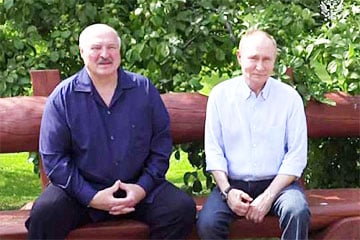
Lukashenko may try to play some games with the West, but at the first real threat to his power, he’ll run to Russia to beg for salvation. Just as he did in 2020. As long as Putin is in Moscow and Lukashenko is in Minsk, these two are “bound by a single chain, united by a single goal.”
Vitaly Tsygankov, “Belsat”

Bank's name: Bank Millennium S.A.
Address: ul. Stanislawa Zaryna, 2A, 02-593, Warszawa
IBAN: PL97116022020000000216711123
SWIFT: BIGBPLPW
Name of the account holder: Fundacja “KARTA ‘97”
Purpose/title of payment: Donation for statuary aims
You can contact us by the e-mail charter97@gmail.com