

Talks In Abu Dhabi: Initial Statements From Ukraine, The U.S., And Russia
- 11.11.2026, 17:10
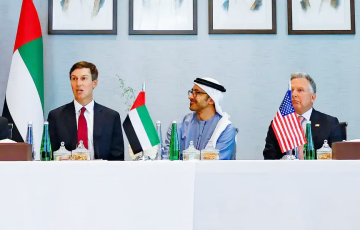
Representatives from Ukraine, the U.S., and Russia at talks in Abu Dhabi
Trump's envoys will travel to meet with Putin and Zelensky.
Following two days of talks between Ukraine, the U.S., and Russia in Abu Dhabi on November 10–11, the parties announced their initial conclusions. Among the key points was an agreement on a new large-scale prisoner exchange and the possible continuation of talks following the Americans’ visit to Moscow.
RBC-Ukraine has compiled the key statements from representatives of Ukraine, the U.S., and Russia.
Ukraine
On the next possible round of talks
According to a member of the Ukrainian negotiating delegation, the head of the “Servant of the People” faction David Arakhamia, U.S. presidential envoys Steve Whitcoff and Jared Kushner will travel to Moscow to meet with Putin and then meet with Zelenskyy in Dublin. After that, a date for a new round of negotiations should be set.
“We have good momentum to find a solution by the new year,” he said.
Why the Negotiations Were Tough
Arakhamia attributed this to the Russian delegation’s stance.
“The negotiations were tough because they (the Russians—Ed.) came with very strict directives that left no room for ‘bargaining,’” he said.
Three outcomes of the meetings
According to Arakhamia, these are:
the possibility of setting a date for the next meeting following Whitcoff and Kushner’s visit to Moscow;
an agreement to involve Europeans in the negotiation process;
discussions on humanitarian issues.
Arakhamia also noted that Ukraine is particularly vulnerable this winter due to a shortage of interceptor missiles. At the same time, the country knows how to get through the winter. But both within and outside the team, there is hope that everything will be resolved by the new year. However, no one knows (how things will turn out).
On Russia’s Demands Regarding Donbas
A member of the Ukrainian negotiating delegation and head of the Presidential Office Kirill Budanov declined to disclose whether the Russian side insisted on the withdrawal of Ukrainian troops from Donbas.
“Any issue raised during negotiations is a matter for the negotiations. Only the result matters. When we achieve it, it will be publicly announced,” he said.
On ultimatums
A member of the Ukrainian negotiating team, First Deputy Head of the Presidential Office Serhiy Kislitsa, emphasized that during the meetings there were no ultimatums from any of the parties (namely Ukraine, the U.S., and Europe).
“I didn’t hear any ultimatums—neither from the U.S., nor from Europe, nor from Ukraine. This is very important. Because the media often reports on ultimatums, but neither today nor yesterday did I hear any ultimatums,” he said.
U.S.
On the meeting with Putin and Zelenskyy
Kushner announced that tomorrow, November 12, he will travel to Moscow with Whitcoff to meet with Vladimir Putin. After that, the American representatives will travel to Dublin to speak with Volodymyr Zelenskyy.
Kushner expressed hope for a successful meeting with Putin and further progress in the negotiations.
On Involving Europe
Kushner stated that the presence of EU and NATO representatives in Abu Dhabi was important and helpful.
“We must have Europe at the negotiating table,” he emphasized.
At the same time, the U.S. representative noted that Europe should designate a single person to participate in the negotiations, since it brings together different countries with different views and interests.
According to Kushner, the U.S. explained to the Russian side that it can discuss its concerns and demands, but at the same time must take steps to de-escalate the situation and put forward its own proposals.
On a possible meeting between Zelenskyy and Putin
Kushner said, “It would be good if they met at any time.” However, according to the U.S. special envoy, “Russia wants to see more progress” in the negotiations before such a meeting takes place. He also noted that there is not much trust between the leaders.
According to him, the parties already see various components of a potential peace agreement but must determine how to bring them together into a single framework. Final decisions can only be made by the leaders.
On Territories and Security Guarantees
Kushner called territorial issues the most difficult part of the negotiations.
He noted that it is impossible to implement initiatives on the post-war world order until the territorial issue is resolved.
“The main issue is the post-war peace settlement, security guarantees for Ukraine, and preventing a new war,” Trump’s special envoy stated.
On the prisoner exchange
Kushner reported that the exact details of a large-scale prisoner exchange are to be determined the following day, November 12.
Russia
On the Results of the Talks
The head of the Russian delegation, Vladimir Medinsky, stated that the parties exchanged views: on some issues, they managed to reach an understanding; on others, they did not.
According to him, the central topic of the meetings was the European security system. The Russian side considers it “the right way to frame the question of what security will look like after the war in Ukraine ends.”
Medinsky also stated that the Russian delegation did not interact with the European representatives present in Abu Dhabi, as Moscow “does not understand their status.”
On a New Prisoner Exchange
Medinsky also confirmed that Russia and Ukraine have agreed on a new large-scale exchange of prisoners of war. Specific details, he said, will be provided later.
At the same time, the first deputy head of the Information Directorate of the General Staff of the Russian Federation Alexander Zorin, who also participated in the negotiations, clarified that the exchange could take place within the next two to three weeks. According to him, it will be one of the largest exchanges to date.
ON NATO
Medinsky reiterated Russia’s demand that NATO return to its 1997 borders.
“The issue of the need to create a new security system in Europe has been raised by Russia more than once—both in 2008 and in 2021, when we sent the relevant documents to NATO, the U.S., and European countries,” he said.
As a reminder, these are the demands Moscow put forward during negotiations with U.S. President Joe Biden in December 2021.
Russia demanded, in particular, that NATO refrain from further expansion, reduce the Alliance’s military presence in countries that joined after 1997, and limit military cooperation with post-Soviet states outside NATO, specifically Ukraine.

Bank's name: Bank Millennium S.A.
Address: ul. Stanislawa Zaryna, 2A, 02-593, Warszawa
IBAN: PL97116022020000000216711123
SWIFT: BIGBPLPW
Name of the account holder: Fundacja “KARTA ‘97”
Purpose/title of payment: Donation for statuary aims
You can contact us by the e-mail charter97@gmail.com