


A Ukrainian Navy Captain Described What Fate Awaits Russia's Baltic Fleet
- 24.11.2026, 17:37
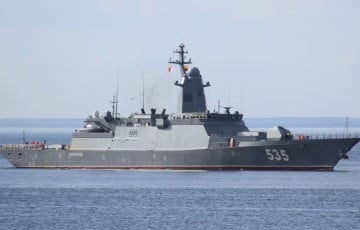
Russian ships risk being trapped in their bases.
In recent weeks, Ukraine has carried out a series of strikes against Russian ships in the Baltic and Mediterranean Seas. In Benghazi the corvette "Mercury" was destroyed, and in the Baltic the "Naro-Fominsk" and the "Sparta II" were struck.
What do these attacks mean for the Russian Navy and its military logistics? The website Charter97.org discussed this with Captain 1st Rank of the Ukrainian Navy and head of military programs at the “Strategy XXI” Center for Global Studies Pavlo Lakiychuk, head of military programs at the “Strategy XXI” Center for Global Studies.
The “Merkury” became yet another loss for the Russian Navy
— How did Ukraine manage to strike and sink the corvette “Merkury” in Benghazi? After all, it’s a fairly new and well-protected ship.
— With unmanned systems. How do you actually hit a ship? It has defenses, of course. But the missiles used to strike ships are also relatively small, yet deadly. The same goes for torpedoes. An attack marine drone is, in essence, the same as a surface-to-surface torpedo.
Today, a ship—especially in confined waters—becomes a very conspicuous and vulnerable target. In this case, Ukrainian marine drones located and struck that target. As for the loss itself, this is yet another Russian ship that Russia has lost during the war. Before this, there were the cruisers “Moscow,” “Saratov,” “Caesar Kunikov,” and others. Now the “Mercury” has been added to that list.
There’s an interesting detail here. The “Mercury” belongs to the Black Sea Fleet, even though it has never once been in the Black Sea. And it was destroyed by Ukrainian naval drones in the Mediterranean Sea.
— In the Baltic Sea, the “Naro-Fominsk” and “Sparta II” were struck. Could the Baltic Fleet ultimately suffer the same fate as the Black Sea Fleet and be forced to hide in its bases?
— It could. If the Baltic Sea becomes a combat zone, ships will indeed be forced to spend more time in their bases.
A modern fleet in an enclosed sea is generally very vulnerable. We’ve already seen this with Russia’s Black Sea Fleet. According to the original plan, it was supposed to blockade the Ukrainian coast, ensure dominance in the Black Sea, support ground forces, and participate in amphibious operations.
In the end, of all these tasks, it has effectively retained the ability only to carry out isolated missile strikes. Everything else has either been thwarted or severely limited.
The situation with the Baltic Fleet is, in some respects, even more complicated. It is smaller than the Black Sea Fleet and is largely concentrated in the Kaliningrad Oblast, primarily in Baltiysk. The air force is also stationed there. This means that the main forces are concentrated in an exclave and cut off from normal logistical support.
Therefore, in the event of a serious conflict in the Baltic region, this fleet could find itself in a very difficult position and, in many ways, repeat the fate of the Black Sea Fleet.
Russian naval logistics have also come under attack
— What do the attacks in the Baltic and Mediterranean Seas mean overall? To what extent could they affect Russian military logistics?
— It’s important to understand the difference here. The Black and Baltic Seas are enclosed seas where Russia has its own bases. The Mediterranean Sea is a much more remote area, and there the Russian fleet is far more dependent on its system of basing, repair, and resupply.
The Soviet Union once attempted to create an entire network of logistical support points. Tartus, Syria, remained the last remnant of this system for Russia. But even that, by and large, did not provide adequate basing for a large naval group.
When Russia began to deploy forces more actively in the Mediterranean, it quickly became clear that ships alone were not enough. A permanent system of supply, repair, and basing is needed. This is precisely why ties with forces in Libya are so important to Russia. This is necessary both for the presence of the “African Corps” and for resupply, as well as to serve as a base for the Russian Navy in the Mediterranean Sea. Now this very system is coming under attack.
Russian military cargo ships sail from Baltiysk and Murmansk through the Baltic and North Seas, the English Channel, the Bay of Biscay, and the Strait of Gibraltar, and on into the Mediterranean Sea. Russia has already been forced to escort some of these ships with warships. Now, both the transport ships themselves and the ships escorting them are being targeted. This is already placing an additional strain on Russia’s entire maritime logistics system.
As for the *Mercury*, this Russian warship—a vessel of the aggressor state—was struck by a Ukrainian maritime drone off the Libyan coast and destroyed.
We are at war with Russia. Therefore, a Russian warship can be struck not only in the Black Sea. This could happen in the Mediterranean, the Atlantic, the Indian Ocean, in Vladivostok, or in Kamchatka. Given the circumstances of this war, this is entirely to be expected.

Bank's name: Bank Millennium S.A.
Address: ul. Stanislawa Zaryna, 2A, 02-593, Warszawa
IBAN: PL97116022020000000216711123
SWIFT: BIGBPLPW
Name of the account holder: Fundacja “KARTA ‘97”
Purpose/title of payment: Donation for statuary aims
You can contact us by the e-mail charter97@gmail.com