
The WSJ Learned Of The “urgent Matter” That Prompted Stubb And Støre To Call Putin
- 25.11.2026, 19:21
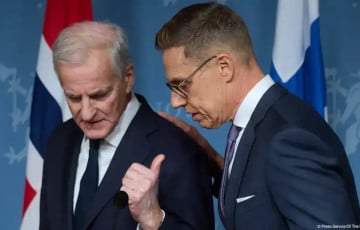
Photo: Press Service of the President of Ukraine/SvenSimon/IMAGO
The conversation took place on October 27.
Finnish President Alexander Stubb and Norwegian Prime Minister Jonas Gar Støre called Russian dictator Vladimir Putin not only to discuss a resolution to Russia’s war in Ukraine, writes The Wall Street Journal reports, citing sources. According to the newspaper, they had another “urgent task—to prevent a conflict with Russia in their own region.”
On October 27, Putin held a phone conversation with Støre and Stubb—at the initiative of the Norwegian and Finnish sides. The conversation lasted 90 minutes. The Kremlin reported that the parties welcomed the agreement to resume trilateral talks on Ukraine and agreed to continue their dialogue.
According to the WSJ, Stubb and Støre initiated this conversation in order to “ease tensions,” assuring Putin that they had no intention of “blocking a maritime trade route vital to Moscow”—the Baltic Sea.
Prior to the call, officials had already attempted to convey this position through diplomatic channels, but Stubb doubted that the message would reach Putin without being distorted, the WSJ reports. Therefore, Helsinki and Oslo decided to enlist an informal mediator in the form of a certain “Russian businessman,” whose name the publication does not disclose. According to sources, it was this individual who traveled to Norway for consultations with high-ranking officials, after which he returned to Moscow to deliver the message to Putin.
Several factors have caused concern among the leaders of Finland and Norway, the WSJ notes—in particular, the escalating situation surrounding the potential threat of isolating the Kaliningrad region. Another source of tension in the Baltic region is the interception of tankers by the “shadow fleet,” the WSJ reports. Moscow, the publication writes, has begun using military ships to escort merchant vessels, as previously reported by Nikolai Patrushev , an aide to the Russian president and chairman of the Maritime Collegium .
For example, last summer, when environmental activists came dangerously close to a tanker in the Baltic Sea, a corvette from the Russian Baltic Fleet—which was escorting the vessel at the time—had to intervene. It contacted a nearby German coast guard vessel and demanded an explanation. According to sources who spoke with the WSJ, the German captain later reported that the incident posed “a high risk of escalation.”
In mid-September, the Russian Ministry of Defense reported another incident in international waters in the Baltic Sea. A Danish Fennec helicopter approached a Russian corvette, hovered at an altitude of less than 50 meters, and did not respond to calls on the international communication channel. The ship’s commander ordered two red signal flares to be fired to prevent provocation. The Danish Defense Command stated that the helicopter was conducting “routine aerial photography” of the Russian vessel, and that one of the flares passed in close proximity to the aircraft.
NATO has repeatedly expressed concerns about a possible conflict with Russia. The Kremlin has emphasized that Russia does not pose a threat to European countries and that it has no grounds for a conflict with Europe.

Bank's name: Bank Millennium S.A.
Address: ul. Stanislawa Zaryna, 2A, 02-593, Warszawa
IBAN: PL97116022020000000216711123
SWIFT: BIGBPLPW
Name of the account holder: Fundacja “KARTA ‘97”
Purpose/title of payment: Donation for statuary aims
You can contact us by the e-mail charter97@gmail.com