

ISW: Russia Is Unable To Defend Itself Against Ukrainian Strikes
1- 6.05.2026, 10:10
- 1,360
Analysts explained what was behind the Kremlin's words on the eve of May 9.
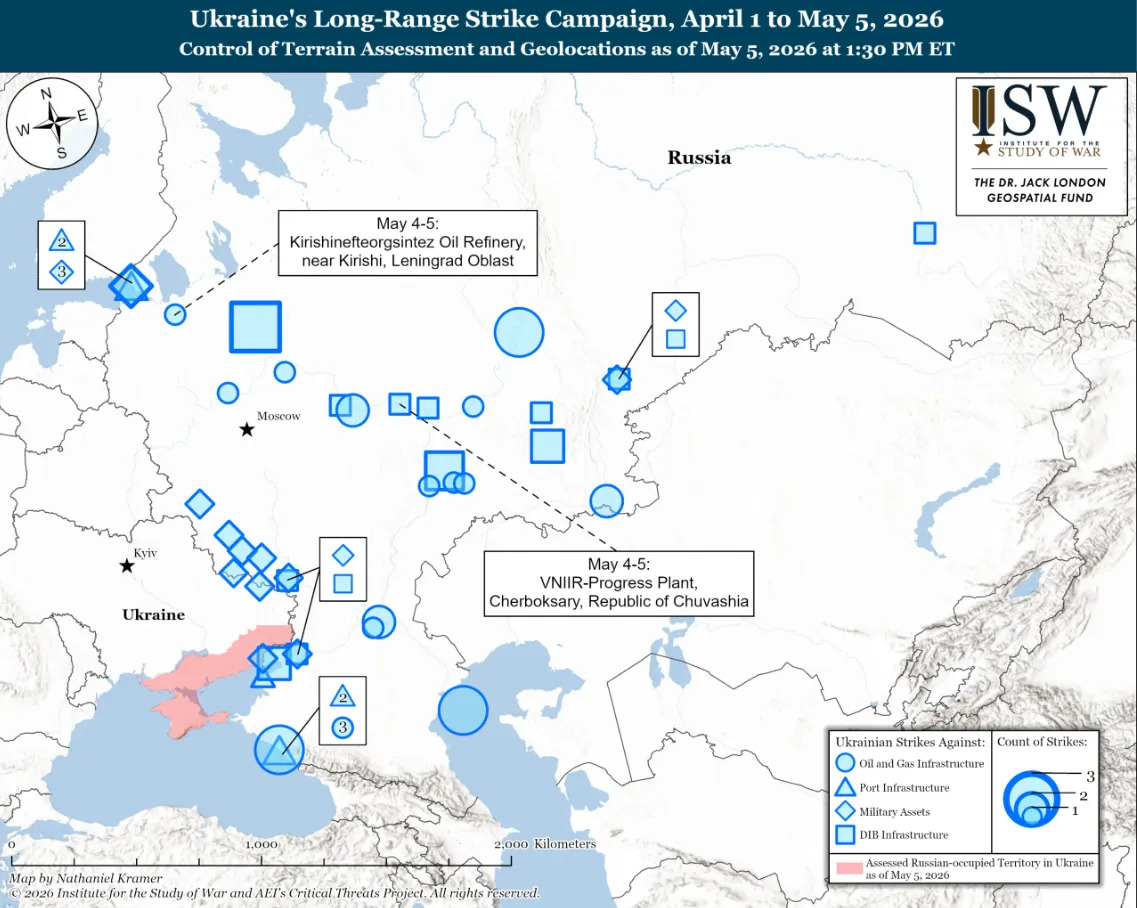
Ukraine is not only continuing but also stepping up strikes on important targets deep behind the Russian Federation's lines - hundreds or more than a thousand kilometers from the Ukrainian border. The latest attacks include strikes on the Kirishi oil refinery in Kirishi, which is one of the three largest in Russia, and an important plant for the Russian defense industry.
These strikes, as well as the hysteria with which Russia is trying to achieve a ceasefire on May 9, when a military parade will be held in Moscow, is evidence of the inability of the aggressor, who started the war, to defend itself from retaliatory strikes. This is according to the Institute for the Study of War (ISW).
Russia is unable to defend itself against Ukrainian diplostrikes
On the night of May 5, the Defense Forces struck the Kirishinefteorgsintez oil refinery in Russia's Leningrad region and the VNIIR-Progress plant in Russia's Chuvashia. The latter produces receivers and antennas for the GLONASS, GPS and Galileo systems, as well as REB-resistant Kometa navigation components that Russia uses in various drones and long-range missiles.
Ukrainian President Vladimir Zelensky said Ukrainian forces used F-5 Flamingo missiles that hit a target in Cheboksary more than 1,500 kilometers from the Ukrainian border. And geolocation footage recorded the plant being hit by six missiles and an An-196 Lyuty drone.
"Cheboksary is just 300 kilometers from the Alabuga special economic zone, a large Russian industrial and manufacturing zone in the Republic of Tatarstan, where Russia produces many of the long-range Shahed-type drones it launches across Ukraine," the analysts added.
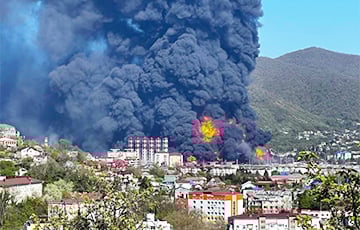
In the meantime, Leningrad Region Governor Alexander Drozdenko confirmed after the overnight attack that there was a fire in Kirishi, and NASA's FIRMS system detected thermal anomalies near the Kirishi refinery, which is one of Russia's three largest and can process up to 21 million tons of oil in a year.
Reuters reported that the Kirishi refinery suspended operations after a UAV strike damaged three of its four crude distillation units and several secondary units.
"Prolonged long-range Ukrainian strikes on cities deep in the Russian rear demonstrate Russia's inability to reliably defend major cities and infrastructure in European Russia from attack," the ISW said.
The Tuapse refinery in the Krasnodar region was under attack before this, having been hit several times in April, as well as on May 1. The AFU GSH estimated that these strikes caused more than $300 million worth of damage to the refinery and infrastructure at the Tuapse port.
Satellite images released on May 5 show two damaged workshops at the Sverdlov plant, a key Russian manufacturer of explosive components, in Dzerzhinsk in the Nizhny Novgorod region after the Ukrainian strike on April 30.
"Ukrainian forces have intensified their campaign of long-range strikes over the past few weeks, targeting several major Russian cities, including Moscow and Chelyabinsk, Yekaterinburg in the Sverdlovsk region, Primorsk and Ust-Luga in the Leningrad region, and Tuapse and Novorossiysk in the Krasnodar region," the analysts said.
Kremlin threatens Ukraine
Analysts said Russia's threat to "take revenge" on Ukraine for allegedly planned strikes on Moscow on May 9 reflects Russian dictator Vladimir Putin's admission that he cannot reliably defend deep rear areas (including Moscow) from Ukrainian strikes.
The Russian Defense Ministry said on May 4 that Russia would adhere to a cease-fire "until Victory Day" from May 8 to 9, allegedly announced unilaterally by Putin. The statement was released about an hour before Zelensky proposed Russia's ceasefire, which begins on the night of May 5-6.
"The Kremlin did not recognize Zelensky's statement. The Defense Ministry falsely accused Zelensky of threatening to strike Moscow on May 9, allegedly voiced during a speech at the European Political Community summit in Yerevan, Armenia, and threatened to launch a 'massive missile strike in response on central Kiev,'" the ISW piece said.
Analysts added that Zelensky actually told the Yerevan summit that "Russia has announced a May 9 parade in Moscow ... and they are afraid that drones might fly over Red Square."
"Russian and other media interpreted Zelensky's words as an assertion that Ukraine might strike the Victory Day parade on May 9, but some sources said this was a distorted characterization of his statement. ISW saw no evidence that Zelensky made another statement at the European Political Community that would be consistent with the Russian Defense Ministry's accusation," the analysts stressed.

Bank's name: Bank Millennium S.A.
Address: ul. Stanislawa Zaryna, 2A, 02-593, Warszawa
IBAN: PL97116022020000000216711123
SWIFT: BIGBPLPW
Name of the account holder: Fundacja “KARTA ‘97”
Purpose/title of payment: Donation for statuary aims
You can contact us by the e-mail charter97@gmail.com