
Roman Svitán: This Is Just The Beginning
25- 9.07.2026, 13:18
- 27,464
Only after the collapse of the Russian Empire will peace come.
Over the past three days, the Ukrainian Armed Forces struck 19 Russian tankers in the Sea of Azov, as well as a dry cargo ship and a ferry. Experts are already calling this the “Tsushima” for Russia’s “shadow fleet.”
What does the defeat of the Russian tankers mean for supplies to occupied Crimea and the Russian military forces in the region?
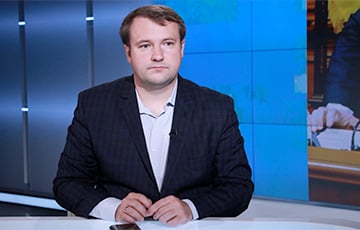
The website Charter97.org discussed this with Colonel (Res.) of the Ukrainian Armed Forces, military expert, and flight instructor Roman Svitan:
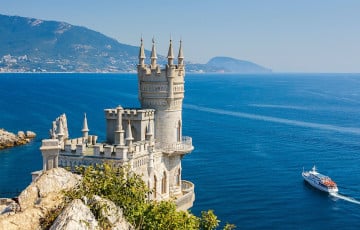
— The main blow is falling precisely on Crimea. The fact is that the Russian occupiers are trying to establish a so-called “maritime bridge” through which fuel reserves are being transported. These are precisely the strategic reserves that the Russians were gathering and stockpiling in the rear in preparation for the summer military campaign.
By striking these tankers, we’re trying to leave the Russian army in Crimea without fuel, so that it simply cannot leave. At the very least, it won’t have anything to move on if we take out practically all of them.
But so far, we haven’t been fully successful. Some of the tankers are still getting through. Several dozen vessels were traveling in a tight convoy. We are, at the very least, trying to work against this “maritime bridge.” We have long-range weapons and operational-level drones, which are used by the Unmanned Systems Forces as well as by our other special operations units. These will be used to strike this “maritime bridge.”
Let’s look at the effectiveness. This isn’t a 100% result. We need to do more than just disable the tankers—we need to destroy them. For now, they’re being disabled and aren’t being used to their full capacity. Nevertheless, some of the ships get through, and some fuel does end up reaching Crimea.
And since the fuel will undoubtedly be used by the Russian army, in a hypothetical war between a tractor driver and a tanker, the tanker will win. Because he has a gun. Because he’s in a tank.
We still have a lot of work to do. This isn’t a complete halt to fuel transit. It’s just the beginning—an attempt to stop this traffic.
— Along with the tankers, oil refineries across Russia are going up in flames. Could this lead to a real fuel crisis in Russia, and what would that mean for the Russian economy?
— This is one of our main objectives: to destroy the Russian Empire, to bring it down by destroying the Russian economy. And Russia’s entire economy relies on the oil and gas sector—specifically, on the secondary and tertiary processing stages.
In addition to gasoline and diesel, which are produced at oil refineries, the Russians use gas and oil to make petrochemical and gas processing products. These range from ammonium nitrate and ammonia—which are used in both agriculture and the production of military explosives—to, for example, rubber. Today, for example, a strike targeted a petrochemical plant belonging to the SIBUR Group. They produce rubber, plastics, and synthetic materials.
This is a serious problem for Russia. If we destroy the entire Russian oil and gas industry, it will be a blow to the entire system. But we’re only at the beginning of this destruction. It’s too early to say that everything there will fall apart. We’re just getting started.
We’ll need to operate at this pace for 1.5–2 years. It will take about three years to bring about the complete collapse of the Russian Federation through economic means. They have certain mechanisms to cushion the blows, which they will activate.
Right now, the Armed Forces of Ukraine are only at the beginning of the process of destroying the Russian economy. We’re already seeing the results. Civilian sectors at various levels are the first to suffer. But the real goal is to cripple the Russian military economy and the military-industrial complex.
Through such actions, carried out over time, we will ultimately ensure that the Russian economy is unable to sustain the military operation to seize Ukraine. That is the main objective.
— What else can the Ukrainian Armed Forces do to further compel Russia to make peace?
— It is impossible to compel Russia to make peace. At this stage, a ceasefire will not lead to peace. It will only lead to the next escalation after a tactical pause. Russia will regroup and strike again.
This is the wrong approach. There is no point in forcing Russia to make peace. Russia must be dismantled. Only after the collapse of the Russian Empire will peace come.
To achieve this, we must continue strikes against the petrochemical industry, expand their geographic scope, and extend strikes to new sectors of the petrochemical industry. In addition to oil and gas processing, we must destroy the logistics infrastructure: pipelines, linear production and control stations, oil and gas stations, oil transfer stations, and oil pumping stations. We must destroy all oil refineries and gas hubs, including the Yamal Cross. We reached the Omsk Oil Refinery 3,000 kilometers away, which means we can reach Yamal.
We must destroy the oil depots. They are practically all filled with oil. We must destroy the ports. This is very important: Primorsk, Ust-Luga, Novorossiysk. This is also a stage that will have to be completed in due course to cripple the Russian economy.
After that, we need to tackle the destruction of the Russian steel industry, which depends on oil and gas. The energy sector—power generation, thermal power generation, which relies on gas—power plants, combined heat and power plants, and the like. There is still work to be done.

Bank's name: Bank Millennium S.A.
Address: ul. Stanislawa Zaryna, 2A, 02-593, Warszawa
IBAN: PL97116022020000000216711123
SWIFT: BIGBPLPW
Name of the account holder: Fundacja “KARTA ‘97”
Purpose/title of payment: Donation for statuary aims
You can contact us by the e-mail charter97@gmail.com