


The Ukrainian Armed Forces Struck "Putin's House"
- 6.07.2026, 7:33
- 6,056
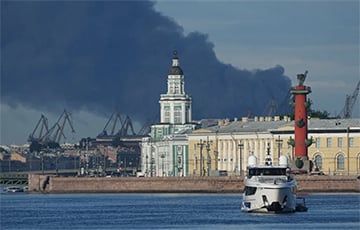
There are major questions about how the Kremlin will continue the war.
As a former taxi driver from St. Petersburg, Putin understands how important it is to keep fuel costs low. And by dealing a powerful blow to his hometown, Ukraine is increasing both the material and political costs of the war for the Russian president, writes analyst Jonathan Singh in an article The iPaper.
The journalist notes that the strikes by Ukrainian drones and missiles this weekend on a major oil storage facility and a military base in Russia’s second-largest city are increasing pressure on Russia’s air defense and logistics and forcing the Kremlin leadership to make difficult decisions about which parts of the country to defend.
The article states that the governor of St. Petersburg Alexander Beglov said the city had been subjected to a “large-scale” drone attack, but there were no casualties at the oil refinery complex.
“This attack occurred just over a month after a Ukrainian strike on the city during a major economic forum designed to attract foreign investment,” Singh notes.
According to the analyst, the humiliation of Russian President Vladimir Putin’s hometown is part of a broader Ukrainian strategy aimed at increasing the cost of the war for the Russian people and its elites.
“Kyiv hopes that its expanded ability to strike at the very heart of Russian life will prompt its allies—in particular, U.S. President Donald Trump—to provide additional vital defense systems needed to protect Ukrainian cities,” — Singh suggests.
It is noted that, like the strike on Moscow, the strike on St. Petersburg is an extraordinary humiliation for Putin, who has tried to shield both cities from the reality of war.
The analyst notes that the fact that a strike was successfully carried out against a city so dear to Putin’s heart—and which is the historic capital of the Russian Empire—demonstrates that the Ukrainian strategy is working—and that there are no safe places in Russia.
“I would say that this is one of the most significant moments we’ve seen in a long time. We are witnessing the rapid development of the Ukrainian defense industry, accompanied by a clear strategic vision that is now bearing fruit and could potentially become a turning point in the war. This represents a far more consistent implementation of Ukraine’s strategy and strategic ambitions,” noted Melanie Garson, an associate professor in the Department of International Security at University College London.
Singh believes that the attack on St. Petersburg—which served as Russia’s capital for two centuries starting in 1712 and is also the location of Putin’s ancestral estate—raises serious questions about the war’s future course for Putin.
“If your home is not safe and you are not defending this place, which has such great psychological significance for you and for the nation, then how can you win the war, and how do you intend to defend the rest of the country? Furthermore, who is affected at the elite level? What losses are they suffering? What interests of theirs are being compromised? And what pressure can they exert on Putin? Those asking these questions are the leaders of Russia’s energy sector and related industries, and it is precisely these people who have the potential to influence strategic changes,” Garson added.
According to Mark DeVor, a senior lecturer at the School of International Relations at the University of St. Andrews and a research associate at the Geostrategy Council , strikes on St. Petersburg are a vital component of Ukraine’s strategy.
He added that the three main pillars of Ukraine’s strategy are as follows:
* undermining the Russian military economy by striking oil and gas infrastructure;
* cutting off Russian logistical support for troops on the front lines;
* striking targets within Russian territory to show the Russian people that they are part of the war and that the war will affect them personally.
Jade McGlynn , director of the Ukraine and Russia Program at the Center for Public Administration and National Security at King’s College London , noted that an attack on St. Petersburg has real military consequences, beyond its symbolic and economic impact.
“An attack on Putin’s hometown certainly has symbolic significance—debris from a drone was found in the courtyard of the Peterhof Palace, but what’s even more interesting is that Russia has concentrated its air defense assets in a tight ring around Moscow and has so far been reluctant to move them; however, there will now be pressure to redeploy these scarce interceptors,” she noted.
The analyst explained that the timing of the Ukrainian attacks this weekend, as well as the largest Russian shelling of Kyiv using drones and missiles since the war began, is more than symbolic.
Singh explained that in the coming days, world leaders are set to gather in Turkey for a NATO summit, which will likely focus on ending the war. What Trump agrees to during this meeting could be of key importance.

Bank's name: Bank Millennium S.A.
Address: ul. Stanislawa Zaryna, 2A, 02-593, Warszawa
IBAN: PL97116022020000000216711123
SWIFT: BIGBPLPW
Name of the account holder: Fundacja “KARTA ‘97”
Purpose/title of payment: Donation for statuary aims
You can contact us by the e-mail charter97@gmail.com