“Be Ready For That Moment To Take The Opportunity That Will Come”
- 25.06.2026, 13:11
- 14,858
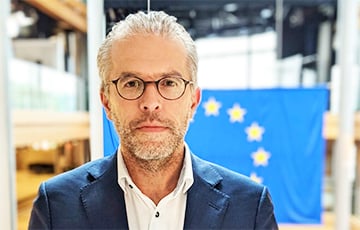
Photo: spring96.org
The Member of the European Parliament called for continued pressure on Lukashenka.
Dutch MEP Thijs Reuten is one of the most consistent supporters of a free Belarus and of Ukraine in its struggle. In an interview with Charter97.org, he said that the only way to bring change to Belarus is to keep up the pressure on Lukashenka, and that the European Union should be more decisive in supporting Belarusians and Ukrainians.
— How does a guy from Amsterdam come to get interested in such topics as Ukraine and Belarus?
— Sometimes people say that it's great that somebody that is a bit further away from Belarus and Ukraine is involved in these topics.
— Counting me in among those who do.
— That is part of my vision. I feel a responsibility as a member of the European Parliament — a responsibility that has to look at the whole of the European Union, the interest of Europe. It is in the interest of those fighting a war against Russian aggression and resisting Lukashenka's dictatorial regime. But it's also in the interest of the European Union as a whole, including those in the Netherlands, in Sweden, in Portugal, who might feel that they are a little bit further away from this side of Europe — that we address it as a European issue.
To me, the Russian aggression towards Ukraine has never been only about Ukraine. It's about the Ukrainians being a successful democracy and about our European values. That is what irritates Putin, because he is afraid that people in Russia might start to say, "Why can they live in freedom and be successful? Why can't we?" Having a successful, democratic, prosperous country at his borders — that is what makes him afraid. Therefore, this war of aggression was not only about all his crazy ideas about historical revisionism — no. It is also about our way of life. Therefore, I think it's completely logical that we support the Ukrainians in their existential fight.
How did I get involved? I came into this parliament in April 2021. I spoke in January 2022 — just before the full-scale invasion — about the dangerous situation, because a lot of people were still under the impression that it was not going to happen.
Why was I involved with Belarus? That is more related to the fact that I took over the mandate from my predecessor, Kati Piri. I became my group’s – the S&D group - shadow rapporteur for Belarus. Now, I'm not a shadow rapporteur anymore but once you get involved, it never lets you go.
I started to be a political sponsor of certain political prisoners. They got released. The one that I currently am godparent of is Iryna Takarchuk. That also keeps me involved, because when there's a chance, I will ask for attention for her and for all the other political prisoners.
What I find interesting about Belarus — and try to tell that story back home in the Netherlands and other member states — is that Belarus, despite all the repression, despite the enormous extraordinary amount of political prisoners taken to make all other people scared, there is still a very active small group of people who still uphold a little bit of resistance: through some independent reporting, through trying to assist the families of the prisoners. That's an interesting feature of the situation in Belarus. It gives me a little bit of hope.
What I continuously try to do is to expose Lukashenka as the lapdog of Putin. This guy is terrorizing his own population (like many dictators do — it happens in Russia, in Iran), but this guy also makes himself so much bigger than he actually is, because his whole position and stature, all his grandstanding, his arrogance — it is completely built on him being a lapdog of the other guy in the Kremlin.
He has — and that's the tragic side of it — sold out his own country to Russia's aggression and to Russia's imperialistic plans. He tries to compensate for that by suggesting that he's somehow in between, that he also looks towards the West, towards the EU. But it's not credible. Now we have these releases of prisoners due to American efforts, and I am of course happy with every prisoner that is released, but this should never be the signal to ease the sanctions or to normalize the relationship with Lukashenka. We have to keep in mind that Putin uses Belarus as a stepping stone for his aggression towards Ukraine, but also for his threatening of the European Union — putting missiles there, drone jamming systems, and so on. He completely sold out his country and is prepared to even sacrifice his own people. So we need to keep an eye always also on Belarus in the context of Ukraine and Russia's aggression.
— When Lukashenka says that he is "in between the EU and Russia" we should not believe him?
— I don't believe him. It's not credible. It's the same as with other autocrats. They make up stories purely in service of remaining in power. He doesn't have a lot of power derived from his own brilliant ideas or leadership, because he doesn't have them. He depends on Putin.
You asked me why I got involved. One of the reasons, interestingly enough, was Ales Bialiatski. I came here in April 2021. A month after I arrived in this parliament, there was the hijacking of the plane brought down in Minsk. Two weeks after the hijacking, I had an online meeting with Ales Bialiatski. He had been in prison before, but at the time, in May 2021, he was free. A couple of weeks later he got arrested again — that partly was an inspiration for me to keep working on Belarus.
I asked him what to do with the sanctions, since the sanctions also have consequences for those in Belarus. It would be perfectly legitimate from inside Belarus to say, "Maybe the sanctions are not targeted enough, maybe you should better target the interests of the leadership." He said, "There are a couple of options, but if you speak with people who are suffering the direct consequences, they all say: keep the pressure on."
There's a lot of criticism of the European Union on the effectiveness of sanctions. Sometimes people say it's not very helpful. But that's partly because we are not strict enough in enforcement. And that's also our fault — because by not being as tough as we could have been in the beginning. I said from the outset: sanctions on Russia have to be mirrored with the sanctions on Belarus.
— Or maybe sanctions against the Lukashenka regime could be even tougher?
— Well, you could even consider that, because the internal repression of Lukashenka is probably more cruel and violent than what you sometimes see in Russia. But let's not go into that debate.
— Sanctions against Lukashenka's regime should be definitely, not less than against Putin's regime?
— Yes, definitely not less. That's exactly my point. Don't underestimate it. Don't think that there's a moment now to normalize or to say, "Oh, maybe we can ease the sanctions." No. He will not change. His whole power is constructed upon lies, fear and dependency from the Kremlin.
My criticism towards the EU is probably rooted in the fact that if we had done more, faster — if we did put the same pressure in sanctions already in 2021 and then in 2022 (when the Russian aggression started) — I'm not saying that we could have prevented things, but autocrats look at each other. They say, "If he can get away with that, then I can maybe do that." So I think there was enough reason to be more tough from the beginning — in 2021 with the hijacking of the plane, and even after the elections of summer 2020. But every time we had resolutions and a little bit of extra sanctions, we ran into the classical issue of sanctions on sectors that made certain member states suffer. I remember the potash issue, where certain member states were very dependent on it. We need to work more in solidarity and say, "Okay, you have a problem with that — then we're going to fix it." But let's not fix it by taking the sanctions off the list, because then we are rewarding the dictator.
So, my criticism of the EU is: be tougher in the beginning, because then your sanctions are more effective. And then enforce these sanctions — because then you also hopefully shorten the period of suffering of the population.
— Indeed, in 2020 there were high hopes that there would be a stronger reply from the European Union — especially after people were killed in the cities of Belarus for peaceful protests. We were definitely expecting some tough measures — like closing the flow of goods completely through the border — something tough and decisive. The European Union did not get to that level.
— There's also a debate — some people say, "Yeah, but these personal sanctions are not so effective because people have already moved their assets away or they're not interested in traveling." You see the recent discussion about visas for Russians traveling to the EU for shopping and holidays. I'm not interested so much in curbing all travel from Belarus per se, because I think there are still people who sometimes want to visit relatives. But when we know that this whole power structure has a lot of layers — a lot of people involved in keeping the repression going — these people and their families, I want them to be targeted. I don't want to run the risk that we end up having children of the highest prosecutors, the judges involved in all these fake trials with trumped-up charges, the prosecutors, the directors of the prisons (not the custodians, the directors) — we should give them the feeling that they are limited in what they can do, what their children and their relatives can do. I think that's not the case yet.
— Why is democracy in Ukraine important for the EU?
— I am a staunch supporter of Ukraine. I'm one of the hardliners here in the parliament when it comes to the support of Ukraine. But ultimately, our job is to support Ukraine. Ukrainians could have decided, "Okay, do we want this fight or not?" They decided that they wanted to take on this fight. Why? Because they care about their democracy, freedom and independence. They surprised the whole world by taking on the Russian aggression and defending so fiercely. So, I see it simply as our duty to help them defend their democracy and their freedom.
Why is it important? Simply because we, as a family of European democracies — the European Union — have to welcome every country in our direct vicinity, especially neighboring countries like Ukraine, that say, "Look, we fight for the same values that you were built on." What can be more beautiful than to have a country that says, "We will never accept aggression, or the changing of borders by aggression, or any kind of oppression of the free will of the Ukrainian people." So for me it's been very simple. It's our duty to help them. A lot of people have a lot of comments about how Ukraine is doing things. I agree in this regard with Jens Stoltenberg, the former NATO chief, who always said that it is not up to us to comment on how it's going on the battlefield or who's doing better or worse today or tomorrow. We have only one job: to make sure we do everything in military and financial support to help Ukraine.
Does the EU do everything possible? No. If we would have done everything that we have done in these four years, but a little bit earlier in the first year... It was this parliament — and I was one of them — that started to ask early on after the invasion for tanks. And then the member states had to go into meeting rooms and talk and discuss and contemplate. If you already know that you're going to make the decision sooner or later, why not do it today? The same for the fighter jets, the same for the long-range missiles. My criticism is directed to doing more and doing it faster.
If we would have shown only half of the bravery and courage of the Ukrainians, then we would maybe be in a different situation. I cannot guarantee anything. But I really think we need to push harder.
To everybody who asks me, "How will this end?" — I say, "This will someday end at a negotiation table." But to get there in a strong position for Ukraine and Europe, the road is by raising the pressure on Putin and making sure that Ukraine can further defend itself. And then at some point there will hopefully be a sustainable and lasting peace — a fair peace — including justice and accountability. And that is probably going to be a difficult endeavor in itself.
I think people sometimes underestimate — when they hear about possible talks, "Oh, maybe it's going towards an end. Maybe it's almost over," — I would say, "Go and tell that to the people who are still defending the frontline in Ukraine, because it is not over."
— No. Not at all. How long is it going to last?
— I don't know. The 90 billion loan is a very good step. But we in the parliament wanted to have the reparations loan based on the frozen assets. I think that will come back on the table, but that will be for later. The issue is that — and it starts from the beginning of the full-scale invasion — the longer you wait with support and with decisions to help, the longer it's going to take before Ukraine has a strong position.
Now you see something unusual — Putin is not winning. His country is not doing well. For normal people — which Putin is not — that would be the signal to say, "Maybe we should start moving towards some kind of negotiation on at least a ceasefire." But he is not reasoning in the same way, because he probably doesn't get the right information. Maybe he gets information about the battlefield that is not correct. On the other hand, the Ukrainians are optimistic because they see that they can still hold out and get quite enough support. Someone else could have said, "Well, I'm gradually getting the upper hand — why should I go and negotiate?" But Zelensky still says, "I want to start talks to have this end." So we are in a very complicated situation in that regard.
— Okay. Looking forward — you've talked about a Cyprus-style EU membership for Ukraine. Could you explain what it means?
— I don't know where you read that but I can clarify what was actually said. I was asked: can Ukraine (or for that matter Moldova) join the European Union when there's still a dispute over territory or a de facto non-recognition of territory? And I said — and that's where the example of Cyprus came in, "I'm not in favor of giving a veto to someone outside the European Union over the membership of a country". I am in favor of Ukraine entering within its complete, internationally recognized borders, as a whole and complete country. But should it be the case that there is some dispute over certain parts of the territory, I think it's not wise to say, "You can never join if there are disputes." Of course, I want disputes to be solved. But if you say upfront, "You can never join if there are territorial disputes," you are actually telling the Kremlin: continue to destabilize, continue to make trouble, because then you can prevent EU membership. That is exactly what Russia is doing, for example, in the Western Balkans — influencing and destabilizing countries that are trying to do reforms. But we should never give a de facto veto to someone on who's going to join and in what form. And that's where I refer to Cyprus, because Cyprus also joined the EU as a whole country but with part of its territory still under occupation. But as I never wished that for Cyprus I don’t wish that for any other future member state of course.
— What is your message to our readers in Belarus?
— What all the people do, in their own neighborhoods, in their own small possibilities: supporting the prisoners, supporting the families of prisoners, doing some independent reporting — it is seen. You are not alone. I cannot promise anything will happen right now, but what I can promise is that there will be a day there also when there's going to be a change. Change will come sooner or later. It might take a little bit more time. But we need to be ready for that moment.
My message to everyone who reads and sometimes maybe feels desperate because it takes long (and it is taking long) is the following. There are a lot of people who say "what if": what if, for example, back when there was the collapse of the Soviet Union, we would have made another choice. But that's not helpful at the moment. What is helpful is to be prepared for the moment of change. Our task on the side of the European Union — and also on the side of the people in Belarus — is to be ready for that moment to take the opportunity that will come. In the meantime, I will keep fighting for Iryna Takarchuk, for all other prisoners, and we need to stay united.
My next message is this, what I sometimes see with the diaspora is a bit of tension. Since people outside Belarus are fighting for the same things while many people are still inside Belarus — let's not be divided over small issues, over things that are maybe differences of opinion. Keep your eye on the ball. First we have to get rid of Lukashenka. I'm not afraid of that. Some people say, "Yes, but what happens after Lukashenka?"— I think it will be better. I don't know exactly what's going to happen, but I think it will certainly be better than what we have now. So, let's keep the eye on the ball, let's get rid of Lukashenka, and then after that there is enough time to discuss all kinds of differences of opinion. But let's try to stay as united as possible in these difficult times.
I also wanted to say to those in Belarus who are reading this: I'm deeply grateful for those who support Ukraine. We know that there are brave people from Belarus who chose to help Ukrainians in their fight. Although the number is maybe not super high, it is really seen. We see it, we feel it, we know that a lot of people in Belarus fully support Ukraine. They are not on the side of Lukashenka and the Kremlin. There were examples of people — risking their own lives and their own freedom — trying to help the Ukrainians by sabotaging Russian troop movements and so on. It has not gone unnoticed. We have seen it. And we have to be ready to support you and to continue to support you. But also in Belarus: be ready for the moment when the window of opportunity opens.

Bank's name: Bank Millennium S.A.
Address: ul. Stanislawa Zaryna, 2A, 02-593, Warszawa
IBAN: PL97116022020000000216711123
SWIFT: BIGBPLPW
Name of the account holder: Fundacja “KARTA ‘97”
Purpose/title of payment: Donation for statuary aims
You can contact us by the e-mail charter97@gmail.com