


Can Belarus No Longer Feed Itself?
5- 13.08.2026, 18:25
- 1,576
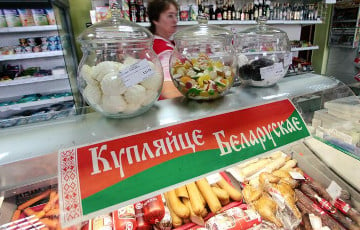
Store shelves are overflowing with Russian products.
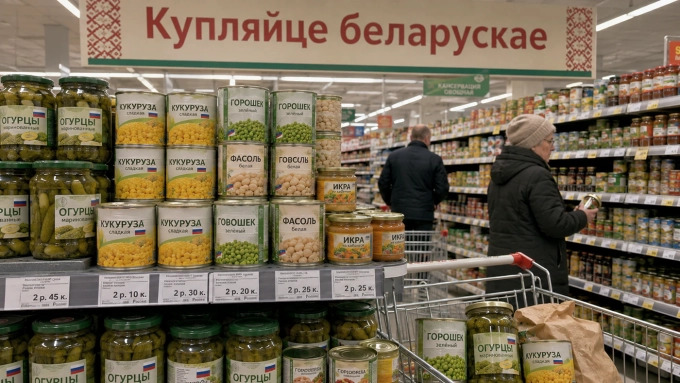
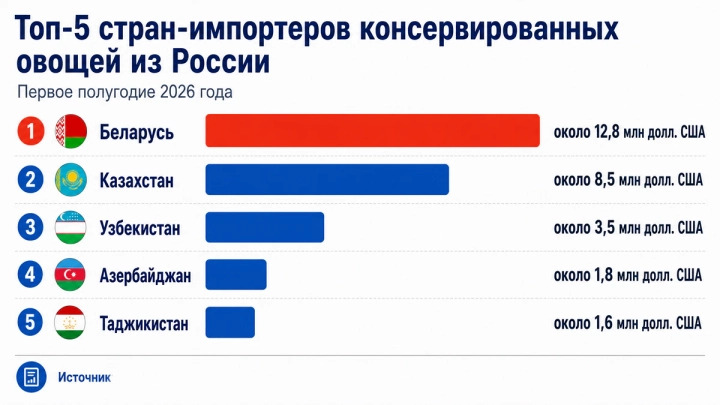
For years, Belarusians have been told that they should love and support their own and, most importantly, “buy Belarusian”. This has almost become an economic mantra. But in reality, things aren’t quite like that. And here’s yet another record—Belarus became the largest buyer of Russian canned vegetables among 65 countries in the first half of 2026, according to “Belarusians and the Market”.
There is an important statistical detail. The half-year data does not yet include June statistics for the EAEU countries. In other words, Belarus’s $12.8 million figure is actually incomplete, whereas the data for other countries covers the entire period. Belarus managed to take first place even with one month missing.
This product group includes canned corn, peas, beans, tomatoes, cucumbers and gherkins, olives, sauerkraut, vegetable mixes, and some baby food.
For many years, Belarus has been touting how it feeds itself, processes its own produce, exports surplus, and still has enough left over for its neighbors. We have our own potatoes. Our own vegetables. Our own meat. Our own milk. Our own poultry. We have fields, factories, agricultural towns, and government programs. At regional “Dozhinka” harvest festivals, it sometimes seems that food security is already so well established that we’ll soon have to rescue neighboring countries from it.
And then the dull foreign trade statistics come along and spoil the whole celebration.
In the first half of 2026, Russia exported more than 22,000 metric tons of canned vegetables worth over $32 million. And nearly $12.8 million of that amount went to Belarus.
Cucumbers, Peas, and a Bit of Import Substitution
And we’re not talking about some exotic product that simply cannot grow in the Belarusian climate. Russia exports canned cucumbers and gherkins, peas, corn, beans, tomatoes, sauerkraut, vegetable mixes, and other products.
In other words, pretty much everything that a country with a massive agricultural sector is theoretically capable of growing, processing, and canning on its own. Sauerkraut stands out particularly well on this list.
Has Belarus really reached the point where it’s more economically advantageous to import cabbage from Russia—cabbage that was first grown there, then processed, packaged, loaded onto a truck, brought across the border, marked up, and put on the shelf—rather than growing its own? Or is the invisible hand of the market making some very telling gestures?
With a salty Russian pickle
In and of itself, importing Russian canned goods is not an economic disaster. That’s exactly how modern trade works. If a Russian factory produces a can of peas more cheaply, has a strong brand, has struck a deal with a retail chain, and is able to deliver goods in large batches, the store will buy it.
The issue lies elsewhere. For decades, state rhetoric in Belarus has been built not around ordinary competition, but around the almost sacred necessity of buying domestic products. Belarusian consumers are told that every ruble spent on imports is practically a small act of betrayal against their own producers.
But for some reason, the state economy doesn’t share these sentiments. When imports are profitable for retail chains and businesses, the ideology ends roughly at the checkout counter.
It’s long since gone beyond just cucumbers
Banks with green polka dots and pickled cucumbers are just a small part of the bigger picture. Belarus buys oil, gas, metals, and raw materials from Russia. This makes sense—geology has distributed these resources without regard for the TV-hyped “import substitution” program.
But alongside raw materials have long been products of which Belarus has traditionally been proud:
Pork.
Dairy products.
Confectionery.
Chocolate.
Potato chips.
Rice.
Canned fish.
Now there are also canned vegetables, and in this last category, Belarus has taken first place among buyers of Russian products. It makes for an interesting dynamic.
At export meetings, officials tally how much Belarusian food they’ve managed to push into the Russian market. And on the next page of the statistical compendium, you can count the Russian goods heading in the opposite direction. The trucks apparently decided not to return empty.
The real economy doesn’t mix well with slogans.
You can talk all you want about food independence and the successes of the domestic agro-industrial complex. But if a country that grows its own cucumbers becomes the largest foreign buyer of Russian canned cucumbers, the statistics start to raise questions of their own.
We can only hope that it won’t come to importing ready-made potato pancakes after all. Although, after sauerkraut, it’s already a bit awkward to rule that out.

Bank's name: Bank Millennium S.A.
Address: ul. Stanislawa Zaryna, 2A, 02-593, Warszawa
IBAN: PL97116022020000000216711123
SWIFT: BIGBPLPW
Name of the account holder: Fundacja “KARTA ‘97”
Purpose/title of payment: Donation for statuary aims
You can contact us by the e-mail charter97@gmail.com