


Car Repair Shops Have Seen A Surge In Russian Customers
- 21.08.2026, 16:16
- 1,370
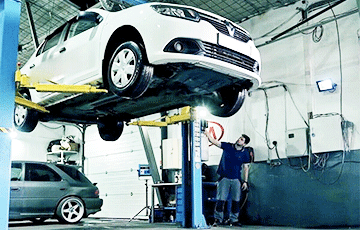
Against the backdrop of lower gasoline standards.
Russians have begun requesting vehicle diagnostics at auto repair shops more frequently amid the fuel crisis and the government’s decision to lower gasoline quality, the Fit Service network told *Izvestia*.
According to the network, in June and July, the number of jobs involving the engine and fuel system increased by 22% year-over-year—to 120,000. Demand grew most significantly for diagnostics and inspections of components, as well as for work on the fuel injection system, the piston assembly, the cylinder head, the camshaft, and the ignition system. In addition, Russians began seeking service more frequently for the replacement of air filters, manifolds, and resonators, as noted by The Moscow Times.
Demand for car repair consultations has also risen in a number of cities with populations over one million. In particular, a large number of such requests are being recorded in Perm, Krasnodar, Novosibirsk, Volgograd, and Rostov-on-Don. Car owners are paying closer attention to their engines, noticing a loss of power, erratic idling, or increased fuel consumption, and are asking to have their cars checked to ensure everything is in order, noted Tatyana Ovchinnikova, director of Fit Service .
The condition of the engine and fuel system directly depends on the quality of the gasoline, the age of the car, operating conditions, and timely maintenance, says Alexey Ivanov, owner of the “Alliance Trucks” dealership network. He pointed out that if the fuel’s specifications do not meet the manufacturer’s requirements, the engine may run erratically, and the car may accelerate more slowly and consume more fuel. The “Check Engine” light may also come on on the dashboard. Prolonged use of such gasoline can damage the fuel injectors, fuel pump, spark plugs, and exhaust aftertreatment system, Ivanov added.
At the same time, according to Ovchinnikova, there have not yet been any widespread breakdowns caused by the fuel. “In the current situation, a sensible strategy for drivers is not to panic, to monitor the car’s warning lights, and to adjust maintenance schedules when refueling at questionable stations. It’s worth shortening the intervals for oil changes, filter replacements, and diagnostic checks,” the expert noted.
The fuel crisis in Russia arose due to attacks on oil refineries. Since the beginning of the year, the Armed Forces of Ukraine (AFU) have put at least 26 facilities out of operation, seven of which had still not resumed production by the end of July. In August, four more were shut down. As a result, according to EA Analytics, oil refining in Russia fell to its lowest level since May 2002—3.6 million barrels per day.
In response, the Russian government banned fuel exports, increased gasoline imports from Belarus by a factor of 25, and began purchasing gasoline from India and Morocco. The authorities also sharply lowered quality standards for producers, allowing them to produce “Euro-3” and “Euro-2” gasoline, which had previously been banned due to their high sulfur content. The Ministry of Energy stated that the authorization will remain in effect until July 1, 2027.

Bank's name: Bank Millennium S.A.
Address: ul. Stanislawa Zaryna, 2A, 02-593, Warszawa
IBAN: PL97116022020000000216711123
SWIFT: BIGBPLPW
Name of the account holder: Fundacja “KARTA ‘97”
Purpose/title of payment: Donation for statuary aims
You can contact us by the e-mail charter97@gmail.com