

CEPA: Europe Is Preparing A Strong Defense In Case Of War With Russia
3- 26.08.2026, 16:16
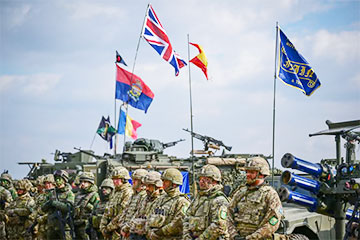
European armies are learning from Ukraine's experience.
European NATO countries are accelerating the restructuring of their armed forces in preparation for a scenario in which, in the event of a conflict with Russia, they would have to operate virtually on their own. Against the backdrop of rising defense spending, European armies are drawing on Ukraine’s experience, focusing on the widespread use of drones, dispersed forces, long-range strikes, and multi-layered air defense, writes CEPA.
Western intelligence agencies are issuing increasingly urgent warnings about a potential Russian attack on NATO. It could take the form of either cyberattacks or a limited military invasion capable of testing the alliance’s readiness to defend its members.
European armies will have to change not only their weaponry but also their very approach to warfare. British General Roly Walker stated that NATO forces must possess capabilities that Ukrainian troops are already using on the battlefield.
“Constant strikes at medium and long ranges… these are what stretch Russian front lines and deprive them of the material resources and personnel needed to sustain their defenses,” he said.
Particular attention is being paid to low-cost drones. The Netherlands is forming units of about 600 military personnel to operate drones, France has ordered 5,000 inexpensive drones, and the United Kingdom is increasing its use of autonomous systems.
At the same time, European countries are developing reconnaissance capabilities, satellite systems, electronic warfare, and long-range weapons. Poland is creating a “drone wall,” Germany is learning to disperse its aircraft across civilian airfields, and the countries of Northern and Eastern Europe are building up their layered defense.
“Procurement alone will not be enough. Europe will need ammunition reserves, secure logistics, well-trained military personnel, and an industry capable of quickly replacing losses,” the authors write.
Without the U.S., the European strategy will likely be more defensive: to prevent a rapid Russian breakthrough, withstand the initial strike, and then leverage the superiority of the European economy and industry.
“Europe must, first and foremost, avoid a quick defeat and then outlast Russia,” the authors argue.
They identify integration as the key prerequisite for such a strategy: European armies must share data, jointly target enemies, and act as a unified force, rather than as a collection of disparate national armies.

Bank's name: Bank Millennium S.A.
Address: ul. Stanislawa Zaryna, 2A, 02-593, Warszawa
IBAN: PL97116022020000000216711123
SWIFT: BIGBPLPW
Name of the account holder: Fundacja “KARTA ‘97”
Purpose/title of payment: Donation for statuary aims
You can contact us by the e-mail charter97@gmail.com