


Oil Refining In Russia Has Plummeted To Its Lowest Level Since 2002
- 3.08.2026, 19:39
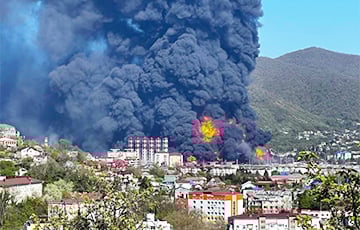
A record-breaking series of Ukrainian Armed Forces strikes on the oil refinery “helped.”
Attacks by Ukrainian drones on oil facilities in Russia—now in the fifth year of the war unleashed by Vladimir Putin—have caused refining output to fall to its lowest level in nearly the entire quarter-century of his rule. According to EA Analytics, refining output in July stood at 3.6 million barrels per day—the lowest level since May 2002, reports Bloomberg.
This is about one-third below the seasonal average. Between 2020 and 2025, Russian refineries processed an average of 5.3–5.6 million barrels per day during this time of year.
Over the past month, 18 refineries have been hit, including the country’s largest—the Omsk refinery, located more than 2,500 km from the Ukrainian border—according to Bloomberg’s calculations based on statements from Russian and Ukrainian officials. The previous record (17) was set in May. Five large tankers, five port infrastructure facilities, and two pipelines were also hit. In terms of the total number of strikes on oil facilities (30), July ranked second only to May (32).
If one takes into account the strikes on eight tankers linked to the Caspian Pipeline Consortium (CPC) terminal, July can be considered a record month in terms of the number of strikes on oil facilities associated with Russia, Bloomberg notes. No one has claimed responsibility for these attacks, which included strikes on two tankers on the night of July 30, after which oil loading at the CPC was suspended.
CTPC’s shareholders include entities from Russia and Kazakhstan, as well as major international oil companies, including the U.S.-based Chevron and ExxonMobil, which, having withdrawn from Russia after the start of the war in Ukraine, continue to operate in Kazakhstan. Kazakhstan’s Ministry of Energy has denied reports of a possible complete shutdown of the CPC.
The future of Russian oil refining and exports depends on the number of drones at Ukraine’s disposal and its decision to use them against specific targets, says Sergey Vakulenko, a senior research fellow at the Carnegie Berlin Center for Russia and Eurasia Studies. In the first half of July, the Ukrainian Armed Forces’ Unmanned Systems Forces focused on strikes against oil refineries, and in the second half, on tankers. But in the past week, oil refineries have once again been subjected to massive bombardment: three major facilities came under fire in the last three days of July, and four more over the weekend.
Vakulenko adds:
“Russia’s efforts to strengthen its air defenses may reduce the number of drones reaching their targets, but they will not fully protect them.”
Russia has some capacity to reroute oil from Novorossiysk to Baltic ports, according to Jorge Leon, senior vice president and director of geopolitical analysis at Rystad Energy. However, “the spare capacity of pipelines, storage facilities, and tankers is unlikely to be sufficient to handle all the volumes diverted from the Black Sea,” he believes.
Furthermore, Ukraine is capable of reaching ports on the Baltic Sea, as it did in the first months of this year, Leon notes.

Bank's name: Bank Millennium S.A.
Address: ul. Stanislawa Zaryna, 2A, 02-593, Warszawa
IBAN: PL97116022020000000216711123
SWIFT: BIGBPLPW
Name of the account holder: Fundacja “KARTA ‘97”
Purpose/title of payment: Donation for statuary aims
You can contact us by the e-mail charter97@gmail.com