


A Belarusian Woman On A Polish Hospital: I Watched It With Admiration
- 20.09.2026, 14:14
- 1,134

I was impressed by the compassion and empathy shown by the medical staff.
Belarusian Yulia Semchenko, wife of former political prisoner and journalist Dmitry Semchenko, shared on social media that she had suffered from excruciating bouts of abdominal pain for two years, but was only diagnosed in Poland, where they moved about a year ago.
— I took a week off from social media in a rather unique way. Seriously, though, I want to share my story of two years of terrible bouts of abdominal pain (“terrible” is an understatement—they were more like devastating). This isn’t a unique case, but it’s not common either. And yes, this kind of thing can happen. I’m sharing this so you’re aware, and I hope it never happens to you (or at most once, with a good outcome). “I’m waiting for the histology results and hope this pain never comes back,” she says.
According to her, over the past two years she has been hospitalized periodically with acute abdominal pain: twice in Belarus and twice in Warsaw. She got through a few more episodes on her own.
“It was hell—you have a fever and are vomiting, but the worst part is the pain, which can last for a whole day. And you feel like you’re dying, but you just can’t die. And then—poof—it all goes away. And then for 3, 4, or 5 months, you don’t feel any pain. Life is wonderful, but deep down you know: it’s going to happen again someday. Because it keeps happening. All on its own. Without any triggers or causes,” she says, describing her symptoms.
Yulia adds that she tried everything to find out what was happening to her; she underwent numerous tests, including an MRI, CT scan, ultrasound, esophagogastroduodenoscopy, enterography, genetic testing, and even saw a psychiatrist, thinking that maybe she’d already gone crazy…
“They suspected all sorts of rare diagnoses, and I took every test imaginable. The last ones were right at the beginning of September. I remember taking them and thinking: ‘That’s it, this is the last time. I don’t want to do this anymore. I’m tired of searching and not finding anything,’” she shares.
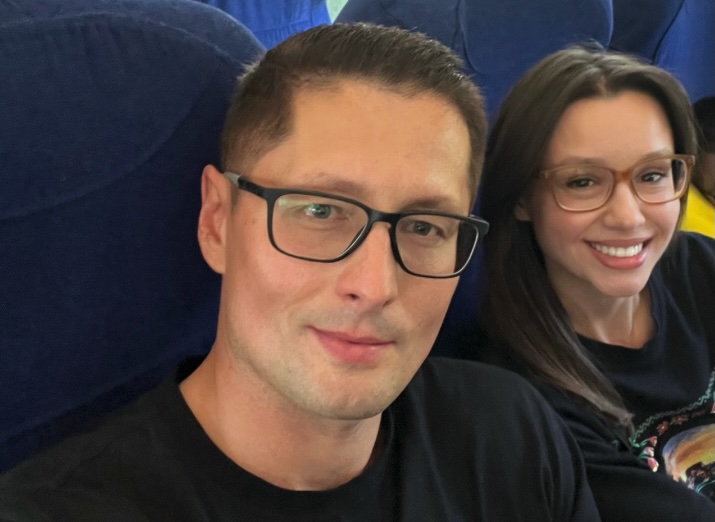
Between episodes, Yulia felt completely healthy; she was making great progress in strength training, took up boxing, and was thrilled with her body and strength. She recalls that back in Belarus, during a private consultation, a doctor had suggested one possible condition, but Yulia herself didn’t believe it, since she thought it would be easy to diagnose in the 21st century.
“So, she suggested it might be recurrent appendicitis. It didn’t even cross my mind at the time, because we’re all used to thinking it can only happen once—and there are two possible outcomes. Damn it, appendicitis!!! And that’s how it goes: it can get inflamed and then subside, but only for a while. I was just lucky that when I started feeling better, it wasn’t because it had burst. That’s exactly what happened, because all my symptoms were absolutely classic,” she says.
According to her, her loved ones—who witnessed her suffering and supported her—helped her keep from going crazy amid the uncertainty, and her husband insisted that she keep looking for the cause of her illness.
In the end, it wasn’t until her fourth trip to the hospital that she was diagnosed.
“When they came up to me and asked if I agreed to the surgery, they saw me smile—because, of course, I agreed!!! What the doctors saw on the ultrasound and CT scan remains a mystery. But later, back in Belarus, I read that they had noted inflammation but, for some reason, didn’t remove it. I’m writing these stories so you understand that appendicitis isn’t always a one-time thing. It’s rare, but it does happen,” says Yulia.
She also compares hospitals and healthcare in Belarus and Poland.
“In Belarus, the ambulance came to pick me up without any problems and took me away just as easily—no complaints at all. In Warsaw, the ambulance came twice; once they refused to take me, so we went to the emergency room (SOR)—there they sent me home and prescribed some antibiotics for IBS (irritable bowel syndrome—ed.), — she recalls.
According to her, the last time an ambulance arrived in Warsaw, two men immediately asked why she hadn’t gone to the emergency room (SOR) and also asked how she would rate her pain on a scale of 1 to 10.
“I said 9. ‘Well, you don’t even look like a 7!’ Thanks, of course, but I’ve been through the Afghan War. I don’t have the strength to scream.” Despite their comments, they still picked me up and took me to the hospital, even though they’d said they’d just drop me off at the emergency room to wait in line. Well, once there, I fell into the warm hands of the medical staff and truly felt cared for,” Yulia admits.
She says she gives the Polish hospital a 10 out of 10 because the staff is excellent; the doctors and nurses joke with one another and handle even the most unpleasant tasks with ease. They high-five each other. Yulia also notes that she never once felt neglected; people often came up to her and asked if everything was okay.
— When they draw blood, they say “thank you” (to me!); when they examine me, they say “thank you” again (to me!). There’s a little button by the bed that you can press if you need anything. And they come to you in three seconds and do everything that’s needed with the utmost courtesy. I remember how, late at night after the surgery, a nurse quietly approached me and said: “Why are you sleeping in that surgical gown? Let me help you change.” And she did everything very gently because I was very weak after the surgery,” she explains in detail.
She especially remembers the very comfortable patient beds, where you can automatically adjust the angle to your liking, as well as how she was greeted after the surgery—when she was woken up from anesthesia with the words, “Ms. Yulia, how do you say ‘good afternoon’ in Belarusian?”?”
“I watched this with tenderness. I didn’t want to run away; I felt completely at ease. Not once did I hear a raised voice or an argument, nor did I see a single ‘sour’ face. I thought long and hard about our Belarusian healthcare system and doctors, and about the conditions in which they work. How I wish it were like that here too, where all employees have a decent salary and good working conditions,” she admits.
She also notes that in Belarus, she encountered good doctors in the hospital as well—very considerate gynecologists—and she’s grateful to them for maintaining their humanity and empathy no matter what.
“But the rest of the medical staff varies greatly; I saw nurses yelling at elderly patients for moaning. I saw one nurse practically lose her temper just because she was asked to close a window in the ward,” Yulia writes.

Bank's name: Bank Millennium S.A.
Address: ul. Stanislawa Zaryna, 2A, 02-593, Warszawa
IBAN: PL97116022020000000216711123
SWIFT: BIGBPLPW
Name of the account holder: Fundacja “KARTA ‘97”
Purpose/title of payment: Donation for statuary aims
You can contact us by the e-mail charter97@gmail.com