


A Flax Harvest Performance At The Shklovo Collective Farm
6- 21.09.2026, 8:35
- 3,340
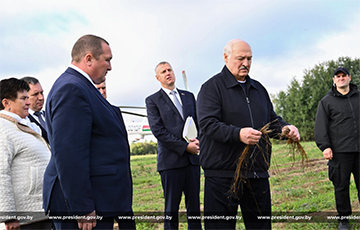
Lukashenko was going wild.
In the Shklov District, Lukashenko went on a rampage. First, rotten flax, and then a tirade against officials, who once again heard the word “prison.”
We’ve seen scenes like this—public floggings of subordinates—dozens of times; it would seem there’s nothing new here. And yet, this spectacle staged in the middle of a flax field raises some intriguing questions.
It seems that Lukashenko is becoming increasingly convinced that the collective farm system he has preserved is no longer standing the test of time. For now, we’re observing a sort of “denial” phase, which manifests as shifting the blame.
In the field of the failing Shklov farm, the ruler diligently blamed everyone but himself.
Upon hearing that the problems at “Govyada-Agro” arose in part due to a recent change in leadership, he remarked sarcastically, “That’s just your style.”
The man who has already replaced five agriculture ministers since 2020 sneered.
The man who personally appointed all these people to their positions—people who had to blush in fear in front of the cameras. Yet, by all accounts, he should share both their successes and their failures with them.
Without any qualms, Lukashenko berated Nadezhda Kotkovets. He sent her—a 65-year-old woman in heels and a white jacket—to inspect rolls of flax straw at the edge of a field.
And this despite the fact that she had been appointed inspector for the Mogilev Region at a time when the flax in Belarus was already beginning to wither.
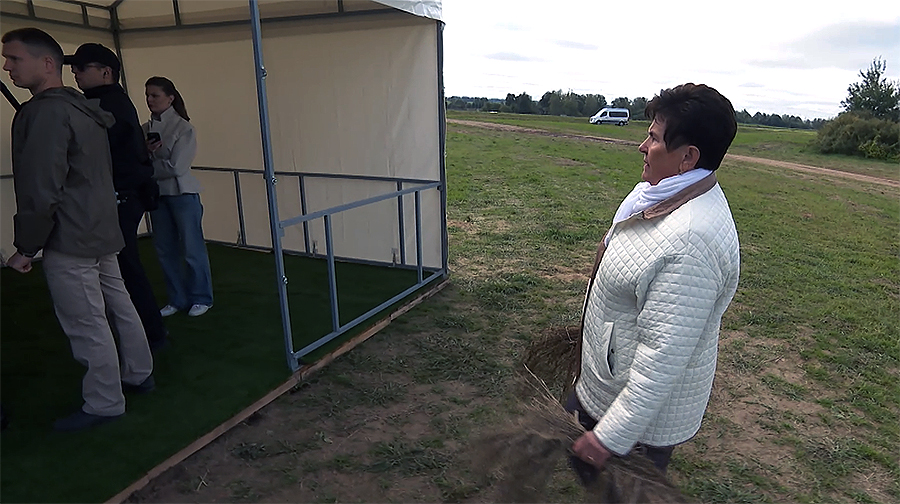
The president called one of the local officials a man from the century before last. The one who is obsessively dragging the entire country back to the era of Soviet agricultural service bureaus and red rags at the village council instead of cash bonuses.
Remember the story about the calves, which he suggested giving away to those who simply wouldn’t let them starve to death? And on top of that, paying compensation to their former negligent owners.
In the Shklov District, that idea—which is, to put it mildly, controversial—was brought up again, but this time flax took the place of the calves. The governor asked how many hectares in the district were allocated for this crop. Upon hearing the answer, he suggested distributing the land to those who simply know how to grow it.
This is yet another publicly voiced acknowledgment that there are those who know how to work, as well as those who let livestock starve and let crops rot.
And the fact that there are hysterical demands to “bring entire regions to their senses”—even down to the oblast level—including the latest demand to impose “martial law” in the Mogilev region, suggests that dying collective farms are becoming the norm.
It’s worth noting that the farce ended on a cautiously positive note. After visiting the ill-fated collective farm, Lukashenko went to see farmer Vladimir Malinovsky, who specializes in growing potatoes. In doing so, he established a new practice of visiting private farms.
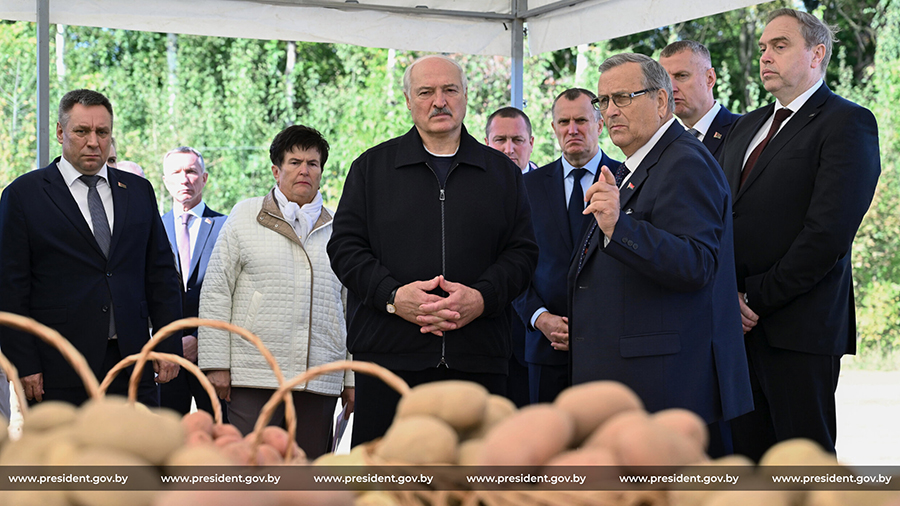
A telling photo. Vladimir Malinovsky’s farm accounts for more than 70% of the district’s total potato harvest. Behind him stand the people who run the country and the Academy of Sciences, who control the state budget—and who have brought about a potato shortage.
Several telling moments also occurred here. The prime minister spoke about the “Kupalovskoye” agricultural holding, a story that fizzled out, as usual, blaming everything on his appointees.
And then he suddenly opened up: “Unfortunately, there aren’t many people like this. If we had 5,000 people like Malinovsky, there wouldn’t be any problems in agriculture. Please, take over the farm—we’ll help.”
What’s the silver lining here? There’s little faith in the ruler’s words, but his increasingly frequent visits to private entrepreneurs and his accompanying remarks about transferring part of the agricultural assets to them give pause to consider the true state of affairs in this sector.
Perhaps things are so bad that the very idea of sharing with farmers and entrepreneurs no longer seems so far-fetched or unacceptable in the governor’s eyes. The main thing is that it doesn’t end up as just another NEP.
Kirill Ivanov, “Solidarnast”

Bank's name: Bank Millennium S.A.
Address: ul. Stanislawa Zaryna, 2A, 02-593, Warszawa
IBAN: PL97116022020000000216711123
SWIFT: BIGBPLPW
Name of the account holder: Fundacja “KARTA ‘97”
Purpose/title of payment: Donation for statuary aims
You can contact us by the e-mail charter97@gmail.com