

CNN: Russia "sends Dead Princes Into Battle"
3- 27.09.2026, 11:14
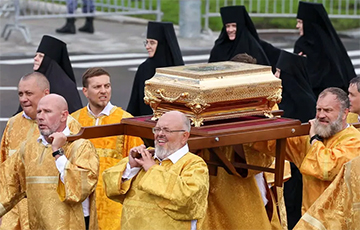
The Kremlin is trying to strengthen the religious "justification" for the war.
Russia has begun using Christian relics on the front lines in Ukraine—specifically, the remains of medieval princes—in an effort to bolster the morale of its troops and, at the same time, strengthen the religious justification for the war. This is reported by CNN.
In early September, a fragment of the remains of Prince Dmitry Donskoy, who is celebrated in Russia as the victor of the Battle of Kulikovo in 1380, was delivered to the front lines. The fragment is part of his right hand. Representatives of the Moscow Patriarchate stated that the saintly prince will symbolically stand “shoulder to shoulder” with the Russian invaders. The relic has also begun to be transported between military bases in the occupied territories of Ukraine.
According to religious studies scholar Sergei Chapnin, the use of such symbols has become part of a broader practice through which the Russian authorities and the church are attempting to portray the war as just and justified.
“The church has practically merged with the state to such an extent that it is impossible to distinguish between them,” he notes.
The authors of the article point out that the image of Dmitry Donskoy has not only religious but also political significance. Experts point out that the prince is portrayed not as a conqueror, but as a defender of the homeland. According to Chapnin, the authorities are thus seeking to create the impression that Russia is not an aggressor, but is merely defending its own territory. The researcher himself calls this a “mobilization myth” and explains that such historical constructs can influence the public consciousness.
Sending relics to the front is not a new practice for the Russian army. Previously, the military was given the remains of Prince Alexander Nevsky, who is also used as a symbol of Russian military glory.
At the same time, priests and religious scholars who criticize the Kremlin’s policies interpret the use of the remains differently. Orthodox priest and historian Alexander Zanemonets stated that this has nothing to do with Christianity and constitutes the use of the church for “patriotic” purposes. According to him, the use of relics is part of a strategy to secure political support for the state.
At the same time, some Russian soldiers on the front lines do indeed turn to religion. A former serviceman told CNN that soldiers pray before combat missions, and field chaplains visit units and hospitals. Another soldier described the opportunity to speak with a priest, pray, or touch a holy relic as “significant moral support.”
CNN also notes that the Russian Orthodox Church’s support for the military is controversial even among the clergy.
“We must support people, particularly those in uniform. But the question is how we support them. On the one hand, (you must) not deny people spiritual assistance, and on the other—not mislead them,” said Grigory Mikhnov-Vaitenko, a Russian priest of the Apostolic Orthodox Church (not part of the Russian Orthodox Church), who is helping Ukrainian refugees displaced by the war.

Bank's name: Bank Millennium S.A.
Address: ul. Stanislawa Zaryna, 2A, 02-593, Warszawa
IBAN: PL97116022020000000216711123
SWIFT: BIGBPLPW
Name of the account holder: Fundacja “KARTA ‘97”
Purpose/title of payment: Donation for statuary aims
You can contact us by the e-mail charter97@gmail.com