How Many Pensioners Left ‘Overboard’ After Retirement Age Raise
9- 31.01.2022, 12:57
- 14,394
Take a look at the outcomes of the “pension reform”.
Starting from 2022, men in Belarus will be able to retire at 63, and women at 58. This is the final increase in the retirement age. The reform began in 2017, when this age was increased: for women — up to 55.5 years, for men — up to 60.5 years. And with each subsequent year, 6 months were added to the initial retirement age. This year the reform will end.
The state saved a lot of money thanks to the reform. InfoBank.by found out the exact figures.
In addition to raising the age threshold, the insurance period is also increasing — the minimum period of payments to the Social Security Fund for receiving a pension. This rise began in 2014. Back then, it was 10 years. And now it has reached 18.5 years, starting from 2022.
If there is no such length of service, only a social pension is provided, which is very low (after all, the basis for calculating it is the pensioner's subsistence minimum budget, which is only 224.1 BYN). The insurance period will be raised until 2025, so that it reaches 20 years.
However, it is precisely the retirement age raise that “saves” money for the state the most — namely, raising the retirement age: in this case, the number of pensioners in the country is significantly reduced, so that less funds are required to pay a pension.
Why did the “pension problem” arise in Belarus – why did they have to raise the retirement age, reducing the number of recipients of old-age pensions?
There are two reasons: economic and demographic, which, in general, are “two sides of the same coin” — the economy can no longer cope with pension provision given the following conditions:
• an ever-increasing proportion of the population over working age
• the share of the working-age population that has begun to decline, with the prospect of a faster decline in the labor force in the country…
• …a too low proportion of the population below working age.

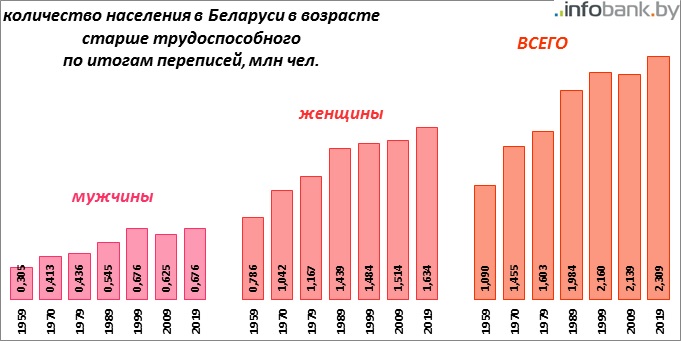
As you can see, according to the last census of 2019, the proportion of the population older than working age has already noticeably increased to a record high both in terms of numbers (2.309 million people) and in terms of the share in society (24.5%), and the proportion of the population of working age has decreased.
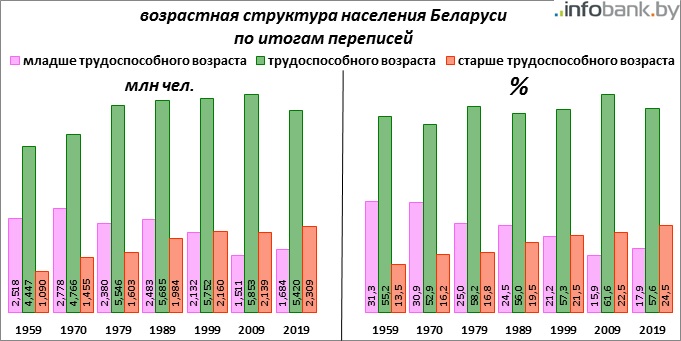
Moreover, this is already with the increase in the retirement age in 2019 (two years have passed since 2017, when the retirement age began to be raised).
Indeed, before this reform, the following were considered older than able-bodied:
• men — 60 years and older
• women — 55 years and older
And at the 2019 census already:
• men — 61.5 years and older
• women — 56.5 years and older.
If in the 2019 census all this was taken into account as before, then the proportion of the older population would be even larger.
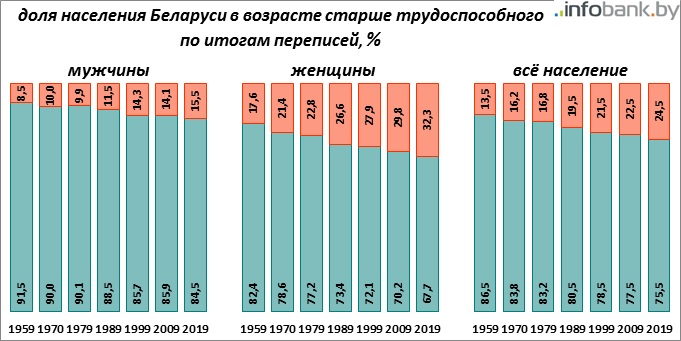
Already with the retirement age increased by 1.5 years, the number of people in 2019 of retirement age exceeded 2.3 million people, and this is a record number. Moreover, it began to grow rapidly after a short-term fall (it was in 2005-09). At the same time, as you know, the total population of Belarus is declining.
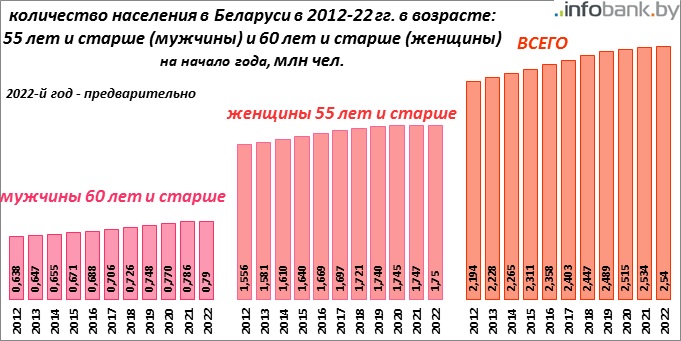
But if we calculate the number of the population older than the working age according to the previous — before 2017 — retirement ages (60 for men, and 55 for women), then in the same 2019 there would be almost 2.5 million such people.
And in 2022, according to calculations and based on annual official data on the age and sex structure of the population of Belarus, there will already be 2.54 million people.
If it were not for the increase in the retirement age, then according to the previous retirement ages, the share of the population older than working age would have increased in 2022 — already up to 27.5% (compare it with 19.5% in 1989 and 13.5% in 1959).
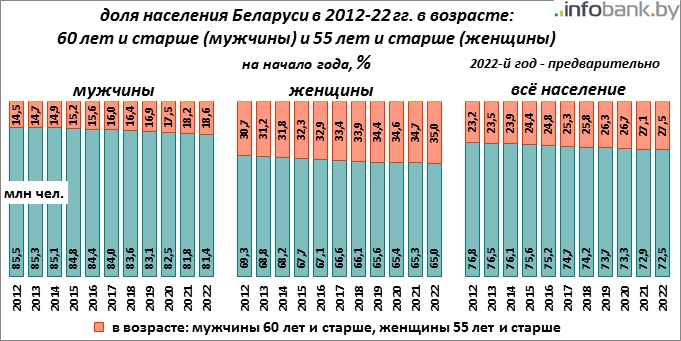
Moreover, the increase in the number of people of “pre-reform” retirement age (60 years and older for men, 55 years and older for women) has been going on every year for more than 10 years.
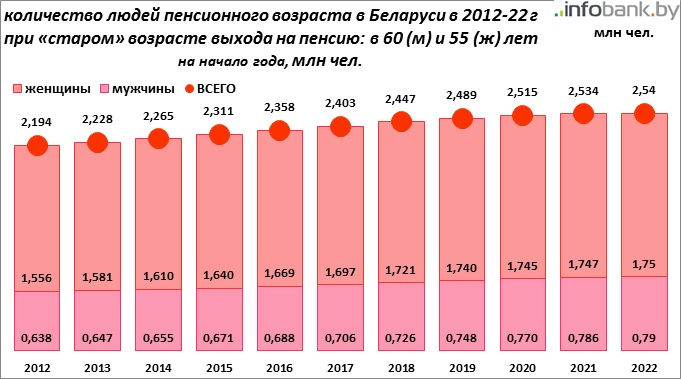
But when calculating taking into account the “new” retirement age, it is clear that since 2017, from the very beginning of this reform, the number of people of retirement age has begun to decrease - and this is the result of an increase in the retirement age: there are already fewer pensioners.
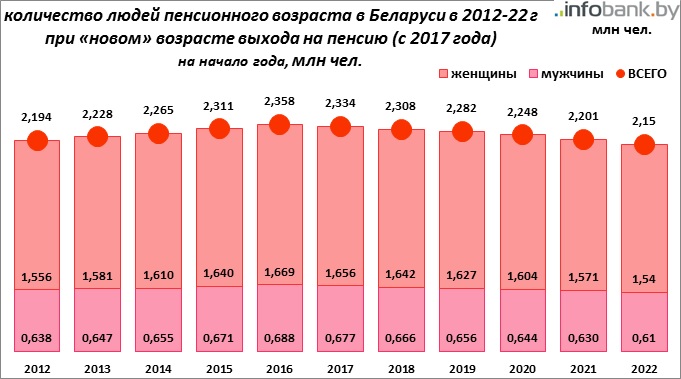
So, according to the “pre-reform” retirement ages (60 years for men and 55 years for women), there would be 2.54 million people in Belarus in 2022 (rough calculation) older than working age, and according to new ages (63 years for men and 58 years for women) - already only 2.15 million people.
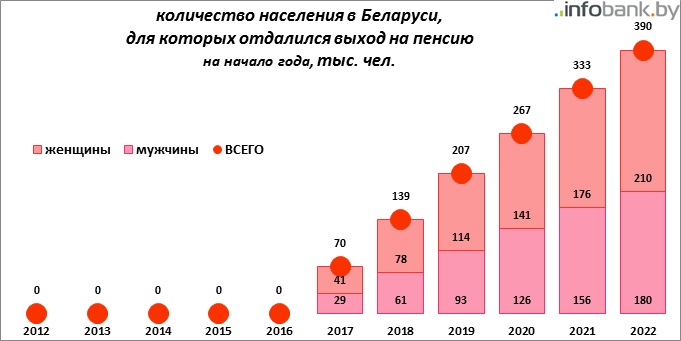
Thus, by the end of this reform (namely, its final in 2022), there will be 390,000 fewer pensioners in Belarus solely by raising the retirement age by 3 years.
This reform lasted 6 years, and every year, with each increase in the retirement age by 0.5 years, the number of people left “below the retirement age” — that is, for whom retirement was delayed — increased, and in 2022 reached its maximum.
Naturally, the official number of pension recipients in Belarus has decreased. So, in 2016, it reached a record high (2.619 million people), and then, starting from 2017, with every year the retirement age increased, there were fewer and fewer pensioners.
According to the latest official data for September 2021 (after which this statistics was closed), the number of pensioners registered with the labor, employment and social protection authorities amounted to 2 million 422.2 thousand people.
And at the beginning of 2022, according to calculations, there are no more than 2.4 million of them — this is a historically record low: there have never been so many recipients of pensions as there are now in Belarus.
And if not for this reform, if the old retirement age had remained, then in 2022 there would have been under 2.8 million pensioners — based on demographic dynamics, and also — due to a sharp deterioration in demographics in the context of the Covid pandemic.
We calculated that starting from 2022, the state now annually “saves” on pensions of about 390 thousand people: due to the increase in the retirement age by 3 years, there are exactly as fewer pensioners than could have been with the previous retirement age.
This saves the Social Security Fund about 2.6 billion BYN per year (with the planned income of the Social Security Fund in 2022 is 21.4 billion BYN). This allows increasing the pension of the “remaining” pensioners to 100 BYN per month — purely mathematics, due to a decrease in the number of pensioners.
In other words, if it were not for the increase in the retirement age in Belarus by 3 years, the average pension could be 100 BYN less in 2022 than planned, or there would be serious problems with money to pay pensions of the current amount.
The economy of Belarus has not shown high growth rates in recent years, while demography is deteriorating. Therefore, raising the retirement age was only a matter of time, because the choice is either to reduce the number of pensioners or to reduce the size of pensions.
Another table that touches on this topic.
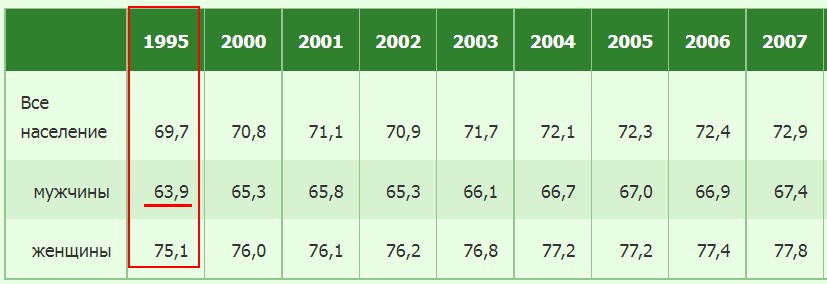
We were looking for the average life span of Belarusians. We wanted to see how long people who are now retiring live on average. But found only life expectancy. This, of course, is not exactly what we need, but there is a certain guideline.
So, according to the table, we see that the later a person is born, the longer their life expectancy (according to Belstat) is.
Since the last year in the table is 2017, it can be assumed that Belstat predicted these data even before the covid pandemic.

So let's see what life expectancy Belstat predicts for those who were born in 1995 (they are now 27 years old and another 36 years before retirement). None of them probably thinks about retirement.
So even for these people, the average life expectancy for men is 63.9 years (!) And the retirement age starts at 63 years.
Life expectancy at birth
What is happening?
Will the average Belarusian (born in 1995) receive a pension for less than a year (0.9 years)?
Women (born in 1995) will be able to receive their pension longer, a little more than seven years. 7.1 years, to be precise.
And this is provided that nothing has changed in Belarus for 36 years. But during this period a lot of things can change, including the retirement age. It's good if it changes downwards, but what if it's vice versa?
As you know, the retirement age has also been raised in Russia, where the demographics are also very difficult for pension provision, although there is much more money there.
And the only country in the region where the retirement age is kept in the “old” format is Ukraine.