
Mark Feigin: Lukashenko's Ouster Will Be A Collective Decision
- 13.10.2026, 7:38
- 2,010
But hybrid warfare will only intensify.
Will Lukashenko become part of Putin’s plan for a hybrid attack on Europe? How should the West respond? What might lie ahead for Belarus if Russia weakens?
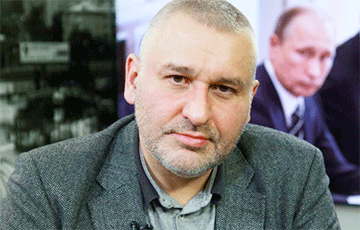
On the sidelines of the Free Russia Forum, which took place in Warsaw on October 11, a correspondent for the Charter97.org website spoke with renowned Russian opposition figure and human rights activist Mark Feigin.
— I’m skeptical about the possibility of direct Russian aggression against Europe. It seems to me that we’re more likely talking about a hybrid war. I deliberately traveled through the Baltic states; I was in Narva and in Suwałki. I want to emphasize once again: it’s impossible to carry out a localized operation. You can’t capture Narva, stop there, and use it as leverage to end support for Ukraine.
In that case, you’d have to advance all the way to Tallinn. And once Tallinn is captured, you’d have to go further, to Riga, and from Riga—to Vilnius. I don’t see any possibility of conducting a localized operation, as was possible in the first half of the 20th century. From a military standpoint, it’s absolutely impossible. Why? Because war has changed. Now it’s not even people who are fighting—it’s drones.
— Can we expect an increase in hybrid attacks, including drone incursions?
— This will intensify; it will escalate—without a doubt. Another thing is that this will continue exactly until Europe decides to respond in kind. As soon as the Europeans take the same actions against Russia, negotiations will begin immediately: “Why are you doing this?” In principle, this could also happen from Belarusian territory.
There aren’t enough resources for direct aggression right now. That’s why I don’t really believe it’s feasible, given what Putin has at his disposal.
If the war with Ukraine ends, then these people will need to be deployed somewhere. Yes, of course, they could move further. But right now, if you pull any forces back from the front—everything falls apart.
I was recently on the front lines, in the Kharkiv region, in Izyum. I visited units of the 3rd Army Corps. And this infiltration tactic has now run its course. So if you relax security even slightly in certain sections of the front line—they break through there, and that’s it.
— At the Free Russia Forum, many scenarios for the possible weakening of the Russian Federation were discussed. What opportunities arise for Belarus in this situation?
— The fate of Belarus, which Lukashenko himself has tied to this war, depends on its outcome. If Putin wins, it’s clear that Lukashenko will face a crossroads. He’ll need to convince Putin not to get rid of him.
If Putin loses, he’ll need to reach an agreement with Europe to ensure that the military capabilities Belarus has developed beyond its borders—I’m referring to volunteer units—aren’t directed against Belarus with the help of the West, Poland, Lithuania, and so on. I’m talking about the Kalinovsky Regiment and all the others.
— You visit Ukraine often. What do they say there about Lukashenko? Could Kyiv agree to a “reset” of relations with the regime, or will they never forgive him?
— I think, of course, they won’t forgive him. Another question is whether Ukraine will take any action to liberate Belarus or overthrow Lukashenko unless it’s a collective decision. That is, Poland, Lithuania, and other countries must agree that this can be done.
Just like with Transnistria. I was in Izmail, looking through binoculars at Transnistrian territory. It would take just one day to take it. There’s nothing there. Just a huge old warehouse in Kolbasna. It’s guarded by five thousand people who are just sitting at home. These are local civilians who enlisted—sort of like contract soldiers—in Russian units. They don’t know how to fight.
So for the Odessa Military District, it would take just a day. There’s no logistical connection with Russia. It’s simply that the Chisinau leadership hasn’t decided to liberate Transnistria. Moldova doesn’t agree; it believes many people would die.

Bank's name: Bank Millennium S.A.
Address: ul. Stanislawa Zaryna, 2A, 02-593, Warszawa
IBAN: PL97116022020000000216711123
SWIFT: BIGBPLPW
Name of the account holder: Fundacja “KARTA ‘97”
Purpose/title of payment: Donation for statuary aims
You can contact us by the e-mail charter97@gmail.com