

Belarusians Have Started Stocking Up On Foreign Currency
- 11.11.2026, 15:38

The exchange rate of the Belarusian ruble may fall.
Belarusians continue to dip into their savings and act as net sellers of foreign currency on the domestic market. However, in October, as shown by National Bank data, the volume of foreign currency purchases by individuals rose after three months of decline.
Over the first 10 months, Belarusians bought $11.4 billion worth of foreign currency and sold $13.3 billion worth, according to the National Bank’s calculations.
It is noteworthy that individuals are primarily getting rid of cash; from January through October, they sold $10.1 billion in cash, while non-cash transactions totaled only $3.2 billion.
For many months in a row, Belarusians have been net sellers of foreign currency—that is, they are selling more than they are buying. Over the past year, the difference exceeded $1.6 billion. In the first nine months of this year, it was just under $1.9 billion.
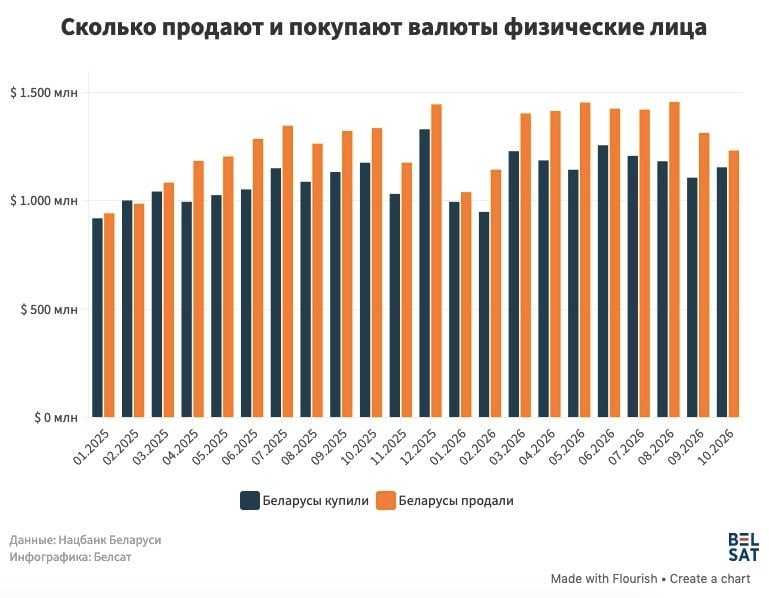
In October alone, individuals sold $1.1232 billion in foreign currency; the volume of sales has been declining for the second consecutive month and nearly hit a new low. Meanwhile, foreign currency purchases in October rose after three months of decline and nearly reached $1.155 billion.
Over the first nine months, Belarus lost $3.9 billion in foreign trade in goods
And while citizens are dumping excess foreign currency onto the domestic market, businesses are picking up the slack. Over 10 months, Belarusian companies purchased $1.559 billion more foreign currency than they sold. Businesses spend this currency on imported goods and equipment. Thus, Belarusians themselves are financing their companies’ overseas shopping.
This outflow of foreign currency from the country is evident in the statistics on foreign trade in goods: over 9 months, imports exceeded exports by $3.9 billion.
Non-resident companies continue to supply more foreign currency to the domestic market than they take out; the difference nearly reached $1.3 billion.
In total, as a result of currency purchases and sales by all market participants from January through October, supply exceeded demand by $1.1546 billion. Partly because of this, the Belarusian ruble is holding up well: during this period, it depreciated against a basket of currencies (which includes the Russian ruble, the dollar, and the yuan) by only 0.46%.
If, however, demand for foreign currency begins to exceed supply, the Belarusian ruble’s exchange rate will start to slide. And this is a very real threat, given that the main source of foreign currency is individual citizens. If citizens change their behavior and start buying more foreign currency than they sell, a shortage could arise in the domestic market.

Bank's name: Bank Millennium S.A.
Address: ul. Stanislawa Zaryna, 2A, 02-593, Warszawa
IBAN: PL97116022020000000216711123
SWIFT: BIGBPLPW
Name of the account holder: Fundacja “KARTA ‘97”
Purpose/title of payment: Donation for statuary aims
You can contact us by the e-mail charter97@gmail.com