


A Belarusian Man Was Fired, But He Managed To Get Nearly 80,000 Rubles And Left Satisfied
- 27.11.2026, 10:16

A man shared his experience of how he managed to do it.
A reader who unexpectedly lost his job contacted the editorial staff of Onlíner. Starting in January 2025, Zhenya had been working as a software engineer at a large company. Initially, he was hired on a one-year contract, which was extended for another three years in January 2026. However, the Belarusian man says that as early as September 2026, he was informed that he would soon be out of a job. According to the documents, Zhenya was laid off by mutual agreement, but with very generous severance pay. How did the Belarusian manage to secure a payment of nearly 80,000 Belarusian rubles?
“Doesn’t my contract protect me?”
This story, which, according to Zhenya, took quite a toll on his nerves, began on a typical workday Friday. A meeting titled “Let’s Talk,” attended by HR, appeared on Zhenya’s corporate calendar.
“For me, calls from HR are associated with hiring or mean that something bad has happened.”
I started thinking about where I might have made an inappropriate joke, or where I’d made mistakes that would now get me in trouble.
After all, just a few months earlier, company management had stated that there would be no layoffs.
But instead of a reprimand, Zhenya learned that “due to a reorganization of the company’s workflow, they would have to let him go.” Upon hearing the news, the man’s first reaction was to ask: had he perhaps made a mistake somewhere, or committed some violation? He was assured that there were no shortcomings in his work—these were simply necessary measures. At the same time, according to the reader, the company had repeatedly emphasized that there were no plans for layoffs.

— My next question was this: ‘How can this be? We have a contract—doesn’t it protect me?’ The call ended with them saying they were ‘sweethearts’ after all, because they weren’t kicking me out into the cold, but were actually giving me three full months’ salary on top of that and would pay my vacation pay.

According to Zhenya, at that point he had one final payment left on the car he’d leased. The young man brought up this point during another call with HR.
“You’re firing me, and I have a lease—maybe I could ask for four months’ salary?” That evening, I received a message saying that three months’ salary was the most they could squeeze out of the company. When I started insisting that I would have received more in the event of an official layoff, HR was at a loss (note that severance pay in the event of a layoff amounts to no less than three times the average monthly earnings (Part 4 of Article 48 of the Labor Code of Belarus); a higher amount may be provided for by a collective bargaining agreement, an agreement, or a contract. — Note by Onlíner).
As a reminder, on the day of termination, the employer must pay wages for time worked, monetary compensation for unused vacation time, and severance pay as provided by law or local legal acts. This is stipulated in Article 42 of the Labor Code of the Republic of Belarus. In the event of termination by mutual agreement, severance pay is not paid unless otherwise specified in the company’s local regulations.
— During our next call, HR offered me four months’ salary. She promised that I would remain employed for another month but wouldn’t have to work. She sent a letter to my email to confirm this.
According to Zhenya, that very letter specifically states that:
for nearly four weeks, the company does not expect him to perform any work tasks: current tasks have been completed or handed off, and no new tasks will be assigned;
it is not necessary to be present at the workplace (in the office) during this period;participation in work meetings, conferences, and regular team events is optional;
his salary for this period will be maintained and paid in full.
— But I demanded a document with the company’s stamp that I could put in a folder to prove I really didn’t have to work—otherwise, they’d fire me later under that provision. I didn’t receive any documents, so I continued to perform my job duties without any paperwork.
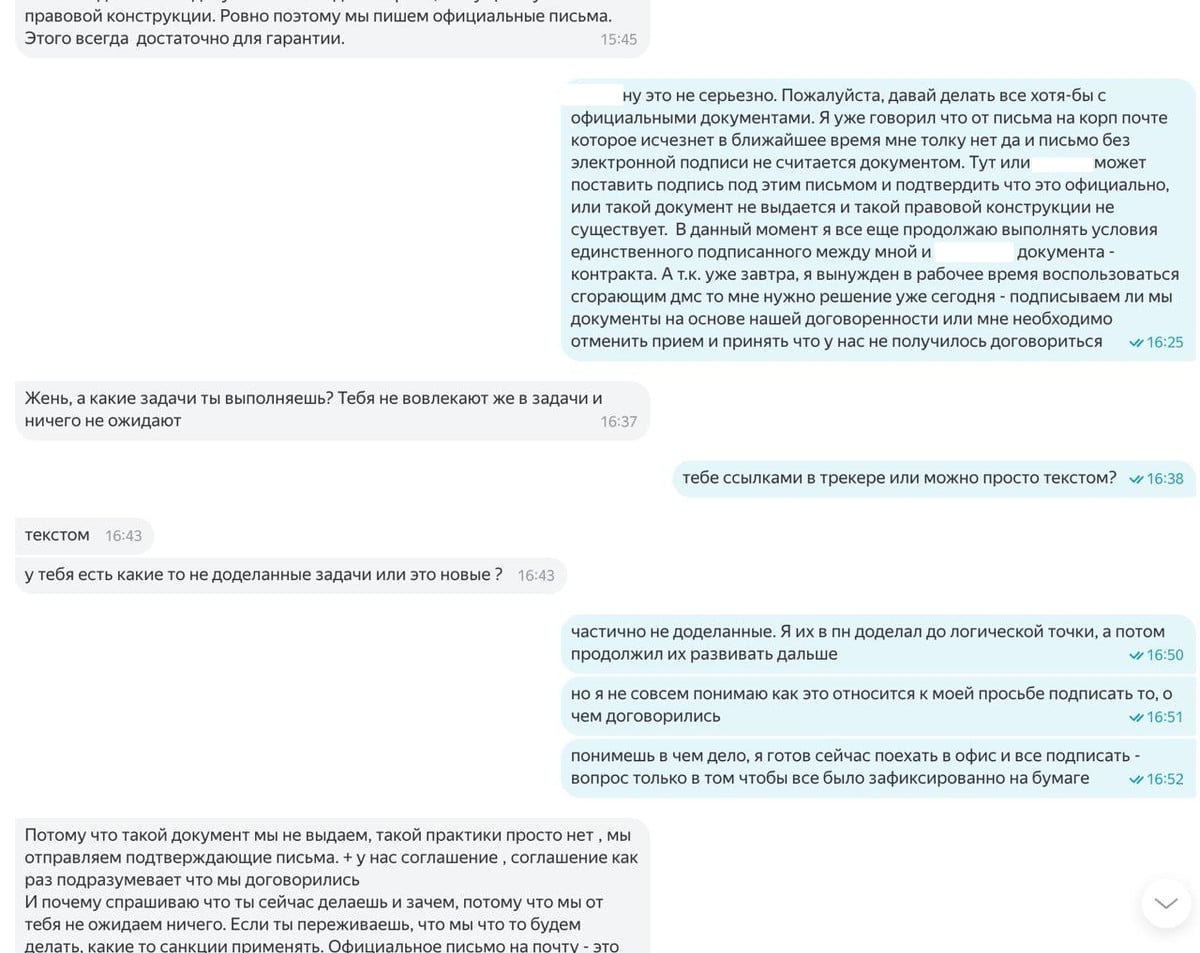
Having not seen his demands met, Zhenya refused outright to sign the contract termination agreement. After that, it turned out that HR had managed to “squeeze out” compensation amounting to five months’ salary, the young man says.
“By that point, I was so upset that I took the call and said I now wanted six months’ salary.”
We reached an impasse because I didn’t want to sign the contract termination agreement, and it was already difficult for HR to negotiate a higher amount.

In the end, Zhenya proposed the following: he would work for one month from the date he received the termination notice and receive compensation equal to five months’ salary. That’s what we settled on.
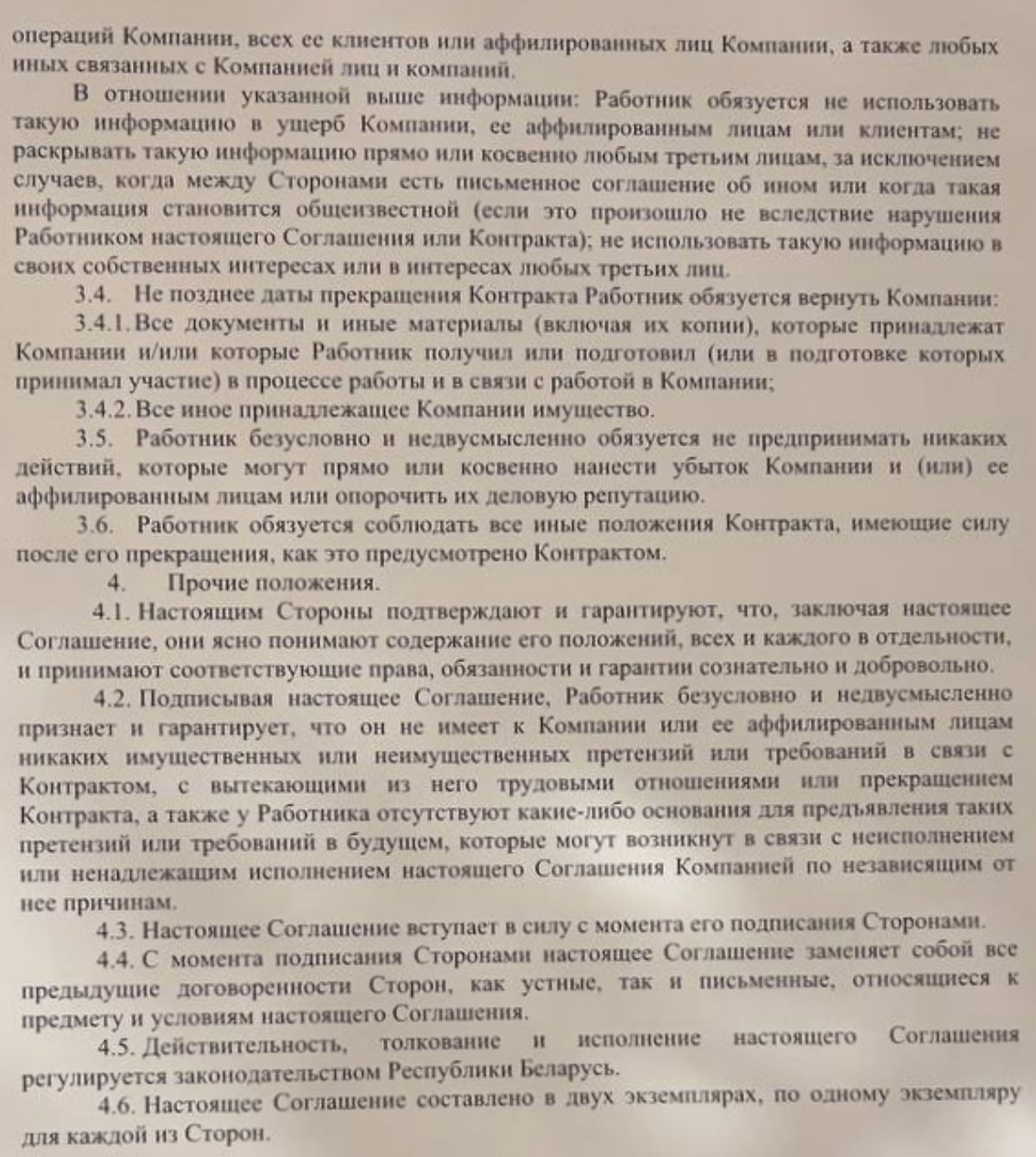
According to our protagonist, the final payment he received from the company ultimately exceeded 75,000 Belarusian rubles.
“So it turns out I left almost satisfied, since I got what I wanted. But it was such a nerve-wracking, exhausting process… Later I found out that my colleagues were leaving, settling for three months’ salary—or even less.”
Technically, the company’s management didn’t deceive anyone; there are no official layoffs, and everything is happening fairly quietly.
“It’s easier to just sign a single piece of paper”
Journalists reached out to lawyer Elena Romanchuk for clarification on Zhenya’s situation.
— Based on the protagonist’s statements, one can conclude that it was “more advantageous” for the company to terminate the contract by mutual agreement rather than through layoffs, because previously some employees had agreed to compensation amounting to one or two months’ salary, rather than three (as is required in the case of a layoff). Furthermore, in the event of a layoff, the employer must give the employee two months’ notice, provide them with a workload for that period, notify the relevant authorities (the executive committee, the union if one exists), and formally process the layoff paperwork.
In Evgeny’s case, to resolve the conflict that had already arisen regarding the formalities of his dismissal, the company agreed to his terms. This cannot be called blackmail or extortion on the part of the employee—rather, the company simply does not know how to lay off employees due to workforce reduction and fears violating the law—and the employee took advantage of this. In practice, it is indeed often easier for private companies to simply sign a single document and pay these amounts.
Elena Romanchuk emphasizes: termination of an employment contract at the employer’s initiative is possible only on the grounds provided for in Article 42 of the Labor Code of the Republic of Belarus. An employer may terminate an employment contract in the following cases:
the organization where you worked is being liquidated;
the employer has decided to reduce the number of employees or downsize the workforce;your health prevents you from continuing to work, as a result of which you no longer meet the requirements of your position (you are ill or lack the necessary qualifications);
you skipped work or were absent for more than 3 hours during a workday without a valid reason;you showed up to work intoxicated, and so on.
— In Evgeny’s case, the employer was not interested in terminating the employee’s contract due to staff reductions, and by mutual agreement, he worked for one month and received compensation equal to five times his average monthly earnings.
Belarusian and Russian law do not specify such notice periods or compensation amounts, but they may be established by the parties in a termination agreement.
— How far in advance must an employee be notified of termination?
— Two weeks’ notice is the standard under Russian law. In Belarus, notice of layoffs must be given two months in advance, with severance pay amounting to at least three times the average monthly earnings (excluding employer bonuses, insurance, English language course payments, and so on). Average earnings include salaries, allowances, bonuses, and additional payments directly related to labor compensation.
This is stipulated in Instruction No. 47 on the Procedure for Calculating Average Earnings, dated April 10, 2000. Evgeny would have been notified of the layoffs two months in advance, and upon termination, he would have received a payment equal to three times his average monthly earnings.
Therefore, in the situation described by the reader, he secured more favorable terms of termination by enshrining all of the employer’s obligations in the termination agreement.
The collective bargaining agreement may stipulate even higher amounts of severance pay in the event of layoffs, but not less than three times his average monthly salary.
The collective bargaining agreement may stipulate that termination of an employment contract at the employer’s initiative may only occur with the consent of the relevant labor union. If such a condition is stipulated but the employer has not coordinated the termination with the labor union, the termination will be unlawful and the employee may be reinstated (Part 1 of Paragraph 15 of Resolution No. 9 of the Plenum of the Supreme Court).
To resolve a dispute regarding reinstatement, regardless of the grounds for termination of the employment contract, one must file a lawsuit. This is required by paragraph 3 of Part 2 of Article 241 of the Labor Code and paragraph 1 of Part 2 of Article 39 of the Code of Civil Procedure of the Republic of Belarus, the lawyer notes.

Bank's name: Bank Millennium S.A.
Address: ul. Stanislawa Zaryna, 2A, 02-593, Warszawa
IBAN: PL97116022020000000216711123
SWIFT: BIGBPLPW
Name of the account holder: Fundacja “KARTA ‘97”
Purpose/title of payment: Donation for statuary aims
You can contact us by the e-mail charter97@gmail.com