


"The Landlady Disappeared, And He Lived In The Room For Free For A Year."
- 28.11.2026, 11:36

A Belarusian woman decided to help her friend with an inheritance in Minsk—and that's when the adventures began.
Helping people is a noble cause, but it can sometimes be extremely unpredictable. Our reader Vitalia found this out firsthand when she agreed to help a friend from Russia claim an inheritance in Minsk and then sell that very inheritance. Mentally, she was prepared for any “everyday hassle,” but reality turned out to be far more colorful, writes Onliner.
A Mysterious Stranger
Vitalia explains that it all began with a request from a friend living in Russia: her sister had passed away, and someone was needed to help claim the inheritance in Belarus.
At stake was a room in a four-room apartment.
Due to the distance and her work schedule, it was inconvenient for the heiress to travel back and forth. After giving Vitalia a general overview of the situation—though she herself didn’t really know much about it—her friend gave the Minsk resident the go-ahead to resolve all issues by any legal means necessary.

— When I agreed to help my friend, I certainly thought through the difficulties I might face. For example, I assumed that the neighbors might have already started using the “vacant” room and that they would try to throw a wrench in the works when it came time to sell. But how wrong I was. The problem lay elsewhere entirely,” the young woman recalls. — The inheritance process took a very long time: I made frequent trips to the notary; the whole process took almost a year (by law, I first had to wait six months for the right to inherit, and then it took almost as long to confirm that there were no other heirs in Russia).
I came to see the room for the first time sometime in early to mid-July of this year. I remember that the neighbors didn’t open the door for a long time; I even thought about calling the police. But in the end, everything worked out: after showing the residents my documents, I went into the apartment.
And I was immediately taken aback: it turned out that a man was living in my friend’s room. While I was trying to figure out how that was possible and who he could be, the man himself came out to see what the commotion was about.
Vitalia says that the unexpected encounter went smoothly: the man introduced himself as Tair (name changed, but similar to the original) and explained that the owner had rented the room to him (as it later turned out, literally the day before her death). They didn’t sign a lease; the man managed to pay once or twice, and then the landlady stopped responding. His words were backed up by their correspondence.
— I was, of course, surprised by his approach: the landlady had suddenly disappeared, yet he continued to live in her room as if nothing had happened and didn’t even set aside rent in case she reappeared.
At the agreed-upon rate of about $150 per month, he had racked up a debt of $1,650 over the course of a year.
And when I brought up the issue of paying that amount, his eyes widened in shock. The man hesitated and asked for an installment plan. Now I think I should have called the police right then and there, but at the time I decided to be more understanding.
Was he a tenant, or did he become a buyer?
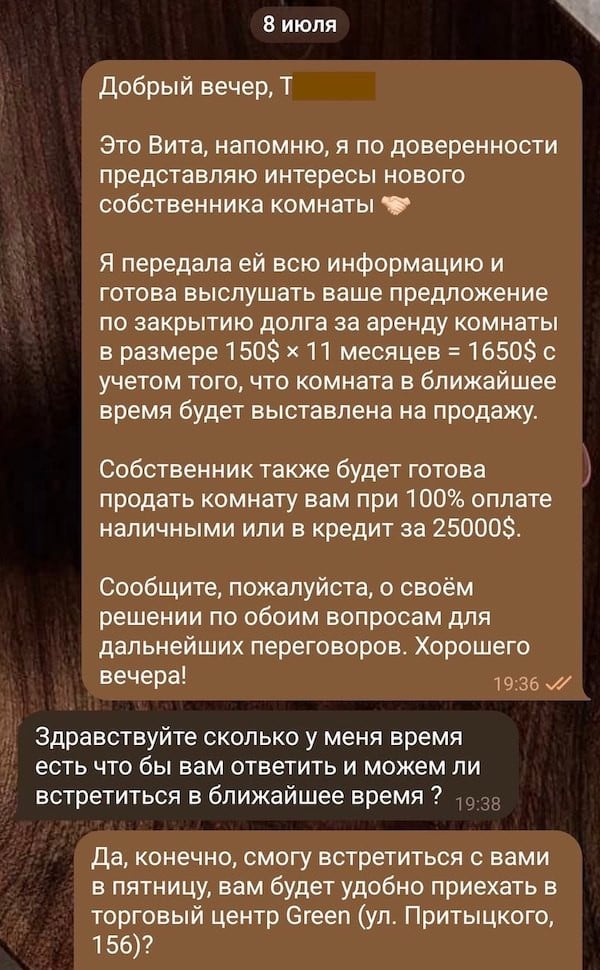
The young woman recalls that she made it clear to the tenant right away—they were planning to sell the room, so a payment plan wouldn’t work. The man replied that he, too, would like to buy the “space” that had already become like home to him. He said, “Just give me a little time to think it over.”
“I told my friend everything and shared my doubts, but we decided to give it a try because he was okay with our terms, and selling the room—especially at a good price—isn’t exactly easy.” We agreed to take a break for a couple of weeks first: I needed to get rejections from the other owners, after which we could discuss closing the deal.
After the agreed-upon time had passed, the tenant confirmed that he was ready to buy the room, but only on the condition that his rent debt be “forgiven.”
— What bothered me most about the whole situation was not only that this person had been living in someone else’s home for free for nearly a year without even thinking about moving out, but also that he hardly ever interacted with his neighbors: no one even knew where he worked. Tair told one resident that he worked as a doctor on night shifts, another that he was a translator and a foreman at a construction site, and me that he was a real estate agent with nearly 20 years of experience. Also, during a face-to-face meeting, the man told me that he used to have a large business and his own cottage in Borovlyany, but then something happened and he had to sell everything. And now he would like to first buy out the room where he lives, and then acquire the remaining shares.
I can’t deny that for a while he managed to dispel my doubts, because he was the one who initiated the meetings, asked a lot of questions about the room, the apartment as a whole, the real estate market, the other owners, and how to communicate with them. At one point, I even started to think that I was just overreacting and that there was no need to worry about anything. That’s when the strange things started.

He was just stalling
In just over a month, the woman from Minsk prepared the paperwork for the transaction and began discussing a deposit with the tenant.
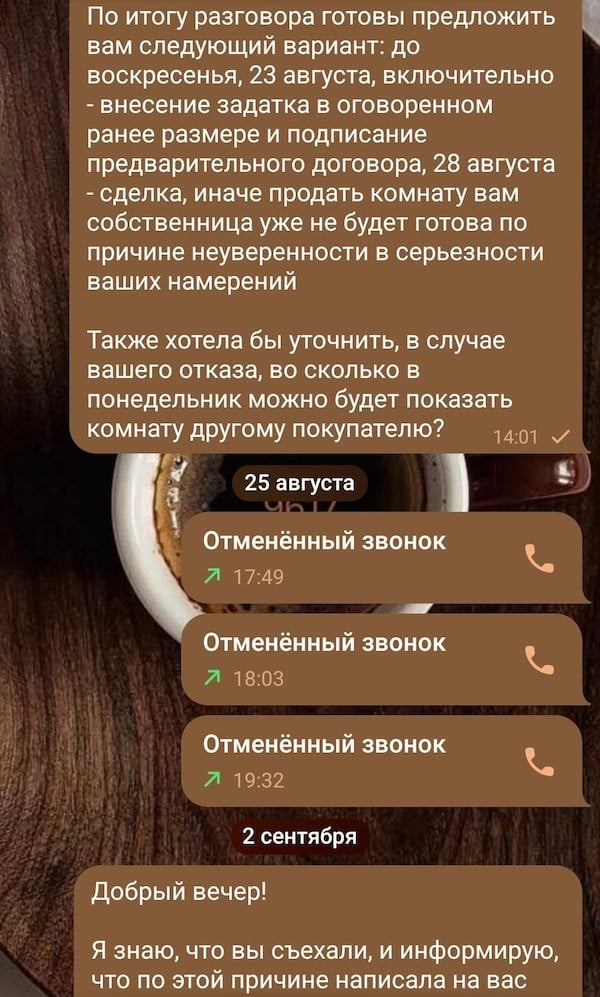
“My friend, who is a foreign national, has to pay a large tax—about 9,000 rubles—to complete the transaction.” Plus, the tenant hadn’t paid his “utility bill” all year (he gave money to his neighbors for electricity and water, but there was still an individual bill for the room), and he’d racked up a debt of about 650 rubles. It was important for us to sign a preliminary agreement and receive a deposit, but at that point, Tair started saying that even though the money had been transferred to him from Lebanon, he didn’t want to pay the deposit. After two meetings—each of which he was supposed to attend with the deposit—I made it clear that I wouldn’t continue negotiations without the money, and we agreed that he would definitely bring the money to the next meeting, we’d draw up the contract, and then set the date for the transaction.
Well, on the day of the meeting, the man stopped responding. Completely.
Vitalia spoke with the neighbors and waited a few days—during that entire time, the tenant didn’t show up at the apartment, and the neighbors said that just the day before the planned meeting, the man had been actively carrying bags of belongings out of the apartment.
“I went to the police station and was pleasantly surprised when, right in front of me, the local officer quickly found Tair in his database using his phone number and took my statement. I felt a glimmer of hope that the tenant wouldn’t get away with such a despicable act. But a few weeks passed, and I received a response: the police couldn’t help—it’s a civil matter.
I’m really angry at myself for being so kind, but there’s nothing I can do about it now: I don’t see the point in filing a lawsuit, as the police suggested.
Even if we win the case, it will take several years to collect the debt. At first, I thought about posting a photo of Taira and her phone number on social media, but because of the law on personal data, that’s no longer safe for me. So now my main goal is to quietly close the deal and forget this whole thing as a valuable life lesson.

Bank's name: Bank Millennium S.A.
Address: ul. Stanislawa Zaryna, 2A, 02-593, Warszawa
IBAN: PL97116022020000000216711123
SWIFT: BIGBPLPW
Name of the account holder: Fundacja “KARTA ‘97”
Purpose/title of payment: Donation for statuary aims
You can contact us by the e-mail charter97@gmail.com