

A Belarusian Doctor And Political émigré Has Become One Of The Most Memorable Characters In A Polish TV Series
- 7.11.2026, 9:34
The word “traitor” is branded on his back.
The story of a Belarusian doctor who was forced to leave his homeland following the protests has become one of the storylines in the Polish series “Anesthesia” (Znieczulenie), which premiered on the Netflix streaming platform. It depicts the plight of many talented Belarusian medical professionals who, due to “politics,” have once again had to start their careers from the very bottom in a foreign country. The series also mentions the migration crisis on the Polish-Belarusian border, writes MOST.
The medical drama directed by Łukasz Ostalski premiered on September 4, 2026.
In the series, Dr. Lazar, played by Leszek Lichota, is an outstanding Polish neurosurgeon. However, his career in Warsaw is threatened after a daring but unsuccessful brain surgery on a young man. As a result, he moves to Suwałki—a city in the Podlaskie Voivodeship, about 60 kilometers from the Belarusian border. There, he gets a job at the local hospital.
“I’m a cardiac surgeon. I used to be one in Belarus”
The Belarusian doctor Oleg Kovalev (played by Ukrainian actor Andriy Zhuravsky) is not a central character, but a memorable one. However, according to the plot, he cannot work as a doctor in Poland and mainly works as a janitor at the hospital.
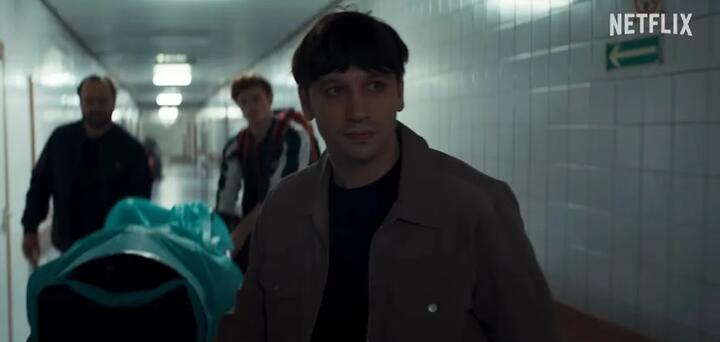
In the first episode, he helps the main character examine a patient who has just been brought in by ambulance in serious condition.
“It looks like a myocardial contusion,” says the Belarusian.
“How do you know that?” asks the neurosurgeon in surprise.
“I’m a cardiac surgeon. I used to be one in Belarus. Here, I’m just cleaning up,” he replies.
Later, Oleg says he has already submitted his application for the state exam required to return to his profession. He’s preparing to take it in six months. “That’s a very long time. By then, your fingers will go numb, kid,” the doctor tells him.
According to the plot, Oleg arrived in Poland after serving time in his homeland for “political reasons.” He has a huge scar on his lower back—the word “zdradnik” (in Belarusian) burned into his skin. This is how the creators of the Polish series depicted what the character had to endure in prison.
Oleg Kovalev—if not a collective embodiment of a Belarusian political emigrant, then certainly someone trying to convey a collective pain. He is tormented by nightmares and has outbursts of aggression. Explaining his condition, he says: “Every other opposition activist suffers from an anxiety disorder.”
The Belarusian doctor is portrayed in the series as a man who keenly feels the pain of others. But despite all his nobility and professionalism, Kovalev is not a perfect character. Unable to cope with the trauma he has experienced, he steals psychotropic drugs in broad daylight, distracting a colleague by flirting with her. Later, one of the staff members finds Oleg lying on a stretcher in a semi-conscious state. Later, during a scuffle with a colleague, an almost empty package of psychotropic medication falls out of his pocket.
The Migration Crisis in the Series
In the fourth episode, the topic of the migration crisis on the Polish-Belarusian border is unexpectedly raised. The show’s creators do not focus on its political causes, instead centering the plot on the migrants’ drama.
A married couple accidentally finds a dark-skinned girl in the woods and calls an ambulance. Lazar, a neurosurgeon who happened to be nearby, accompanies the medical team to the scene. The girl is in critical condition: she has no pulse or breathing, and her heart stops. However, resuscitation efforts bring the child back to life.
At the hospital, the girl, named Ranya, regains consciousness. Oleg Kovalev happens to be by her side at that moment—and, with the help of an online translator, learns that the migrant’s mother is still in the forest. He sets out alone to search for her.
What were you doing in Belarus? — I wanted to make a difference
After finding the migrant woman in the forest, Kovalev sees that she has a chest wound and needs surgery due to fluid buildup in her pericardium. Oleg turns to Lazar for help and convinces him to perform the surgery in the hospital basement so that no one would find out about the woman and deport them—him and his daughter—back to Belarus. In the end, Kovalev—who by that point hadn’t performed surgery in 10 months—performs the operation himself, with the Polish doctor assisting him.
“What were you even doing in Belarus?” the Polish doctor asks.
“I believed in a lot of things. I wanted to change something.”
“But you don’t believe in them anymore?”
This question goes unanswered. The surgery is a success.
How Belarus and its relations with Poland are portrayed
Despite the Belarusian doctor’s controversial actions, his Polish colleagues support him and recognize his professionalism even without official documents. And the psychiatrist he sees tries to help him cope with the ghosts of his past and his addiction.
The viewer learns about Belarus from Kovalev’s words. “You don’t know what it’s like here in Belarus. You can’t see it from Poland, but back home there are many people who want our country to be different,” he tells his psychiatrist.
Who plays the Belarusian
The role of the Belarusian doctor in the series was played by 31-year-old Ukrainian actor Andrei Zhuravsky. He was born in Lviv. He received his acting education at the I.K. Karpenko-Kargi Kyiv National University of Theater, Cinema, and Television.

Bank's name: Bank Millennium S.A.
Address: ul. Stanislawa Zaryna, 2A, 02-593, Warszawa
IBAN: PL97116022020000000216711123
SWIFT: BIGBPLPW
Name of the account holder: Fundacja “KARTA ‘97”
Purpose/title of payment: Donation for statuary aims
You can contact us by the e-mail charter97@gmail.com