


Scientists Have Uncovered The Secret Behind Octopuses' Incredible Flexibility
- 9.11.2026, 17:01
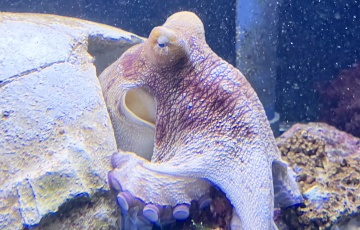
They are able to squeeze through holes much smaller than their own bodies.
Octopuses use various methods to squeeze through openings that are significantly narrower than their bodies. Some are able to first extend their tentacles through a narrow passage and then pull their bodies through in sections. Others do not even attempt to squeeze into a space that is too tight. Biologists discovered these differences by studying the behavior of two species of octopuses, according to Popular Science.
Researchers led by marine biologist Wenqi Xin from the National University of Singapore observed May octopuses (Octopus maya) and young common octopuses (Octopus vulgaris). For the experiment, the scientists set up transparent aquariums connected by openings of varying diameters.
“There is no information on how octopuses squeeze through an opening that is much smaller in diameter than their bodies,” Xin explained, describing the gap in scientific knowledge.
When passing through a wide opening, the octopus first explored it with its tentacles, then slipped one limb through, followed by several more. It clung to the aquarium walls with its suction cups and pushed off, dragging the rest of its body through. On average, the entire process took about 20 seconds.
When faced with narrow openings, common octopuses changed their tactics: first, they retracted all their tentacles, and then they squeezed their mantle and head through.
The May octopuses behaved differently: they did not even attempt to pass through the small openings, preferring to look for a wider passage.
The experiment showed that octopuses’ flexibility is not limitless. The size of the cartilaginous skull, which protects the nervous system, may determine the physical limits of their ability to squeeze through tight spaces.

Bank's name: Bank Millennium S.A.
Address: ul. Stanislawa Zaryna, 2A, 02-593, Warszawa
IBAN: PL97116022020000000216711123
SWIFT: BIGBPLPW
Name of the account holder: Fundacja “KARTA ‘97”
Purpose/title of payment: Donation for statuary aims
You can contact us by the e-mail charter97@gmail.com