Every Fifth Russian Admits Mass Protests In Russia Due To Falling Living Standards
- 14.05.2026, 22:54
Survey.
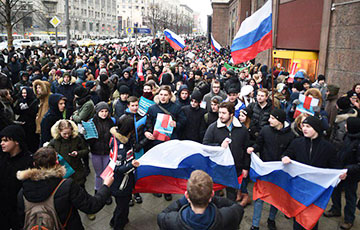
The share of Russian citizens admitting mass protests in connection with the decline in living standards in the country has reached 20%. Another 14% of respondents believe that speeches with political demands are possible. These are the results of the Levada Center survey - both indicators have become the highest since July 2024.
If compared with the November survey, the number of those who believe in the possibility of economic protests has increased by 4 percentage points (from 16%), and political protests - by 3 points (from 11%). The willingness to personally participate in political actions increased by 1 percentage point, to 12%. At the same time, the share of potential participants of economic protests, on the contrary, decreased by 1 p. p. to 16%. The poll was conducted from April 22 to April 29.
The protest potential was recorded higher only in July 2024 (21% - against the fall in living standards, 15% - with political slogans). For comparison: in February 2022, 29% of Russians considered mass protests possible, while 23% were ready to participate in economic actions and 18% in political ones.
The growth of protest sentiment is taking place against the backdrop of a decline in the government's rating. According to the Kremlin-controlled VTsIOM, Vladimir Putin's approval rating fell to 65.6% in April, the lowest since the start of the war in Ukraine. Support for United Russia slipped below 28 percent, also renewing an anti-record since February 2022. In an open poll by VTsIOM, where respondents themselves name those they trust, Putin's result was 29.5% - again the lowest since the start of the full-scale invasion. After that, FOM and VTsIOM refused to publish the weekly presidential rating.
The shift in sentiment, according to experts, can be explained by a complex of reasons. Gulnaz Sharafutdinova, director of the Russia Institute at King's College London, points to the shutdown of messengers and the Internet, unrealized hopes for a deal with the U.S. on Ukraine and general fatigue from the war, which is hitting the economy and living standards harder and harder. Sociologist and former Russian government adviser Konstantin Gaase adds: the authorities are increasingly interfering in everyday life (blackouts, restrictions), and the war is penetrating deeper inside Russia - drones, strikes on oil refineries. "It all accumulates over time," he explains.

Bank's name: Bank Millennium S.A.
Address: ul. Stanislawa Zaryna, 2A, 02-593, Warszawa
IBAN: PL97116022020000000216711123
SWIFT: BIGBPLPW
Name of the account holder: Fundacja “KARTA ‘97”
Purpose/title of payment: Donation for statuary aims
You can contact us by the e-mail charter97@gmail.com