


Ukrainian Defense Forces Have Already Reached Mariupol
2- 9.05.2026, 11:33
- 4,236
ISW analyzed how this could affect the course of the war.
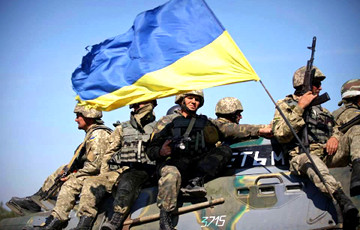
1 Corps of the National Guard of Ukraine "Azov" has already reached temporarily occupied Mariupol. More than 100 km away from the front line, Ukrainian soldiers are conducting reconnaissance and creating problems for the occupants' logistics with the help of drones.
The invaders can no longer feel safe in the Mariupol area. This is stated in a piece by the Institute for the Study of War (ISW).
Azov is nightmarishing the occupiers in and around Mariupol
Analysts noted that the Defense Forces are already conducting reconnaissance and cutting off Russian ground lines of communication in occupied Mariupol, Donetsk region, from which there are about 105 kilometers to the front line. And it is evidence of Ukraine's growing medium-range strike capabilities.
The 1st Corps of Ukraine's Azov National Guard on May 8 reported strikes on Russian military targets near Mariupol and UAV operators cutting off Russian logistics up to 160 kilometers deep.
Geolocation footage released on May 6 and 8, notably by Azov, confirms that Ukrainian forces launched drones and hit a truck on the T-0509 Mariupol-Donetsk highway (H-20 highway) about 95 kilometers from the front line.
Additional geolocation footage of the 1st Corps of the Azov NSU recorded the operation of Ukrainian UAVs along the same highway approximately 95-104 kilometers from the front line, as well as in Mariupol itself, on the M-14 Mariupol-Berdyansk-Melitopol highway.
The N-20 Mariupol-Donetsk highway is used by the occupants to supply their groups operating north of Mariupol and further to the northeast as part of the offensive against the Ukrainian "belt of fortresses."
The M-14 Mariupol-Berdyansk-Melitopol highway extends westward to the occupied Zaporizhzhya and Kherson regions and supports Russian logistics on the Orekhovsky direction and the eastern (left) bank of the Dnieper.
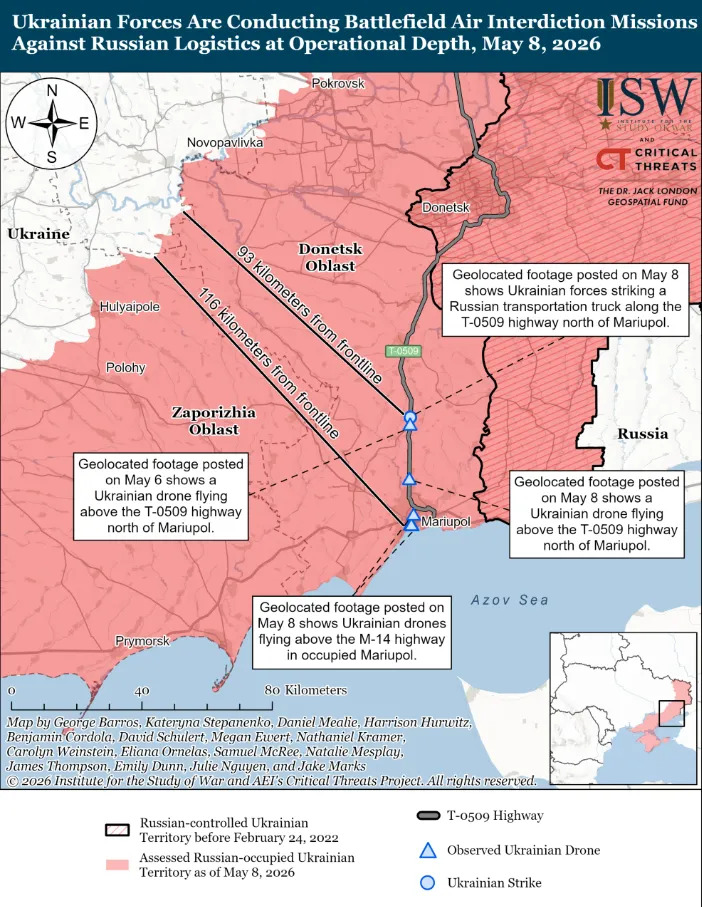
"Ukraine's ability to conduct drone strikes against moving targets more than 100 kilometers from the front line, in areas where Russian forces were previously able to conduct logistics relatively safely, is likely to result in partial battlefield effects of aerial interdiction, impairing the ability of Russian forces to conduct future offensive operations or defend against Ukrainian counterattacks," ISW said.
Analysts recalled that since the end of December 2025, the Defense Forces have been intensifying mid-strikes (strikes at operational depth at a distance of 50-200 km) against occupation troop concentrations and Russian military facilities in the occupied part of Ukraine. Since March of this year, the intensity and frequency of such strikes has increased significantly - and, ISW anticipates, this trend will continue in the future.
"The enhanced and sustained efforts of the Ukrainian air interdiction campaign at operational depth may support future Ukrainian counterattacks, such as the Ukrainian counterattacks that led to the liberation of a large part of Kupyansk in November 2025 and more than 400 square kilometers in southern Dnipropetrovsk Oblast in early 2026," ISW predicted.

Bank's name: Bank Millennium S.A.
Address: ul. Stanislawa Zaryna, 2A, 02-593, Warszawa
IBAN: PL97116022020000000216711123
SWIFT: BIGBPLPW
Name of the account holder: Fundacja “KARTA ‘97”
Purpose/title of payment: Donation for statuary aims
You can contact us by the e-mail charter97@gmail.com