

The Telegraph: Ukraine Has Turned Russia’s Last Land Route To Crimea Into A “road Of Death”
2- 13.06.2026, 10:18
- 7,916
It appears that Kyiv has achieved what Washington once failed to do.
For decades, the American campaign against the Ho Chi Minh Trail remained a textbook example of a failed attempt to cut off an enemy’s supply lines. American bombers struck this jungle route for years, yet North Vietnamese forces continued to advance south. Now, however, Ukraine appears to be achieving what Washington failed to do.
This is currently happening in the temporarily occupied south of the country, writes The Telegraph. The P-280 highway—Russia’s last reliable land route to Crimea—has been turned by relentless Ukrainian drone strikes into what the Russian military itself now call the “road of death”.
Russia has only two routes to Crimea
The first is via the Kerch Bridge, but it is so damaged and vulnerable to repeated strikes that Moscow has long avoided transporting fuel and military cargo across it. The second—the R-280—is now under constant attack.
This is a dilemma that is forcing Moscow to acknowledge an uncomfortable truth: after four years of war, there is no longer a safe way to supply Crimea, the media reports.
“This is a very classic military strategy. It is often said that amateurs discuss tactics, while professionals discuss logistics,” said Robert Tollast, a researcher with the Land Warfare Group at the Royal United Services Institute (RUSI) .
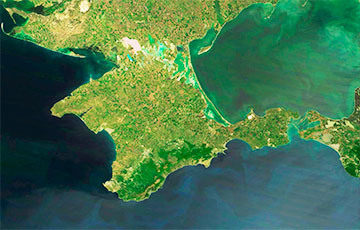
It is reported that the R-280 is one of Ukraine’s main arteries, stretching over 480 kilometers from Rostov-on-Don through the occupied cities of Mariupol and Melitopol to Crimea along the coast of the Azov Sea.
It has become the main supply route for Russian troops fighting across the entire southern front—from Zaporizhzhia and Kherson to the Crimean Peninsula itself.
“There’s the Kerch Bridge, there’s Highway R-280—and that’s it,” noted Nick Reynolds, a research fellow on land warfare at Rusi . “This has always been the dilemma Russia would face if the highway or the bridge were cut off.”
“Logistical Blockade”
On May 27, Ukrainian Defense Minister Mykhailo Fedorov named the campaign and announced its budget: Operation “Logistical Blockade” on Highway R-280 received funding of approximately 4.7 billion hryvnia. In doing so, Fedorov officially enshrined as state policy what had been a quiet and steadily escalating operation over the course of several weeks.
“Even before the defense minister’s announcement, the Armed Forces of Ukraine had been striking Russian logistics in the south for quite some time—starting in the first half of May,” explained Nazariy Barchuk, an analyst at the Ukrainian Center for Security and Cooperation .
According to him, the announcement of a “logistical blockade” is a demonstration of Ukraine’s capabilities and an emphasis on the operation’s success. Circulating footage from Ukrainian drone units shows the campaign in minute detail. One can see how fuel tankers and trucks carrying equipment were caught en route on the R-280—many engulfed in flames after the attack.
The report states that the campaign began not with strikes on logistics, but with the systematic destruction of short-range anti-aircraft missile systems—in particular, the “Pantsir” systems.
The "Pantsir" is a mobile, short-range anti-aircraft missile and gun system designed to engage drones, missiles, and aircraft at close range.
It is precisely this type of weapon that Russia would need to protect its convoys from FPV drones, which are now hunting them along the R-280.
This campaign has presented Russia with an impossible choice
Now the Russian Federation is trying to decide what exactly to defend—Crimean warehouses, railway networks, or oil refineries.
Initially, many wondered why Ukraine was specifically destroying Russian short- and medium-range radar and anti-aircraft missile systems. But in the end, the Ukrainian Armed Forces managed to inflict massive losses on the occupiers and severely stretch Russian air defenses.
“Corridors have formed, allowing Ukrainian drones to successfully penetrate Russian air defenses and carry out strikes,” Barchuk said.
Ukraine’s strikes are carried out by so-called “medium-range” drones—including the Hornet, Darts, FP-2, and the long-range “Behemoth,” operating at ranges of 100 to 240 kilometers.
According to Barchuk, the campaign is currently a large-scale joint operation involving the 1st Corps of the Ukrainian National Guard “Azov,” the 17th Army Corps, Unmanned Systems Forces, the Security Service, and military intelligence.
“The medium-class strike UAVs that Ukraine can now deploy are inferior in performance to more powerful models, and each one individually is relatively easy to shoot down. However, it is precisely the scale of production that Ukraine has now achieved that is decisive,” Reynolds emphasized.
This is the same dilemma that the “Shaheds” presented to Ukraine, only in reverse—and the impact of the “road of death” on Russia’s actions in the south is evident, the media reports.
Russia is facing problems on the front lines
Russian troops on the front lines are already experiencing disruptions in the supply of provisions, weapons, drones, and troop rotations, but the most acute problem is fuel. “The Russian army simply cannot refuel the generators used to charge radios, battery stations, and so on,” Barchuk noted.
Each truck carries three to five tons of cargo; the destruction of hundreds of such vehicles creates a “truly dire situation” for the three to five thousand soldiers that a single convoy can support. The campaign has also hit civilians: fuel shortages have been confirmed in Sevastopol and Yevpatoria, fuel ration cards have been introduced, and vacationers have found themselves trapped—without fuel to leave.
Kremlin press secretary Dmitry Peskov, in turn, called the disruptions “groundless panic” among the population—even as evidence mounted that the Russian defense simply could not cope.
The obvious conclusion is that Russia neglected air defense along this route—but Reynolds disagrees.
“It’s not that Russia hasn’t built up its air defense system,” he said. “Russia has robust coverage across its entire territory—not only along this supply route, but also at other key logistics hubs, command centers, and warehouses.” The problem, in his view, lies in the purpose for which these systems were designed: to intercept a small number of high-end, expensive cruise and ballistic missiles—not to counter a relentless swarm of cheap, mass-produced drones.
Russia is trying to adapt: equipping convoys with anti-aircraft machine guns, experimenting with dazzle camouflage, and deploying FPV interceptors—yet so far, all these efforts have proven futile.
The Kremlin’s options are limited
The remaining routes—road, rail, sea, and air—have all either deteriorated or become too risky.
Even without a single Ukrainian soldier setting foot on Crimean soil again, the strategic picture is changing.
“As we’ve seen on land: even though it’s very difficult for Ukraine to recapture territory, there is still progress—albeit slow,” Reynolds emphasized. “But if Crimea finds itself in a position where Russia cannot supply it properly, that becomes a serious bargaining chip in any future negotiations. It is a significant demonstration of Ukraine’s capabilities.”

Bank's name: Bank Millennium S.A.
Address: ul. Stanislawa Zaryna, 2A, 02-593, Warszawa
IBAN: PL97116022020000000216711123
SWIFT: BIGBPLPW
Name of the account holder: Fundacja “KARTA ‘97”
Purpose/title of payment: Donation for statuary aims
You can contact us by the e-mail charter97@gmail.com