

The Azov Trap
1- 15.07.2026, 8:28
- 2,294
A quarter of Russia's grain exports have suddenly come to a halt.
Attacks on tankers and the suspension of shipping in the Sea of Azov have paralyzed grain exports from Russia. The ports of Azov, Rostov, and Taganrog account for a quarter of shipments, so the blockade in the midst of the harvest threatens Russian farmers with losses, writes New Voice.
The closure of navigation in the Sea of Azov has led to a sharp 3–5% rise in global wheat prices on commodity exchanges. Since the bulk of shipments takes place between August and December, a prolonged blockade of sea routes threatens to cause domestic prices in Russia to collapse due to warehouse overflows, according to Russian Forbes.
Port Shutdowns
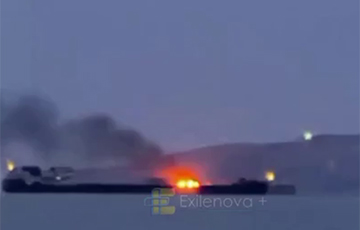
A series of attacks in the Sea of Azov began on July 8 with strikes on two tankers. On July 10, the governor of the Rostov Region, Yuri Slyusar, reported a fire at the port of Taganrog. On July 12, he reported damage to another vessel following a drone attack at the entrance to the Azov-Black Sea Canal.
Reuters reported that Russia had suspended traffic through the Azov-Don Canal and the Kerch Strait following attacks on 13 vessels. Russian border guards stopped accepting transit requests at 6:10 p.m. on July 10. The restrictions affected the ports of Azov, Rostov-on-Don, and Taganrog. These hubs account for a quarter of Russia’s grain exports, according to Eduard Zernin, chairman of the board of directors of BIO-TON.
“The issue of shipping in the Sea of Azov falls under the jurisdiction of the Ministry of Transport,” noted the press secretary for the Russian dictator Dmitry Peskov.
Consequences for the Market and Exports
The consequences of the shipping blockade are being felt at all levels—from physical infrastructure to global pricing. The strait is closed to both incoming and outgoing traffic, which means a complete halt to movement along this route, notes Natalia Zgurskaya, CEO of the agricultural company “Zemlitsa.”
In Russia, the grain harvest is currently underway in the south, and it is precisely these regions that account for the bulk of the country’s export potential. Global exchanges have already reacted to these events. According to Andrey Sizov , director of the Sovecon analytical center , wheat prices on the global market rose by 3–5% on July 10. Futures for grain delivery in September 2026 on the Chicago Board of Trade rose by 3.31% to $235 per metric ton, while on Euronext, the price increased by 4% over the course of the day.
The suspension of ship passage through the Kerch Strait will affect exports. Sizov notes that short-term restrictions through the end of July will have a negligible impact, but a prolonged suspension of navigation will significantly hinder grain exports, especially after the harvest is completed in August.
“During this period, the bulk of grain is sold for export; in some months, shipment volumes reach 6 million metric tons. Therefore, there is virtually nowhere to redirect volumes from the blocked ports, which will significantly adjust export estimates for the season,” he explained.
The Russian Ministry of Agriculture has stated that logistics could be reoriented, but no concrete plans are in place yet; it adds that alternative routes for cargo flows are currently being developed in collaboration with the business community and relevant agencies.
The suspension of shipments has led to overcrowded warehouses, as well as to idling of road transport and the fleet in Russia. The problems have even affected shallow-water ports on the Volga. The deep-water terminals on the Black Sea and in the Northwest are unable to replace the blocked capacity, and the throughput capacity of the terminal in Vysotsk (Leningrad Oblast, Baltic Sea—ed.) is limited to 4 million metric tons per year.
Falling demand, declining purchase prices, fuel shortages, and mounting debt have become the logical outcome both for the Russian occupiers who seized Ukrainian ports in the Sea of Azov and attempted to use them, and for the Russian agricultural sector, which found itself trapped by its own imperial ambitions.

Bank's name: Bank Millennium S.A.
Address: ul. Stanislawa Zaryna, 2A, 02-593, Warszawa
IBAN: PL97116022020000000216711123
SWIFT: BIGBPLPW
Name of the account holder: Fundacja “KARTA ‘97”
Purpose/title of payment: Donation for statuary aims
You can contact us by the e-mail charter97@gmail.com