China Has Displaced MTZ From Russia
2- 19.08.2026, 11:02
- 2,438
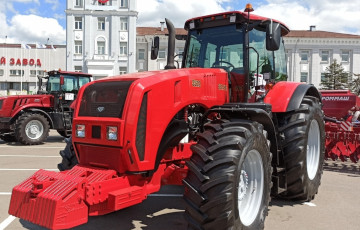
The Minsk plant will reduce the number of dealerships in Russia.
The Minsk Tractor Plant plans to reduce the number of dealerships in Russia. CEO Taras Murog explained that the company plans to focus on the quality of service. Of course, the CEO made no mention of last year’s record plunge in sales profits in Russia.
We’re winding down operations in Russia
Russia accounts for 55 percent of Belarusian tractor sales. That is why the factory has been developing its dealer network there for years. As a result, it has grown to 89 dealerships and 5 retail outlets. Now the plant is planning to cut back on all of this.
According to the CEO, “the company is reviewing its service requirements and intends to give preference to large and strong regional partners capable of ensuring the necessary quality of service.”
Taras Murog did not mention any other reasons. But there are some.
Over the past year, MTZ Trading House (Domodedovo) saw its profits plummet by 55 percent. MTZ Trading House Tatarstan lost 95 percent of its profits. MTZ Northwest posted a loss of 38 million rubles, even though it had turned a profit of 290 million the year before.
As a result, the total net profit of all five trading houses amounted to a symbolic three million dollars. For this giant of Belarusian industry and the pride of the nation’s machine-building sector, this figure is, one might say, insulting—especially in its primary market.
By all accounts, nothing has changed for the better this year. In the first half of the year, sales to Russia fell by 2 percent. In February, Alexander Lukashenko complained that MTZ’s profits do not cover the costs of servicing bank loans. In other words, this giant of Belarusian industry is operating in debt.
One reason is that Belarusian tractors are losing out to their Chinese competitors.
“In terms of price, we can no longer really compete [with foreign equipment, including Chinese models]; our prices are now on par,” said Murog.
Therefore, the factory is trying to attract buyers with unique Belarusian quality. However, judging by the drop in sales, this strategy isn’t working very well—especially given the growing crisis among Russian farmers.
Focus on Africa
At the end of the first half of the year, 30 percent of Russian agricultural enterprises were officially listed as unprofitable. Over the past year, profits plummeted by 100 billion Russian rubles. In Russia’s southern regions, the profitability of agricultural production stood at minus 11 percent.
As a result, Russian farmers are currently in no position to purchase new equipment. Consequently, tractor sales plummeted by 37 percent last year, while combine harvester sales fell by half. And this year, the situation is only getting worse. Ukrainian strikes on the port of Novorossiysk could deprive the Russian agricultural sector of a third of its export revenue. And due to gasoline shortages and rising prices, the entire harvest season is now at risk.
So the bet on the Russian market—where everything could be sold—has once again backfired. In the end, it turned out not to be as bottomless as they had imagined in Minsk. Therefore, the distribution network, which was established with such fanfare, now has to be scaled back.
But that’s okay. Because new horizons have now opened up for Belarusian tractor manufacturers. Now they plan to sell their tractors to Africa and get rich. In Zimbabwe, the plant participated in the opening of an official center for Belarusian machinery. Design work has now begun on a full-scale tractor plant. In Nigeria, MTZ plans to establish an entire network of its own dealerships. So whatever MTZ saves in Russia, it will spend on its African projects.
Andrei Bronishevsky, planbmedia.io

Bank's name: Bank Millennium S.A.
Address: ul. Stanislawa Zaryna, 2A, 02-593, Warszawa
IBAN: PL97116022020000000216711123
SWIFT: BIGBPLPW
Name of the account holder: Fundacja “KARTA ‘97”
Purpose/title of payment: Donation for statuary aims
You can contact us by the e-mail charter97@gmail.com