
"White Coats" Cited Shocking Figures On The COVID-19 Outbreak In Belarus
1- 4.08.2026, 7:53
- 3,834
The truth that officials are trying to hide.
Three years ago, the WHO declared an end to the global COVID-19 emergency. Belarus insists that its “unique approach”—rejecting the “COVID madness”—allowed it to preserve its economy and weather the pandemic almost as well as the most successful countries in Europe. For a long time, it was nearly impossible to verify these claims. Now the situation has changed. A group of Belarusian medical professionals, in collaboration with the BYMEDSOL Medical Solidarity Foundation and the project “White Coats” analyzed mortality data from the pandemic years, comparing it with pre-pandemic levels, statistics from Poland and Lithuania, and the experience of other European countries.
7,000 or 97,000 deaths?
Official Belarusian statistics reported 7,118 deaths from COVID-19 over the entire course of the pandemic. But these are only those who were officially diagnosed with COVID-19 and subsequently listed it as the cause of death.
The study paints a very different, more realistic picture. It is based on excess mortality, which accounts for both those who died without being tested for COVID-19 and those who died due to pandemic-related strain on the healthcare system.
The authors compared monthly mortality rates during the pandemic years with the average figures for 2015–2019. Across the four main waves of the pandemic, they found approximately 97,026 excess deaths.
This figure is more than ten times higher than the official COVID-19 statistics.
Experts note that this does not mean that each of these 97,000 people died directly from the coronavirus. Some of the deaths may have been linked to the strain on the healthcare system, the inability to receive scheduled treatment, delayed hospitalization, and other consequences of the pandemic. But that is precisely why this figure is important: it shows the overall demographic cost of what was happening.
Incidentally, officials in Belarus did everything they could to hide the truth. After the pandemic began, they stopped regularly publishing detailed mortality statistics. Belarus became a blank spot on the statistical map. In January 2025, “Cyberpartisans” reported that they had obtained a database of deaths during the pandemic period.
And that’s when the numbers started to add up again.
Was Belarus really “just like Sweden”?
One of the favorite arguments of Belarusian officials went like this: we opted against a strict lockdown, much like Sweden, and Sweden proved that this approach was correct.
Of course not!
“Sweden did not, in fact, impose a lockdown like Italy or some other European countries. Stores and restaurants remained open, and there was no nationwide stay-at-home order. But Swedish authorities consistently urged people to limit social contact, switch to remote work, and avoid large gatherings. The public largely followed these recommendations. Later, the country achieved high vaccination coverage,” the study’s authors note.
And even so, Sweden fared worse during the pandemic than its closest neighbors—Norway and Denmark. Belarus, however, adopted one notable aspect of the “Swedish model”—the absence of a nationwide lockdown. Everything else was completely different.
Per capita healthcare spending in Sweden, adjusted for purchasing power, is approximately 3.6 times higher than in Belarus. Mortality from cardiovascular diseases there is several times lower. The organization of hospitals is different, the public health system is different, and trust in government institutions is much higher.
And most importantly—communication is different. In March 2020, Lukashenko spoke about vodka, saunas, and a tractor that would “cure everyone.” At a meeting on October 19, 2021, in the midst of the deadly Delta wave, he criticized the mandatory mask policy introduced by the Ministry of Health and referred to medical masks as “muzzles.” (Interestingly, over the past couple of years, most references to official propaganda sources containing quotes from this meeting have been carefully purged, the study’s authors note). At the same time, the Swedish government was speaking about the extreme danger of the disease and actively urging its citizens to act responsibly, maintain a safe distance, and wear masks.
At the start of the pandemic
At the start of the pandemic, Belarus hospitalized virtually all patients with confirmed COVID-19 and even their first-level contacts. Hospital beds filled up quickly. As early as April 10, 2020, close contacts had to be transferred to home self-isolation. And then, the country gradually stopped hospitalizing mild cases.
Belarus liked to cite the sheer number of hospital beds as proof of the strength of its healthcare system. In April 2020, Deputy Health Minister Elena Bogdan stated that the country had 38 ventilators per 100,000 people—roughly twice as many as in the United States.
But the pandemic quickly revealed the fallacy of such arithmetic. It’s easy to have a lot of hospital beds on paper. A patient with severe respiratory failure needs trained staff, oxygen, monitoring, equipment, and the ability to be quickly admitted to the specific hospital where they can be treated.
In Belarus, critically ill patients often ended up initially in small hospitals ill-equipped for intensive care. Healthcare workers lacked personal protective equipment. There were problems with patient triage. A formal stockpile of resources existed, but managing it proved to be much more difficult.
And then—disaster
“There is one more detail that significantly changes the familiar narrative about the Belarusian COVID years. The first wave was far from the deadliest. In June 2020, 13,329 people died in Belarus. By summer, the mortality rate had dropped to nearly normal levels. At that point, it might have seemed that the worst was truly behind us,” the authors write.
On September 14, former Health Minister Vladimir Karanik predicted that the second wave would be less severe. According to him, a “layer of immunity” had already formed in the population. But the opposite turned out to be true.
In the fall, the death toll rose sharply. In December 2020, 18,437 people died. The second wave coincided with a political crisis following the presidential election. According to the study’s authors, hospitals were forced to cut costs after the expenses of the first wave, leading to shortages of medications and supplies. Furthermore, no comprehensive audit of equipment and oxygen systems was conducted between the waves. At the time, these problems were publicly denied.
The following year proved even more difficult. In the fall of 2021, the Delta variant reached Belarus. In August, 11,652 people died. In October, the number rose to 22,162. This was the highest monthly death toll in the series cited by researchers.
Almost at the same time, an incident occurred that clearly illustrates how anti-epidemic decisions were made in the country. At the meeting mentioned above on October 19, it was stated that masks and vaccination should remain voluntary. On October 22, the Ministry of Health lifted the mandatory mask requirement. At that time, the country was going through the most severe phase of the pandemic.
The comparison with neighboring countries looks even worse
On its own, the figure of 97,000 means little to a person without context. Belarus can be compared with its neighbors using a single methodology. The study’s authors used publicly available monthly data from Lithuania and Poland and calculated excess mortality using the same method they used to reconstruct the Belarusian figures.
The results showed 15,129 excess deaths in Lithuania, 283,080 in Poland, and 97,026 in Belarus. However, since the countries differ in size, the figures were adjusted for population.
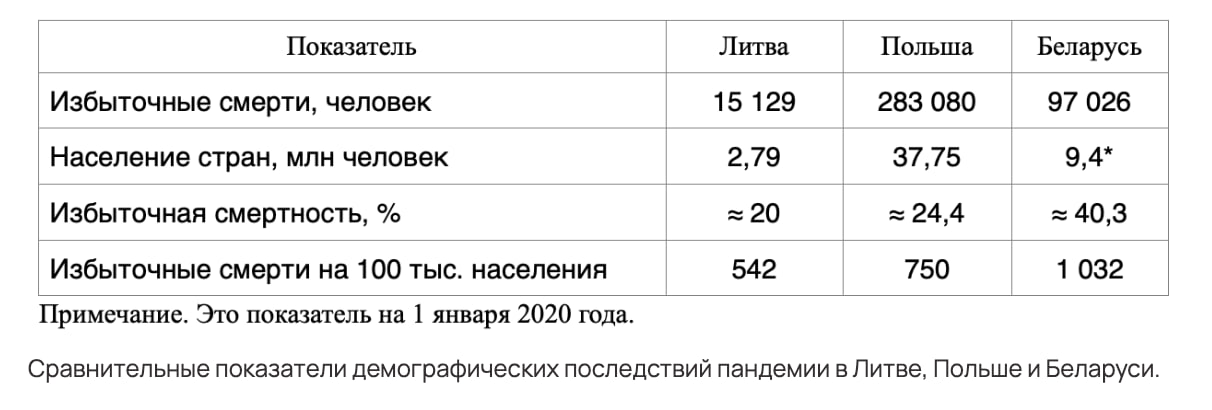
In other words, the Belarusian rate turned out to be approximately 1.4 times higher than Poland’s and nearly 1.9 times higher than Lithuania’s. The study estimates the excess mortality rate at approximately 40.3% for Belarus, compared to 24.4% for Poland and about 20% for Lithuania.
On the map of Europe, this places Belarus right alongside those Eastern European countries that were hit hardest by the pandemic. It’s hard to talk about “best practices” here.
Vaccination: Figures That Are Hard to Trust
By 2021, the rules of the game had changed. Vaccines became available. In Western and Northern European countries, high vaccination coverage among the elderly significantly reduced the risk of death during the Delta wave. Unfortunately, it is much more difficult to estimate actual vaccination coverage in Belarus.
The country primarily used Russian and Chinese vaccines. Pfizer, Moderna, and AstraZeneca were not widely available. But researchers point to another problem: administrative pressure to meet vaccination targets led to falsified records and the destruction of unused doses.
Such cases later resulted in criminal proceedings.
“In the Brest region, according to the investigation, the head of a medical facility’s department had been ordering vaccines to be written off for over a year to conceal low vaccination rates. The cost of the destroyed vaccines exceeded 93,000 rubles. In Gomel, clinic staff inflated the number of people vaccinated, and the volume of various types of vaccines illegally written off exceeded 92,000 doses. In Vitebsk, isolated incidents of the destruction of thousands of doses of COVID-19 vaccines were uncovered.”
As a result, the official vaccination rate must be viewed with great caution. There is also an indirect indicator. The most severe Delta wave occurred in the fall of 2021, when the vaccine was already available. If the most vulnerable groups had received adequate protection, the mortality rate should have been lower. Instead, October 2021 became the worst month of the entire pandemic.
So, did Belarus handle COVID-19 well or poorly?
The study provides no basis for considering the Belarusian approach a success. The picture that emerges is practically the opposite of the official one. Belarus did indeed have strengths before the pandemic began: a large number of hospital beds, many doctors and nurses, and a significant number of ventilators.
“But hospital beds alone don’t cure people. What’s needed is management, patient triage, adequate hospital supplies, transparent epidemiological data, public trust, and the ability for doctors to make professional decisions without looking over their shoulders at political leadership. None of this was present,” the experts state.
In the spring of 2020, the authorities rejected many of the measures recommended by the WHO. Healthcare workers faced a shortage of protective gear. Some hospitals quickly became overwhelmed. Then came a more severe second wave. Following the political crisis of 2020, the healthcare system lost some of its staff and found itself in even more difficult circumstances. In the fall of 2021, the Delta variant caused mortality rates to peak, and the Ministry of Health’s mask mandate was rescinded after Lukashenko’s public intervention. The authors conclude that it remains difficult to determine the actual scale of vaccination due to the identified cases of falsified records.
As a reminder, on November 1, 2021, at the height of the epidemic, the Belarusian Workers’ Union called for a strike and urged people to stay home.

Bank's name: Bank Millennium S.A.
Address: ul. Stanislawa Zaryna, 2A, 02-593, Warszawa
IBAN: PL97116022020000000216711123
SWIFT: BIGBPLPW
Name of the account holder: Fundacja “KARTA ‘97”
Purpose/title of payment: Donation for statuary aims
You can contact us by the e-mail charter97@gmail.com