


The Ukrainian Armed Forces Are Thwarting Russia's Plan For An Offensive In Donbas
2- Dmitry Snegirev
- 18.09.2026, 17:38
- 2,862
The occupiers are attempting to break through on two key fronts at once.
The situation on the front lines in the Donetsk region remains difficult. Russian occupiers are intensifying combat operations along the entire front line and are attempting to apply pressure on multiple fronts simultaneously.
The most problematic sectors at present are the Dobropillia (Pokrovsk) and Kostiantynivka sectors.
In the Dobropillia sector, the enemy is advancing between Shevchenko and the “Zaporizhska” mine. In addition, small enemy assault groups continue to operate in the direction of the “Vodyanskaya” mine. Fighting also continues in the areas of Matyashevo, Svetloye, Belitskoye, Vodyanskoye, and the village of Dobropolye. This indicates that the occupiers have deployed their operational reserves.
The occupiers’ strategic objective is to attempt to advance directly toward the city of Dobropillya. Fighting in the area of the village of Dobropolye indicates that the occupiers are attempting to shift the active phase of combat operations directly into the city.
The distance from the village of Dobropolye to the city of Dobropolye is approximately two kilometers. Several issues are at stake here. The occupiers are trying to secure control over this sector—that is, to capture Dobropillya. Once they do, they will effectively have full control over the so-called Pokrovsk sector. In addition, they are attempting to reach the flank of the Kramatorsk-Sloviansk metropolitan area and open up routes of advance toward the Dnipropetrovsk region.
The Russians have abandoned sustained head-on attacks and are attempting to outflank Ukrainian Armed Forces positions. Currently, the occupiers are making extensive use of small assault groups and infantry on motorcycles, and are also attempting to concentrate their forces in wooded areas under the cover of fog and deteriorating weather conditions. It is expected that starting in October, when the leaves fall, the enemy may switch to deep mechanized breakthroughs using armored vehicles.
Officers of the National Guard’s “Rubezh” Brigade report hundreds of daily sorties by Russian FPV drones along logistics routes and toward Defense Forces positions. Since the enemy’s infantry has not achieved significant success, Russia has intensified its strikes with guided aerial bombs (GAB), destroying settlements near the front lines.
Dobropillya, which was previously considered a rear base for unit rest and recuperation, has been severely damaged as a result of constant drone and airstrikes, and the intensity of the shelling is forcing local residents to evacuate.
The General Staff of the Armed Forces of Ukraine reports that Ukrainian troops are holding their defenses in the areas around the towns of Novoye Shakhovo, Novy Donbass, Dobropillya, and Vodyanske, and are blocking the enemy’s main advance routes by preemptively mining and destroying potential breakthrough paths.
As of September 2026, the situation on the Konstantinovka front remains one of the most tense and dynamic along the front line. Occupation forces carry out between 12 and 29 attacks daily, attempting to break through Ukrainian defenses.
The Ukrainian Defense Forces are countering these attacks; in particular, UAV operators are eliminating members of assault groups. The occupiers are launching strikes in the areas of Novoselivka, Mykolayivka, Shakhove, Sofiivka, Rusyn Yar, Ilinivka, and Kucheryv Yar.
Reports have come in of small assault groups of occupiers infiltrating the village of Izhevka. The situation and reports are contradictory. According to preliminary data, the village is located in the so-called “gray” zone. After information and objective monitoring data emerged regarding the presence of small enemy assault groups in Izhevka, the occupiers shifted the focus of their attacks to Bezimyanoye and Popasnoye.
The enemy is attempting to outflank Ukrainian Armed Forces positions in order to restrict the Ukrainian units’ room for maneuver and cut off their supply lines. Additionally, assaults are recorded daily in the direction of Novoselivka, Ilinivka, Dolha Balka, and Rusin Yar.
The main concern is the deteriorating situation for the Ukrainian Armed Forces in the Chasovyi Yar area. The occupiers are attacking the Shevchenko neighborhood. The Ukrainian Armed Forces had managed to maintain control over this neighborhood for three and a half years. This allowed the Ukrainian Defense Forces to thwart the occupiers’ attempts to rapidly encircle the Ukrainian force in Konstantinovka.
The main objective of the occupying forces is to gain full control of the city. For them, Kostiantynivka is significant not only militarily, but also politically and in terms of public perception. They are exaggerating the issue of historical parallels. The claim is that it was precisely in Kostiantynivka, at the local glass factory, that the stars for the Kremlin’s towers were manufactured. In this way, they are attempting to highlight the Soviet historical legacy.
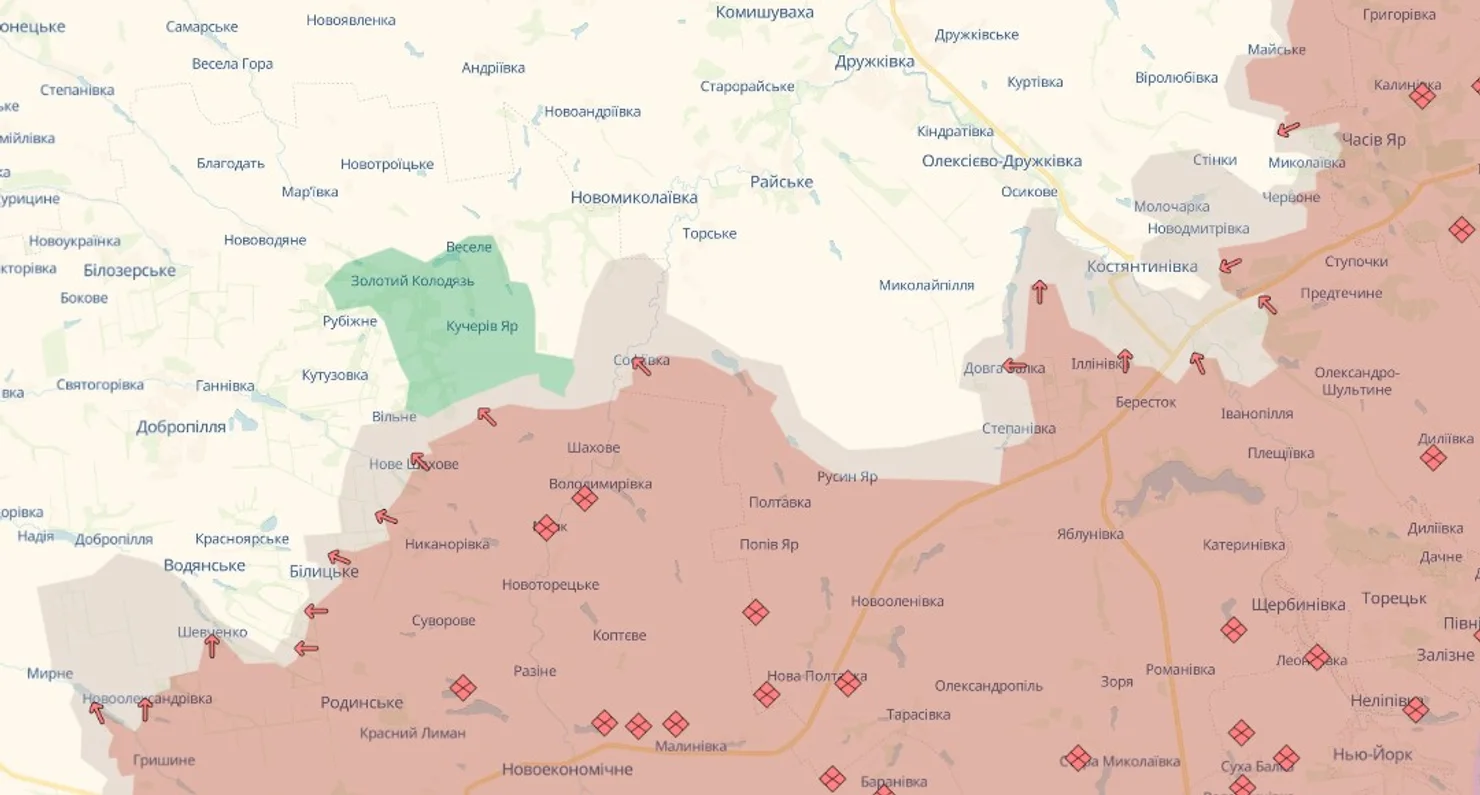
It is also worth noting that the number of enemy UAV operators directly in the city has risen sharply. This creates serious problems for the positions of the Armed Forces of Ukraine. The problem is compounded by the fact that Kostiantynivka is located in a low-lying area, while the occupiers control the high ground in both Chasov Yar and Toretsk. This is a rather serious problem for us.
According to military intelligence, the Russians often employ a deceptive tactic: they change into civilian clothing when moving around the city, hiding their weapons under their jackets. Ukrainian UAV operators carefully scan suspicious individuals from various angles from the air to neutralize them.
The city has effectively ceased to exist in the traditional sense. The occupiers are actively using frontline attack aircraft—delivering strikes with guided aerial bombs against the positions of the Ukrainian Defense Forces.
The occupiers are employing a scorched-earth tactic: they are depriving the Ukrainian Defense Forces of the ability to use surviving industrial structures to house personnel and serve as defensive strongpoints.
The enemy’s primary targets on the Donetsk front are Dobropillia and Kostiantynivka.
These two directions will effectively develop in parallel as part of this process. This is precisely what gives the enemy the opportunity to plan its further advance on Kramatorsk, and then on Druzhkivka and Sloviansk.
Dmitry Snegirev, Focus

Bank's name: Bank Millennium S.A.
Address: ul. Stanislawa Zaryna, 2A, 02-593, Warszawa
IBAN: PL97116022020000000216711123
SWIFT: BIGBPLPW
Name of the account holder: Fundacja “KARTA ‘97”
Purpose/title of payment: Donation for statuary aims
You can contact us by the e-mail charter97@gmail.com