

WSJ: Ukraine Is Holding Back The Mighty Russia Because It Fights In A Completely Different Way
1- 25.09.2026, 22:28
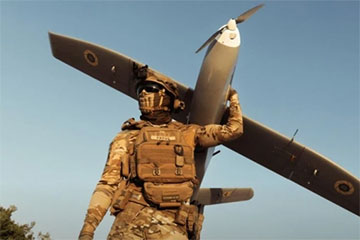
The Ukrainian Army relies on the effectiveness of every unit and every strike.
The Ukrainian Unmanned Systems Forces are increasingly changing their approach to modern warfare by relying on data analytics, decentralized decision-making, and the rapid adoption of new technologies. This is reported by The Wall Street Journal based on an interview with Robert “Madyar” Brovdi, commander of the Ukrainian Armed Forces’ Unmanned Systems Forces.
The author of the article notes that at the start of the conversation with Brovdi, the digital counter in his underground command post showed 302 Russian soldiers killed that day. By the time the interview ended, that figure had risen to 343. The Unmanned Systems Forces make up about 2.5% of the Ukrainian army; however, according to estimates cited in the article, they account for roughly one-third of Russian troop losses over the past year.
Brovdi attributes Ukraine’s success not to numerical superiority, but to a change in the very organization of the army. “A small, modern Ukrainian army is defeating the old Soviet system that existed in Ukraine,” he says.
According to him, the involvement of civilian specialists has made the military structure more flexible, and management increasingly resembles business processes—with planning, performance evaluation, and cost control.
The Delta digital platform plays a key role in this system. It integrates data from drones, sensors, and other devices into a single network. Pilots can mark detected targets on a map, after which the information immediately becomes available to units, which can respond without lengthy coordination of orders. Brovdi estimates that he delegates about 90% of combat decisions to his troops.
At the same time, every operation leaves a digital trail: the location, time, conditions, resources used, target, and outcome are all recorded. Video footage and sensor data make it possible to verify whether a target was actually hit, which helps avoid misrepresentation of the situation on the battlefield.
The SBS commander places significant emphasis on analyzing large datasets. Brovdi began systematically collecting this data as early as 2022. Currently, his unit, “Madyar’s Birds,” alone accumulates 10–12 terabytes of information daily. This data is used not only for combat control but also to evaluate the effectiveness of various drone models and weapons. Feedback from the front lines helps to improve new systems more quickly.
According to Brovdi, Western armies will also have to rethink their approaches. “The goal is to build an ecosystem,” he says.
It is not about finding a single “best” drone, but about creating a system in which inexpensive and sufficiently effective drones, software, intelligence, manufacturing, and operational control work together.
At the same time, the SBS commander emphasizes that technological superiority must constantly evolve. According to him, simply matching the enemy’s capabilities is not enough: it is necessary to significantly surpass them in order to reduce the very likelihood of a new war in the future.

Bank's name: Bank Millennium S.A.
Address: ul. Stanislawa Zaryna, 2A, 02-593, Warszawa
IBAN: PL97116022020000000216711123
SWIFT: BIGBPLPW
Name of the account holder: Fundacja “KARTA ‘97”
Purpose/title of payment: Donation for statuary aims
You can contact us by the e-mail charter97@gmail.com