


How Belarusians' Attitudes Toward Theft Differ From Those Of Russians
2- 26.09.2026, 10:10
- 1,632
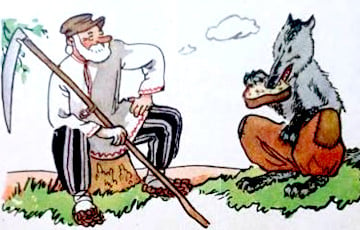
Our eastern neighbors interpret the biblical commandment differently.
People have been stealing from one another for as long as anyone can remember. Theft, as a phenomenon, knows no national or territorial boundaries. There are people in every country who are willing to line their pockets at the expense of others, writes "Solidarnast".
What sets us apart is our attitude toward the phenomenon itself, shaped over centuries from generation to generation. And this is yet another point to add to the list of differences between Belarusians and Russians.
Before the creation of the Statute of the Grand Duchy of Lithuania in 1588, our ancestors lived according to unwritten legal customs, which, with the advent of the code of laws, came to serve a supplementary function.

Theft was considered a serious crime in those days. For stealing a sheaf of rye, a person could be flogged with a cane at the pillory for the amusement of onlookers. For catching fish from someone else’s pond without the owner’s permission, a person would have an ear cut off. And those caught with stolen goods were led to the gallows without further ado. The same applied to horse thieves—stealing a horse was considered a serious offense and was punishable by death.
Our ancestors despised theft; thieves were considered lazy and incapable of honest work. And laziness is yet another grave sin.

Many of us remember the classic Belarusian folk tale *Easy Bread*, in which a wolf found the path from sowing the seed to pulling a hot loaf out of the oven too long and too difficult. His choice to take the easy way out—stealing a ram or a horse to get food—ended in utter disaster.
And this isn’t the only example from the rich Belarusian folklore. Another classic story is about a son who didn’t want to become a blacksmith and decided to steal instead. But he never managed to fill his belly by stealing an ox; on the contrary, he wasted away while waiting to be exposed and face his inevitable punishment.
Unlike his father, who had secretly bought that ox from the owner without his son’s knowledge. And once again, the moral is clear: live by the fruit of your labor, even if it is hard. And do not steal.
A characteristic feature: as a rule, in our fairy tales, it is the positive hero who falls victim to theft or outright robbery.
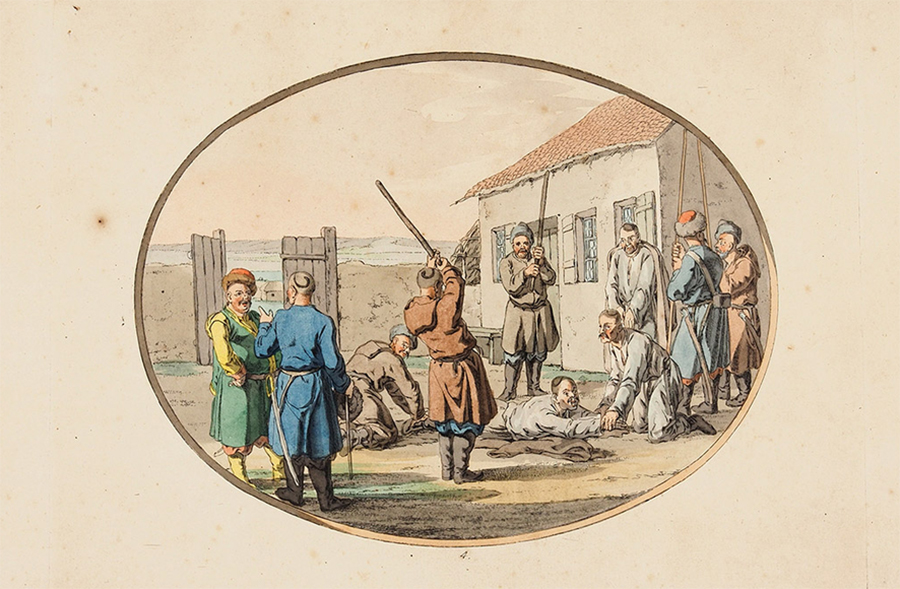
In Russia, the first code of laws was the Sobornoye Ulozheniye of 1649, adopted during the reign of Alexei Mikhailovich. It remained in use until 1832, much like the Statute of the Grand Duchy of Lithuania of 1588, which was repealed in 1835.
The code provided for a wide range of punishments for theft—from corporal punishment to the death penalty. In Russia, horse thieves were also executed. Stealing another person’s harvest was considered a serious crime, as was stealing bees.
While in the Grand Duchy of Lithuania, stealing from an apiary could result in flogging, in Russia, the thief faced the death penalty. Bees were considered sacred creatures, as they provided the wax for church candles. At the same time, stealing from a priest was not considered a great sin, since it was believed that he profited from ordinary mortals throughout their entire lives anyway.
Unlike in our case, many articles of the 1649 Code left the final decision not to the court or the local feudal lord, but to the tsar. He, as is well known, was one man, while those whose fates were left to his will were “beyond count.”
In one Russian study of traditional Russian culture in the mid-19th to early 20th centuries, Russians’ attitude toward theft was described as ambivalent. On the one hand, theft was viewed as a grave sin. On the other hand, there was a whole system of exceptions, according to which certain types of taking what belonged to others were considered less serious offenses, and some were not considered sins at all.
Among peasants and the poor urban middle class, theft out of hunger was considered acceptable: “Even a hungry bishop will steal.” Pregnant women were not blamed for stealing food. Furthermore, theft was not viewed as a misdemeanor or a sin if it occurred within the family.
Galina Shipitsyna /b>, a professor at Belgorod University who studied mid-19th-century Russian folklore, concluded that, unlike the Scandinavian peoples, for example, a categorical rejection and condemnation of theft had not historically taken root in the Russian collective consciousness.
And once again, the same ambivalence: some proverbs and aphorisms clearly condemned theft, drawing on Christian morality, while others emphasized its benefits. There was also class inequality: “The [rich] steal themselves, but they don’t let us.”
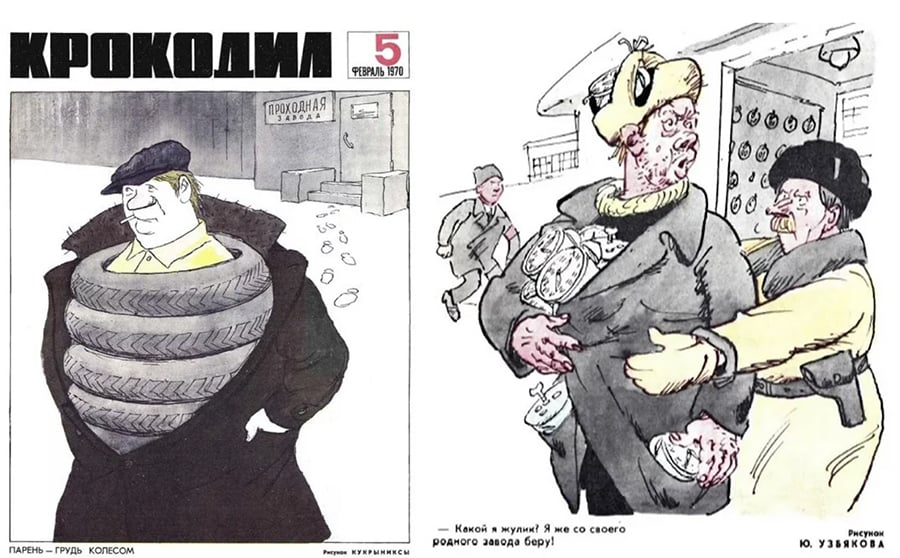
Columnist Alexei Bolgarov describes in a lengthy article in *Ezhednevny Zhurnal* describes how, in the early years of the USSR, the authorities’ attempt to protect state property from encroachment—and in those years, stealing from the state was punished much more severely than stealing from a private individual—backfired. To quote:
Armed with the slogan “what belongs to the state belongs to the people,” which the communists had imposed, the people instantly transformed this slogan into the well-known saying, “Take every nail from the factory: you’re the master here, not a guest.” While petty theft—such as burglary or pickpocketing—that harmed private individuals was still generally condemned, stealing something from a workplace was never even referred to by that word.
For a Soviet citizen, stealing from the state was so normal that the very word “theft” was practically never used among the people. Even in the Soviet press, the term “pilfers” was often used instead of “thieves.”
Our history as part of the Russian Empire and the USSR, as well as our close ties with modern Russia, have left their mark on us. In the collective farms “preserved” by Lukashenko, many still follow the old Soviet “folk wisdom” that states, “Everything around here belongs to the collective farm; everything around here is mine.”
However, on the whole, Belarusians honor the commandment “Thou shalt not steal” to a much greater extent than Russians do. And this is yet another reason to do everything possible to keep our distance and remain true to ourselves.

Bank's name: Bank Millennium S.A.
Address: ul. Stanislawa Zaryna, 2A, 02-593, Warszawa
IBAN: PL97116022020000000216711123
SWIFT: BIGBPLPW
Name of the account holder: Fundacja “KARTA ‘97”
Purpose/title of payment: Donation for statuary aims
You can contact us by the e-mail charter97@gmail.com