

Charter of liberties
79- 17.04.2012, 17:12
Assaults, searches, death of a co-worker, arrest, prison and escape from the country.
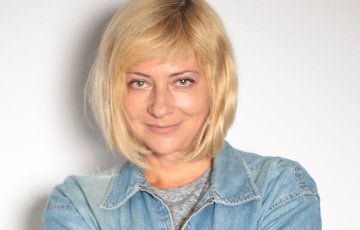
What the 32-year-old editor of Charter97.org Natallia Radzina has gone through in the recent years could break anyone. But she survived. Today Radzina lives in Vilnius, looks fabulous and as it appeared talks eagerly about the details of her work that she still loves passionately.
Magazine 34mag.net has met with the journalist in a Vilnius café to talk about conflicts with colleagues, self-censorship and “untimely relaxation”.
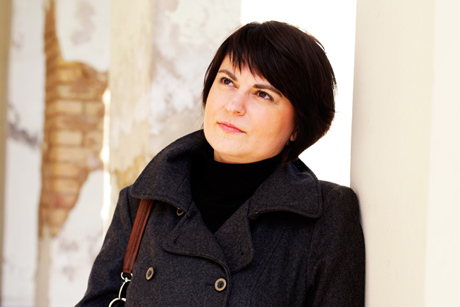
”Even in prison, Zmitser Bandarenka was told to abolish pre-moderation at Charter”
- Who are Charter’s target audience?
- First of all, these are free-thinking people who want to get uncensored information; people who don’t have access to independent press today, since not everyone can get hold of Narodnaya Volia and Nasha Niva; people who cannot watch independent television. And these people search information online.
- Your site receives a hundred thousand unique visitors daily. There is a theory of your popularity: reading Charter is therapeutically effective and people visit it even to laugh at the regime, to read your witty titles…
- We provide our readers with information and a possibility to express their opinion. It is also very important. Today people cannot express their point of view and it’s important for them that their comments appear on the website, and that they can communicate with each other.
- There are some common claims to Charter: pre-moderation and, so to speak, no alternative point of view…
- Pre-moderation is obligatory. It is impossible to read comments on independent sites with no pre-moderation. There is a huge number of trolls, KGB employees, and entire departments of trolls spend days writing comments. KGB trolls are not allowed at Charter. And it is appears to be disturbing to the special services. Even in prison, Zmitser Bandarenka was told to abolish pre-moderation at Charter.
As for an alternative point of view, I see no meaning in giving the floor to the powers since they own all the media. They have television, Sovetskaya Belorussiya with an immense circulation, a big number of radio stations. Would German partisans in the fascist Germany give the floor to Goebbels and publish his texts? What for? Of course, we gladly give platform to officials; gladly quote the nonsense that they deliver. Lukashenka’s words are there too. But there is our evaluation, there is counter-argumentation.
- How does the editorial office’s work look like?
- I am the editor-in-chief; there are other journalists, translators, and people from IT-support. Today we are about 15 people working in Minsk, in Poland, Vilnius, even in France and Sweden. All planning meetings are generally held via Skype. Plans and topics are discussed as needed.
- How do you work those days when vital events are happening in Minsk?
- We work a lot. All the time we keep in touch with Minsk via telephones, Internet. I don’t experience any particular inconveniency from not being in Minsk. On the contrary, today Charter is able to write much more than before. Today, nobody can launch a criminal case against us, nobody can beat me and throw to jail, nobody can seize our equipment. Today we don’t have any self-censorship, and we can write what journalists in Belarus unfortunately can’t write about.
“It’s going to be a very expensive site”
- How will Charter look like after the change of power?
- First of all, it is going to be a very expensive site. Second of all, we will enhance our work, move towards becoming a holding.
- What are your current plans?
- We plan to re-design the website. We will work with the site’s further development. It will become more convenient with richer contents.
- What is the present correlation between the re-posts and your own articles?
- 70% reposts and 30% own content. Presently we get loads of information from different sources, lots of news comes from the readers, there are “leaks” from the powers. Moreover, we translate nearly everything we find online about Belarus in the foreign media. As for the allegations of unethical re-posting, I should say that there are open information sources, and that the news is not a copy right object. All major information sites work along this principle. And we always make sure to provide hyperlinks to all sources.
- Have you found your dream job?
- Right now I cannot imagine doing something different. I studied journalism at the university because I dreamed of becoming a journalist. My dream hasn’t changed. Of course I’d love to work under other circumstances. But if this is the way it is, I have no regrets. I have never thought of working at the Belarusian television. Since I was 18, I have been working with independent media. My first job was with the newspaper Imia, then Narodnaya Volia, Naviny, Nasha Svaboda, and finally Charter. I’ve been working at Charter since 2001.
- What is an ideal working situation for you?
- In my ideal work I have an actual control over the powers, I can influence decisions crucial for the country. This is a journalist’s task. When we can conduct journalist investigations, unmask corrupt authorities, write about corruption. When journalists can see a result of their work.
- Is Charter an influential site?
- Of course it is. And the proof is the powers’ nervous reaction to Charter’s work. Just remember the bacchanalia a year before the presidential election - three criminal cases against us, plunders first in the office and then in my apartment, Aleg Biabenin’s death. And finally I was imprisoned. This proves the effectiveness of our work.
- How does your working day look like?
- I get up at 8 a.m. and turn on the computer. I work till 7 or 8 p.m., then take a rest for a couple of hours, and then come back to check what has happened during this time. To be a journalist is different from working from 9 till 6 in a factory. You should always be informed, the site doesn’t sleep – and neither do you.
”For me, the only conflict I can have is the conflict with the powers”
- Do you feel safe in Vilnius?
- In our situation a relaxation is untimely, for it is not long between Vilnius and Minsk. Of course I feel much safer here than in Belarus. When I was released from prison and said that I would continue working as Charter’s editor I was sent to Kobryn. Every morning when I opened my laptop I had to overcome fear before starting to work. One mistake and I wouldn’t work anymore. From time to time, when they didn’t like my materials, I was summoned to the KGB. Here I don’t have to be afraid that they will ring the door bell and take me to the KGB. But sometimes I get weird SMS with threats, which means that they know where I am, where I travel, who I talk to. I try to ignore that. Fear is a hinder, it should be chased away.
- Do you ever regret having left?
- I couldn’t stay. I would never be allowed to work. The year before and after the presidential election, when I was forced to remain in Kobryn and was ordered by the KGB not to write evaluating materials, prove it. In Belarus, I even couldn’t tell what had happened to me in prison. I told it when I arrived to Moscow, and then in Lithuania. I was clearly a hostage who would be used to influence the website’s politics. And I had two choices: to quit, or to escape and keep working. There were no other choices. They would not let me confirm what Ales Mikhalevich had said about tortures. I confirmed and was threatened immediately. When I called upon economic sanctions I was detained, a policeman from Minsk arrived and threatened me with a new prison term. Today I can call upon economic sanctions freely.
- What journalists do you always read?
- I always read Sviatlana Kalinkina, of course, Iryna Khalip, Andrzej Poczobut. In general, in my work I read or at least look through articles of all journalists.
- The Belarusian journalism, even independent, is a rather conflict environment. There are conflicts even between the people who seem to be united with a single goal…
- I don’t have any conflicts. I am harsh in certain questions, but I’m conflict-free, which may seem like a paradox. For me, the only conflict I can have is the conflict with the powers; I cannot conflict with my colleagues. I always try to find a peaceful solution. Yes, sometimes I am wrong. And when I see I’m wrong I try to be strong enough to apologize.
- Some time ago you posted an article about Pavel Sheremet’s column, and in the title claimed he “had lost his mind”.
- It was hard to find a reasonable explanation to his text, and so I was surprised – what was it? Such things happen. Nevertheless, my relationship with Pavel is good.