


Ukrainian Navy Captain: The Good Times Are Over For Putin’s “shadow Fleet”
1- 11.06.2026, 16:35
- 4,800
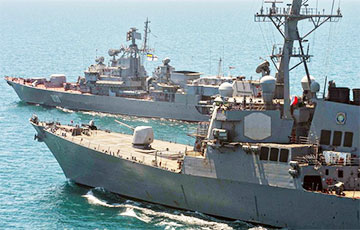
The blows to Russia's maritime logistics sector will only intensify.
According to new satellite images, the Russian corvette *Boyky* of the Russian Federation’s Baltic Fleet, hit by Ukrainian drones in Kronstadt, has sustained critical damage.
Can we really say that the ship has been effectively destroyed and is beyond repair?
The website Charter97.org posed this question to Captain 1st Rank of the Ukrainian Navy and head of military programs at the “Strategy XXI” Center for Global Studies Pavlo Lakiychuk:
— One cannot categorically say that it is destroyed and beyond repair. Even something lying on the seabed can be raised and an attempt made to reassemble it. The question is different: what do such damages mean?
Nowadays, many people own cars and know: when you buy a used car, they ask if it’s just old, if it was in a fire, or if it was a total loss. There is such a classification. A “flooded car” is, as a rule, the end of the line. Even if someone has restored it. A “fire-damaged car” isn’t good either, because all the wiring—even if rewired—is already a problem. But if the car is just old, it will still run.
It’s the same with ships, only worse. When a ship is built, they start by assembling the hull. That’s about 30 percent complete. It looks like it’s already sitting on the slipway—a huge hunk of metal—but in reality, that’s only a third of the work.
The main work takes place inside the ship: laying cable routes, equipping combat stations, and connecting all the systems to each other. This is the most complex work. And when compartments and cable runs burn out inside the hull, it’s practically impossible to restore everything to its original state. Because that’s part of the technological process of building a ship. In principle, if there is no critical damage to the hull, it is possible to build something new on this foundation. But it will be more expensive than building a new ship.
I was very surprised when the corvette "Boyky" was struck. When a ship is put in dry dock for repairs, all fuel and lubricants, as well as all weapons, are removed from it, because repair work in the dry dock is a fire hazard.
To be honest, the way the "Boykiy" burned was surprising. My friends and I even joked: they were probably burning winter tires in the cabin. Because a ship shouldn’t burn that intensely in a drydock. But it turned out it can.
The Ukrainian Armed Forces had already scored victories against Russian ships in dry docks. For example, at the Sevmorzavod Storm Shadow missiles struck the large landing ship "Minsk" and the submarine "Rostov-on-Don." But it must be understood: the Storm Shadow is a missile with a corresponding warhead. It pierces right through the submarine’s hard hull. An entry and exit hole—and it’s already a goner. The “Minsk” also sustained very serious damage.
And yet the Russians have transferred them to the 13th Ship Repair Plant and claim they are somehow repairing them. It’s the same story with the “Rostov-on-Don.” The military command is always afraid to admit that the Russian Navy has lost a combat unit. They constantly report to higher-ups that it will be restored.
Judging by what we see with the damage to the “Boyko,” the weapon was an order of magnitude less powerful. But the consequences are very serious. Obviously, most of the blame lies with the ship’s crew and the organization of the work. I believe it cannot be truly restored.
— What does the loss of such a corvette mean for the Russian Federation’s Baltic Fleet?
— The Russians had four such corvettes in the Baltic Fleet. Minus one—leaves three. That is, 75% remain.
But it must be understood that the Russians do not have just one Baltic Fleet. There is the Northern Fleet, the Pacific Fleet, the Black Sea Fleet—well, a fleet of sorts.
By the way, in addition to the ships of the Baltic Fleet, the frigate "Admiral Grigorovich" of the Black Sea Fleet has been carrying a heavy load in the Atlantic and the Mediterranean, accompanied by the Russian "shadow fleet." It entered service in the Mediterranean Sea off the coast of what was then still a struggling Syria, and has not yet been able to return to the Black Sea. It seems to be intact, but one is missing.
— The Ukrainian Armed Forces are consistently striking at Russian maritime logistics: the port in Mariupol has been put out of commission, the dry cargo ship Lady Augusta has been hit, and ships of the “shadow fleet” and vessels supporting the defense of the Crimean Bridge are under attack. Can we say that the Black and Azov Seas are becoming a “death zone” for Russia? How realistic is the prospect of a complete blockade of the occupiers’ maritime traffic?
— Back in July 2023, the Ukrainian Navy command, the Hydrographic Service, and the State Hydrographic Service of Ukraine issued a warning to mariners that the ports of occupied Crimea, the Sea of Azov, and the Russian Caucasus coast are closed by Ukraine. The waters near them are a danger zone. Ships that proceed there will be considered potential military targets.
Ships carrying military cargo or cargo that violates international law will be targets for strikes. Unfortunately, some shipowners believe that the risk and the windfall profits such an operation offers are worth it. In reality, they are not.
The more effectively Ukrainian weapons strike the ports of occupied Crimea and the Sea of Azov, the more obvious it will become that the criminal activities of the so-called “shadow fleet” in the Black and Azov Seas, and indeed across the entire world’s oceans, must be curtailed in one way or another.
Can we say that the Black Sea is already close to a point where the occupiers have completely halted all movement due to strikes against their logistics? I don’t think so. The sea is vast. Some ships will always get through.
Look at the situation in the Strait of Hormuz. Thousands of huge tankers are stuck in the Persian Gulf because of the blockade. And what is a blockade? There, the Iranians, as far as I know, have sunk a few ships, and the Americans about the same number. In other words, the very danger of being destroyed already creates a problem.
It’s the same here: the danger is there, and ships, in theory, shouldn’t be sailing. But that’s only if the shipowner, the cargo owner, and the shipper are honest, upright people who care about the safety of their property and the lives of the crew.
But where there’s money to be made, there will always be people willing to take the risk. These are the kind of buccaneers and pirates: either we die, or we make a profit. Therefore, traffic is unlikely to be completely shut down, but it will be severely restricted.
— What new operations against Putin’s “shadow fleet” and the occupiers’ ships are possible in the near future? Are such strikes capable of seriously limiting the Kremlin’s ability to finance the war?
— Based on what is happening in the world, certain conclusions can be drawn. A month and a half ago in the Atlantic, off the west coast of Africa, unknown drones attacked ships of the “shadow fleet”. The Russians are blaming the Ukrainians. I don’t know where the Ukrainians came from, but the fact remains: the ships were attacked.
Recall the Russian dry cargo ship Ursa Major owned by the company "Oboronlogistika." It was sailing from Murmansk to the Pacific Ocean, reached the Mediterranean Sea, and there it was apparently attacked by naval or underwater drones. It sank. It’s hard to say who they belonged to. Many blame Ukraine, but the fact remains: yet another vessel linked to Russian logistics has sunk far from the active theater of war.
So if the Russians transport military cargo in the Mediterranean, the Caspian Sea, or somewhere else, and something happens to them, I won’t be surprised. It could be the Israelis. The Israelis have struck Iran’s northern ports. Or maybe it wasn’t the Israelis. But they won’t have any peace anymore.

Bank's name: Bank Millennium S.A.
Address: ul. Stanislawa Zaryna, 2A, 02-593, Warszawa
IBAN: PL97116022020000000216711123
SWIFT: BIGBPLPW
Name of the account holder: Fundacja “KARTA ‘97”
Purpose/title of payment: Donation for statuary aims
You can contact us by the e-mail charter97@gmail.com