Jefferson, religious freedom and Belarus
3- By Geraldine Fagan, The Daily Progress
- 7.05.2012, 13:57
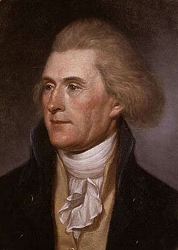
Last month, admirers of Thomas Jefferson laid a wreath at the Founding Father’s Washington memorial to mark his 269th birthday.
Two months prior, riot police raided a history club at the home of a Protestant pastor in Minsk, Belarus.
What could possibly link these two events?
Religious freedom.
And more closely than you’d think.
Underpinning the First Amendment to the U.S. Constitution, Jefferson’s Bill for Establishing Religious Freedom of 1777 is among his proudest achievements. It borrows unabashedly from English philosopher John Locke, whom Jefferson considered one of “the three greatest men that have ever lived.” Portraits of his “trinity” — Locke, Francis Bacon and Isaac Newton — still grace the parlor at Monticello.
But the ideas supporting religious freedom that inspired Jefferson didn’t begin with Locke’s renowned “Letter Concerning Toleration” of 1689.
On fleeing to the Netherlands in 1683, Locke became increasingly influenced by the writings of the Socinians, a school of radical Protestant thinkers founded nearly a century before in Rakow, Poland. Their rector and first apologist for religious freedom was Johann Crell, an immigrant from German-speaking Franconia.
Published in English in 1646, Crell’s “A Learned and Exceeding Well-Compiled Vindication of Liberty of Religion” advances key arguments repeated by Locke and later Jefferson.
Faith cannot be forced, writes Crell. “An opinion can neither be thrust into the minde by violence, nor extorted and wrested from it. That is all force can do, to cause a man to approve of that opinion in words, which he dislikes in his heart.”
But, he warns, “such a simulation and hypocrisie is abominable to God.”
Locke’s 1689 letter coincides. “No man can, if he would, conform his faith to the dictates of another… . To whatever outward worship we conform, if we are not fully satisfied in our own mind … we add unto the number of our other sins those also of hypocrisy.”
Similarly, Jefferson’s 1777 bill urged Virginia’s legislature to acknowledge that all attempts to influence the mind “by temporal punishments or burthens, or by civil incapacitations, tend only to beget habits of hypocrisy.”
Jefferson’s bill further sought to separate legal rights and religious affiliation: “Our civil rights have no dependence on our religious opinions.”
Here again, he was following Locke: “The whole jurisdiction of the magistrate reaches only to these civil concernments… . [I]t neither can nor ought in any manner to be extended to the salvation of souls.”
But Crell had argued for the same even earlier: “Whosoever observe the rules of civill society … they cannot by any just authority be ejected out of a civill society.”
Yet how could ideas as radical as Crell’s thrive in Poland in the early 1600s?
Poland then formed part of the joint Polish-Lithuanian Commonwealth, where the Grand Duchy of Lithuania corresponded roughly with the territory of present-day Belarus. On converting to Calvinism in 1553, the Duchy’s de facto ruler, Mikalai Radzivil the Black, became a passionate advocate of the new faith. Lobbying by his first generation of Belarusian Protestants was crucial to the Commonwealth’s adoption of the Warsaw Confederation in 1573. This pledged the realm’s inhabitants to “preserve peace between ourselves and not, on account of variation or differences in faith, to shed blood in the churches or punish anyone.” It created conditions for religious freedom that were unparalleled in Europe.
In today’s Minsk, the Litvin Club — raided by riot police in February — is part of a broader local movement to rediscover and promote this forgotten Belarusian heritage. Its activists thereby hope to advance religious freedom, stifled by Europe’s “last dictator,” Aleksandr Lukashenko. The campaign’s boldest initiative yet was a 50,000-signature petition in 2007 — the largest ever gathered in Belarus — against the nation’s repressive religion law.
Americans have every reason to support them.
Geraldine Fagan, The Daily Progress